आसनāsana · seat
Yoga props: blocks, strap, bolster, and what you really need
A prop is not a crutch. It brings the posture to your body today, so that you can stay in it steadily and breathe. Here is what each one does, and which ones are worth having.
5 min read · Updated October 20, 2026 · sources checked October 20, 2026 · Editorial: The Yogide team
In short
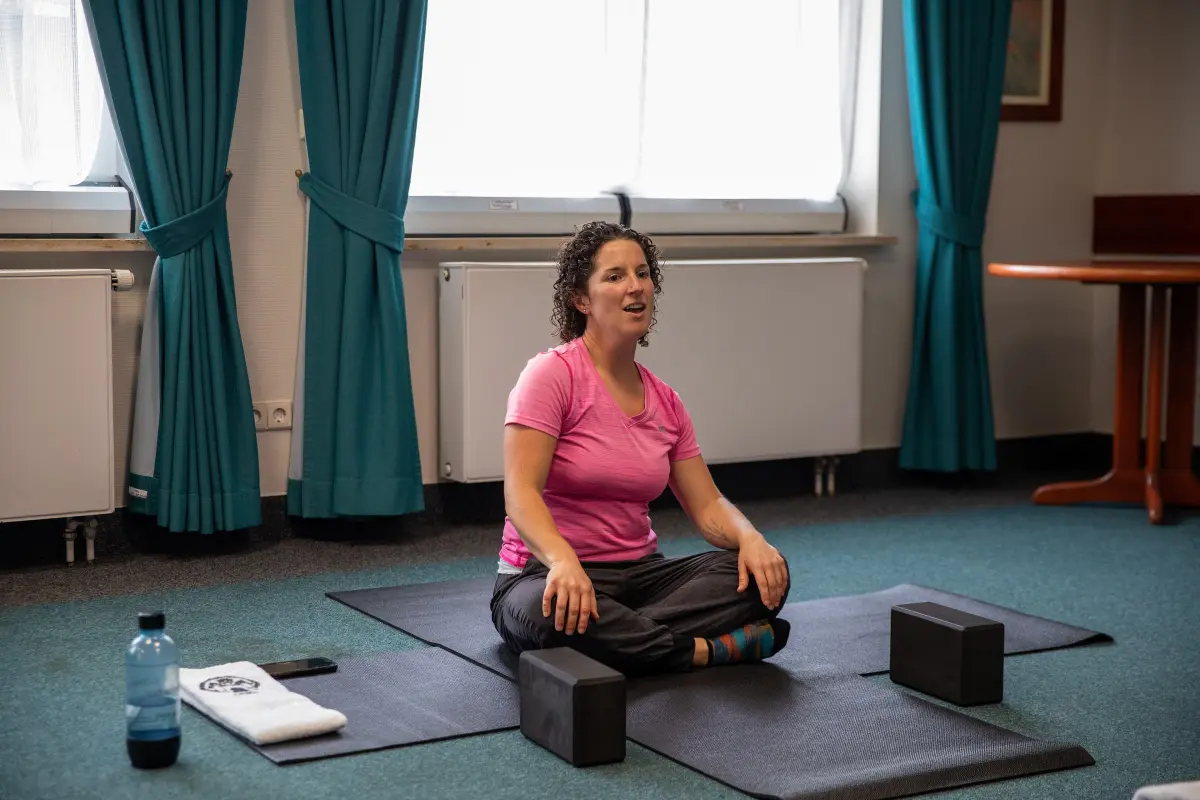
Yoga props are simple supports that adapt a posture to your body: blocks bring the floor closer, a strap lengthens the arms, a bolster and blankets support you in rest and seated poses, and a chair or wall gives stability. Most beginners need only two blocks, a strap and a blanket; household objects can replace them.
This page recommends no brand and ranks nothing; we sell no props and earn nothing from any. What it gives you is the use of each support, so that you can decide what is worth having at home, and what a folded blanket can do just as well.
A short history of props
Props are older than the yoga mat. A cloth band used to hold the legs in a seated posture, the yogapaṭṭa, is carved prominently around the legs of a seated sage in the great seventh-century rock relief at Mamallapuram, on the Tamil coast (Sears, 2013); art historians report it on other Indian sculptures too, some older, some later. The oldest commentary on Patañjali's Yoga Sutra, listing the seats of its time under sutra 2.46, names sopāśraya, "the seat with a support", which medieval commentators explained as sitting with such a strap.
The cushion under the yogi is as old as the texts. The Gheranda Samhita describes the seat for breathing practice:
कुशासने मृगाजिने व्याघ्राजिने च कम्बले । स्थूलासने समासीनः प्राङ्मुखो वाप्युदङ्मुखः …
kuśāsane mṛgājine vyāghrājine ca kambale | sthūlāsane samāsīnaḥ prāṅmukho vāpy udaṅmukhaḥ …
Seated on a seat of kuśa grass, a deer skin, a tiger skin or a blanket, on a thick seat, facing east or north…
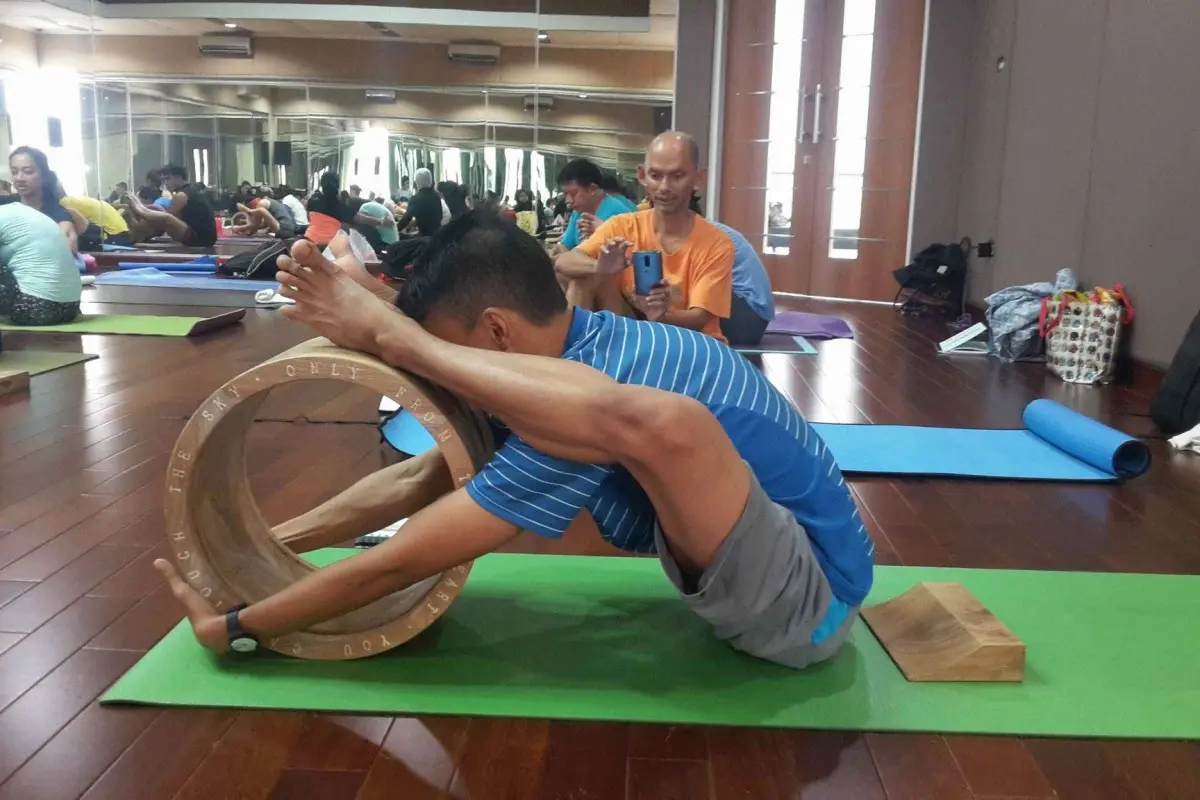
The modern props come mostly from B.K.S. Iyengar in Pune. His official site says that props "designed by Guruji, such as wooden gadgets, belts, ropes" help the practitioner "to achieve perfection in any asana". They also let people whose movement is limited by stiffness, injury or arthritis keep practising, and let a posture be held long enough to learn from it. His method is described on Iyengar yoga; the rest-oriented use of props developed by Judith Hanson Lasater became restorative yoga. In 1982, Lakshmi Voelker-Binder created Chair Yoga for a student whose arthritis kept her off the floor.
What each prop does
| Prop | What it does | Typical uses | Household substitute |
|---|---|---|---|
| Block (brick) | brings the floor closer; raises the hips | hand under the shoulder in the triangle, under the sacrum in the bridge, seat in vajrāsana | a stack of thick books, a firm box |
| Strap (belt) | lengthens the arms; holds without effort | around the foot in the seated forward bend, around the thighs in legs up the wall | a dressing-gown belt, a long scarf |
| Bolster | supports the body in rest | under the knees in śavāsana, under the chest in child's pose, under the back in a supported fish | two or three folded blankets, sofa cushions |
| Blanket | padding, height, warmth | under the knees, under the pelvis in easy pose, over the body in rest | any firm woollen or cotton blanket |
| Chair | brings poses to sitting or standing height | chair yoga, support for balance in the tree | a sturdy chair without wheels or arms |
| Wall | stability and alignment | balance, legs up the wall, first inversions | any clear wall |
What to get first
- A blanket or two that you already own: the most versatile prop of all.
- Two blocks: they turn many standing and seated postures from impossible to accessible. Firm blocks (cork, wood or dense foam) are steadier under the hands; lighter foam is softer under the body. A block gives three different heights depending on which side it stands on.
- A strap about two metres long with a buckle or ring.
- A bolster, only if you practise restorative yoga or long seated meditation; folded blankets can wait in its place.
How to use props well
- Start with more height, then remove it. Place the block on its tallest side first; lower it as the body opens.
- The prop serves the posture, not the ego. In the Iyengar method the prop is part of the pose, not a sign of weakness.
- Stability first. A block must not wobble under the hand; put it on the mat, not on a slippery floor.
- Do not use a prop to go deeper by force. A strap pulled hard in a forward bend can strain the back of the legs; use it to stay, not to pull.
Good to know
Keep your props where you practise. A block and a blanket within reach make it far more likely that you will choose the gentle version when you need it.
Related pages
Props make most cards of the asanas chapter accessible, starting with the twelve basic poses for beginners. For the surface underneath them, read choosing a yoga mat, and to begin at home, yoga at home.
Questions people ask
What are yoga blocks for?
A block brings the floor closer when the hands do not reach it, as in the triangle or a forward bend, and raises the hips in seated poses so the back can stay upright. It can also support the head, the knees or the sacrum in resting poses.
How many yoga blocks do you need?
Two are enough for most home practice: one under each hand in standing poses, or both under the hips or the back in supported poses. Iyengar-style and restorative classes sometimes use more, but you can start with two, or with thick books.
What is a yoga strap?
A strap, or belt, is a band of cotton or nylon with a buckle. It lengthens your reach: around the foot in a seated forward bend or a lying hamstring stretch, between the hands behind the back, or looped around the thighs to keep the legs together without effort.
What is a yoga bolster?
A firm, long cushion, round or rectangular, used to support the body in restorative and seated poses: under the knees in śavāsana, under the chest in child's pose, under the back to open the chest. Two folded blankets do the same job.
Do I need yoga blocks as a beginner?
They are not essential, but they help: they make many postures accessible and safer when the body is stiff. Using a block is not cheating; in the Iyengar method, props are part of the posture. If you have none, a stack of books or a firm cushion works.
Sources
- Tamara I. Sears, From Guru to God: Yogic Prowess and Places of Practice in Early-Medieval India, in Debra Diamond (ed.), Yoga: The Art of Transformation (Smithsonian, 2013), pp. 46-57 checked October 20, 2026
- Yoga using props, Wikipedia (sopāśraya in the Yoga Sutra commentary, Iyengar, Chair Yoga 1982) checked October 20, 2026
- Iyengar Yoga, official site of B.K.S. Iyengar and RIMYI (props designed by Guruji: wooden gadgets, belts, ropes) checked October 20, 2026
- Pātañjalayogaśāstra, Yoga Sutra with the bhāṣya, 2.46: list of seats including sopāśraya (GRETIL, University of Göttingen) checked October 20, 2026
- Gheraṇḍasaṃhitā, Sanskrit text, 5.33: the seat of kuśa grass, skin or blanket (GRETIL, University of Göttingen) checked October 20, 2026
- Restorative yoga, Wikipedia (Iyengar props, Judith Hanson Lasater, Relax and Renew 1995) checked October 20, 2026