Viparīta karaṇī, legs up the wall
6 min read · Updated October 20, 2026 · sources checked October 20, 2026 · Editorial: The Yogide team
- Sanskrit
- विपरीतकरणीViparīta karaṇī
- Meaning of the name
- The reversing practice: viparīta, turned round, inverted, and karaṇī, a practice or technique
- Level
- Beginner
- Family
- Rest and gentle inversion
- In the texts
- Modern supported pose; the name comes from the inverted mudrā of the Hatha Yoga Pradipika 3.78-82 (GRETIL; 3.77-81 in Pancham Sinh)
In short
Legs up the wall, called viparīta karaṇī in modern yoga, is a resting pose: you lie on your back with the buttocks close to a wall and the legs resting up the wall, often with a folded blanket under the pelvis, for five to fifteen minutes. In the Hatha Yoga Pradipika, viparīta karaṇī is a different practice, an inverted seal.
Some postures ask for effort; this one asks you to stop. Lying on the floor with the legs resting up a wall, nothing has to be held, and the body is gently turned upside down without any weight on the neck. It is the inversion of tired evenings, and of those who cannot or should not do the shoulder stand.
Steps
- Place a folded blanket or a low bolster on the floor about 10 to 15 cm from a wall. Sit sideways on one end of it, one hip touching the wall.
- Lower yourself onto the elbows and, in one movement, swing the legs up the wall as the back comes down to the floor. The pelvis rests on the blanket, the buttocks close to the wall.
- Let the legs rest against the wall, together or slightly apart, the knees soft.
- Place the arms a little away from the body, palms up, or rest the hands on the belly.
- Close the eyes. Breathe naturally through the nose; let the belly rise and fall.
- Stay five to fifteen minutes.
- To come out, bend the knees, push the feet into the wall, slide the blanket away, and roll onto your right side. Rest a few breaths, then sit up slowly.
Alignment
- The back of the pelvis rests on the support; the lower back is not arched over its edge.
- The legs rest on the wall without effort; if the hamstrings pull, move further from the wall.
- The back of the neck is long; a thin cushion under the head helps if the chin points up.
- The shoulders and arms are completely relaxed.
Variations
- No support: simply lie on the floor with the legs up the wall. The easiest version.
- Further from the wall: knees bent and feet on the wall, or the calves on the seat of a chair or sofa, if the backs of the legs are stiff.
- Wide legs or soles together: let the legs open into a V, or bend the knees and join the soles against the wall.
- Covered: a light blanket over the body; one cools quickly when still.
- Strap: a belt around the thighs keeps the legs together with no effort.
Contraindications
- Glaucoma, raised eye pressure, or retinal problems: ask your eye doctor first.
- Uncontrolled high blood pressure, heart conditions, breathlessness lying flat: avoid, or rest with the legs on a chair instead.
- Reflux: lying flat may worsen it; keep sessions short or choose another rest.
- Pregnancy: lying on the back is not advised from the second half of pregnancy; rest on the side instead.
- Recent neck or back injury, or hip problems that make the legs uncomfortable upright: use the chair version or skip it.
- Menstruation: some traditions avoid inversions during the period; this is a matter of tradition and personal choice, not of medical risk established by studies.
What the studies show
We found no trial testing legs up the wall on its own for sleep, circulation, digestion or menstrual comfort; the answers you may read about its benefits come from experience, not from measured results. What has been measured is a risk: in a 2015 study of ten people with glaucoma and ten without, holding four common head-down yoga positions for two minutes raised the pressure inside the eye in both groups. Legs up the wall produced the smallest rise of the four (from about 17 to 21 mmHg), and the pressure returned to normal within two minutes of sitting up. The authors could not say whether such rises harm glaucoma over time, which is why the advice is to ask your eye doctor. For a broader view, see is yoga safe?.
In the texts
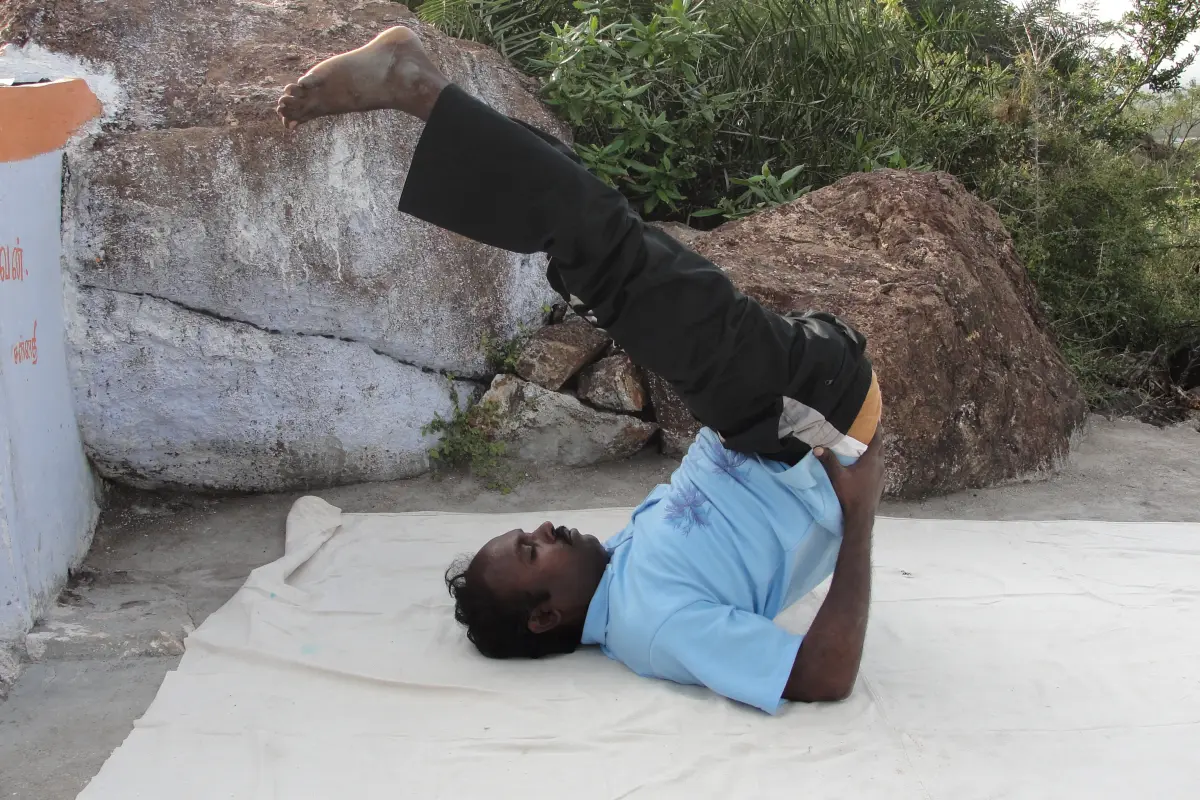
The supported pose against a wall is modern: today it is taught in many styles as a restful posture, often with folded blankets or a bolster under the pelvis, and we know of no premodern text that describes it. The name, though, is much older, and designates something else. In the Hatha Yoga Pradipika, viparīta karaṇī is not a posture but a mudrā, a "seal" of the subtle body, in the chapter after the postures:
ऊर्ध्वनाभेरधस्तालोरूर्ध्वं भानुरधः शशी । करणी विपरीताखा गुरुवाक्येन लभ्यते ॥
ūrdhva-nābher adhas tālor ūrdhvaṃ bhānur adhaḥ śaśī | karaṇī viparītākhā guru-vākyena labhyate ||
With the navel above and the palate below, the sun is above and the moon below: this is the practice called the reversal, and it is received through the word of the guru.
In the text's subtle anatomy, the "moon" at the palate drips a nectar that the "sun" at the navel consumes, and this is why the body ages (3.77 in the GRETIL text). Turning the body upside down reverses the flow. The method is a real inversion: "head below, feet above", held for a moment on the first day and a little longer each day (3.81-82; 3.80-81 in Pancham Sinh). The Gheranda Samhita gives the same seal (3.33-36), with the head on the ground and the hands placed beside it. The text's promises, that wrinkles and grey hair disappear, are its own claims, not medical facts.
So the old viparīta karaṇī is closer to the shoulder stand or the headstand than to a rest against the wall. The modern pose keeps the idea of reversal while removing the load from the neck. The seal and its place among the other mudrās are explained on the mudras page.
Related postures
Legs up the wall closes a session before śavāsana, and belongs to the poses of restorative yoga. It is a gentle alternative to the shoulder stand. For rest and sleep in general, read yoga and sleep; all the cards: the asanas chapter.
Questions people ask
How long should you do legs up the wall?
Five to fifteen minutes is usual. Start with three to five minutes and come down earlier if the legs tingle or go numb. When you come out, roll to the side and sit up slowly.
What is legs up the wall good for?
It is a comfortable way to rest with the legs raised, and many people find it calming at the end of the day. We found no trial testing this pose on its own for sleep, swelling or digestion, so take it as a resting posture, not a treatment.
What is the best time for legs up the wall?
At the end of a practice, in the evening, or after a long day on your feet. Avoid it straight after a large meal; a passage on the daily routine printed in Pancham Sinh's 1915 edition of the Hatha Yoga Pradipika already advised practising the inverted seal in the evening, not just after eating.
Who should avoid legs up the wall?
People with glaucoma or other eye pressure problems unless their eye doctor agrees, with uncontrolled high blood pressure, heart or lung conditions that make lying flat difficult, recent neck or back injury, or in later pregnancy. Reflux may also worsen when lying flat.
Is legs up the wall dangerous?
For most healthy people, no: it is one of the gentlest poses. It does raise the pressure inside the eye a little while you hold it, which matters if you have glaucoma. Tingling legs simply mean it is time to come down.
Yogide explains what the texts and the studies say; it is not medical advice. If you have a health condition, are pregnant or feel pain, talk to your doctor before practising, and stop any posture that hurts.
Sources
- Svātmārāma, Haṭhayogapradīpikā, Sanskrit text, 3.78-3.82 viparītakaraṇī mudrā (GRETIL, University of Göttingen) checked October 20, 2026
- The Hatha Yoga Pradipika, translated by Pancham Sinh (Allahabad, Panini Office, 1915; later reprint), 3.77-81, Internet Archive checked October 20, 2026
- Gheraṇḍasaṃhitā, Sanskrit text, 3.33-3.36 viparītakarī mudrā (GRETIL, University of Göttingen) checked October 20, 2026
- Viparita Karani, Wikipedia (both asana and mudrā; Vivekamārtaṇḍa) checked October 20, 2026
- Jasien JV, Jonas JB, de Moraes CG, Ritch R. Intraocular Pressure Rise in Subjects with and without Glaucoma during Four Common Yoga Positions. PLoS One, 2015 DOI 10.1371/journal.pone.0144505 PMID 26698309 checked October 20, 2026