Maṇḍūkāsana, the frog pose
5 min read · Updated October 20, 2026 · sources checked October 20, 2026 · Editorial: The Yogide team
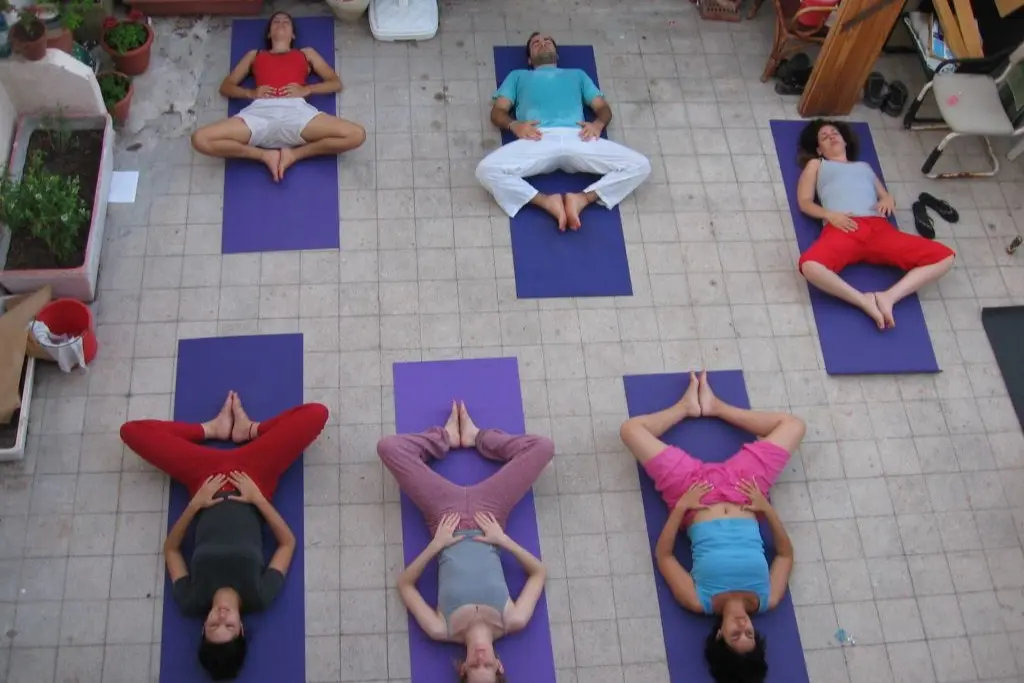
- Sanskrit
- मण्डूकासनMaṇḍūkāsana
- Meaning of the name
- Frog posture: maṇḍūka, frog, and āsana, posture
- Level
- Intermediate
- Family
- Hip opener
- In the texts
- Kneeling frog in the Gheranda Samhita 2.34 (GRETIL and Vasu); the wide-knee, face-down frog of modern classes is not in the classical texts
In short
Frog pose, in modern classes, is a face-down hip opener: on hands and knees, the knees slide wide apart, the shins stay parallel with the ankles in line with the knees, and the forearms rest on the floor while the hips ease back. The Gheraṇḍa Saṃhitā's maṇḍūkāsana is a different, kneeling frog. Pad the knees and never force the stretch.
Two very different postures share the frog's name. The one most people mean today is a face-down stretch with the knees wide apart, common in vinyasa and yin classes. The one the hatha texts describe is a kneeling seat, the knees forward and the toes joined behind. This card teaches both, starting with the modern one.
Steps
- Pad the floor. Fold a blanket under each knee, or double your mat. Start on hands and knees.
- Widen the knees a little at a time, sliding them apart on the padding.
- Set the shins parallel, pointing straight back, ankles in line with the knees, feet flexed so that the inner edge of each foot rests on the floor.
- Lower onto the forearms, elbows under the shoulders, or rest the chest on a bolster.
- Ease the hips back towards the line of the knees, only as far as the inner thighs allow. Keep the lower back long rather than sagging.
- Breathe slowly, five to ten breaths, letting the inner thighs soften on each exhalation.
- To come out, shift the weight forward onto the hands, slide the knees together, and rest in child's pose.
Alignment
- Knees, ankles and hips on one line seen from the side; if the hips sit far behind the knees, the strain goes into the knees.
- The knee joint bends at about a right angle; do not let the feet turn in under the body.
- The intensity stays moderate: a stretch you can breathe through, never a pull at the groin or a pinch in the knee.
- The neck is long, the forehead can rest on the hands or a block.
Variations
- Half frog: one leg in the frog shape, the other straight back. Gentler on the hips, easier to control.
- Frog with a bolster: the chest and belly lie on a bolster lengthwise, so the hips do not have to carry the weight; good for longer, yin-style holds.
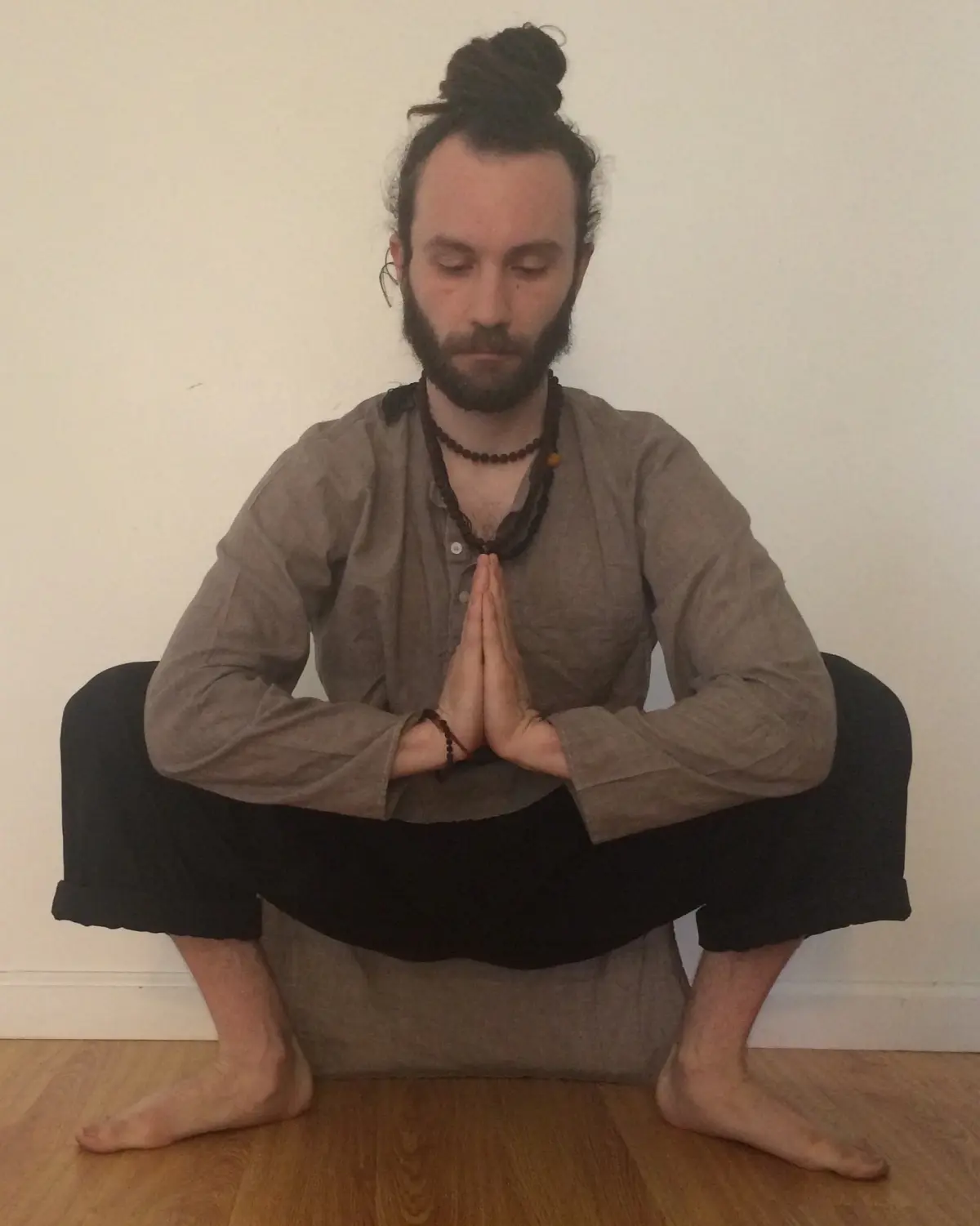
- Kneeling frog, the classical form: kneel with the knees forward, join the big toes behind you and sit down between or on the heels, hands on the knees; many teachers spread the knees wide. This follows the Gheraṇḍa Saṃhitā's short description (below). A cushion under the buttocks makes it accessible.
- Upturned frog (uttāna-maṇḍūka): from the kneeling frog, lie back and hold the head with the elbows. Demanding for the knees and the back: only with a teacher.
Contraindications
- Knee injury, meniscus or ligament problems: avoid the face-down frog, which loads the inner knee.
- Groin or adductor strain: avoid until it has healed, then return with a small range.
- Hip replacement or hip impingement: ask your surgeon or physiotherapist; wide external rotation may be off limits.
- Lower-back pain: keep the hips higher than the knees and the belly supported, or skip.
- Pregnancy: from the second trimester, choose the supported or half frog with the belly free, and stop at the first discomfort in the pubic area.
- Hypermobility: stay well short of your maximum and keep the muscles of the thighs active.
In the texts
The frog is one of the thirty-two postures of the Gheraṇḍa Saṃhitā (2.3-2.6), which also lists an "upturned frog". Its description is short:
पादतलौ पृष्ठदेशे अङ्गुष्ठौ द्वौ च संस्पृशेत् । जानुयुग्मं पुरस्कृत्य साधयेन्मण्डुकासनम् ॥
pādatalau pṛṣṭhadeśe aṅguṣṭhau dvau ca saṃspṛśet | jānuyugmaṃ puraskṛtya sādhayen maṇḍukāsanam ||
Placing the soles of the feet behind, one makes the two big toes touch; bringing the two knees forward, one accomplishes the frog posture.
Śrīśa Chandra Vasu's 1914-1915 translation reads it the same way: "Carry the feet towards the back, the toes touching each other, and place the knees forwards. This is called the Frog-posture". It reads as a kneeling seat, close to vajrāsana; the verse does not say how far apart the knees are, and many Indian schools still teach a kneeling maṇḍūkāsana with the knees wide. The next verse adds the upturned frog: in the frog's position, holding the head with the elbows, "upturned like a frog" (2.35); see the page on supine poses for the other "upturned" postures. The GRETIL text spells the name maṇḍuka with a short u; the dictionary form is maṇḍūka.
The wide-knee, face-down frog of modern classes is not in the Gheraṇḍa nor in the Haṭhayogapradīpikā. Sanskrit has a second word for frog, bheka, and bhekāsana names yet another modern posture, described in twentieth-century manuals: lying on the belly, the hands press the feet of the bent legs down beside the hips. Same animal, three different shapes; the name tells you less than the description.
Related postures
Prepare with garland pose, a wide squat, and with the pigeon. After the frog, rest in child's pose, then lie on the back. For the front splits, which stretch the hamstrings rather than the inner thighs, see Hanumānāsana. All the cards: the asanas chapter.
Questions people ask
Is frog pose good for the hips?
It is a strong stretch for the inner thighs, the adductors, and asks the hips to rotate outward. That is why it appears in hip-opening sequences. Go slowly: the stretch arrives late, and the groin and the inner knees are the places that get hurt when people push.
How long should I hold frog pose?
Five to ten slow breaths in an active class. In yin-style practice it is held one to three minutes, supported, at a mild intensity. Come out slowly, sliding the knees together, and rest in child's pose.
Why does frog pose hurt my knees?
Because the whole weight rests on the inner edge of the knees, on a hard floor. Fold a blanket under each knee, or put the knees on two folded mats. If the inner knee still hurts, bring the knees closer: knee pain is a signal to stop, not a stretch.
What is the difference between frog pose and bhekasana?
Bhekāsana is another 'frog' name for a different posture of modern yoga: lying on the belly, the hands press the feet of the bent legs down beside the hips. Neither the wide-knee frog nor bhekāsana appears in the Gheraṇḍa Saṃhitā, whose maṇḍūkāsana is kneeling.
Practise gently and within your limits. Yoga is learnt best with a qualified teacher; this page does not replace one.
Sources
- Gheraṇḍasaṃhitā, Sanskrit text ed. Peter Thomi (GRETIL, University of Göttingen), 2.3-2.6, 2.34-2.35 checked October 20, 2026
- The Gheranda Samhita, translated by Srisa Chandra Vasu, Sacred Books of the Hindus vol. XV (Allahabad, 1914-1915), Internet Archive: 2.34-2.35 checked October 20, 2026
- Monier-Williams, Sanskrit-English Dictionary (1899), entries maṇḍūka and bheka, Cologne Digital Sanskrit Dictionaries checked October 20, 2026
- Bhekasana, Wikipedia (20th-century manuals that describe the posture) checked October 20, 2026