Bālāsana, child's pose
5 min read · Updated October 20, 2026 · sources checked October 20, 2026 · Editorial: The Yogide team
- Sanskrit
- बालासनBālāsana
- Meaning of the name
- Child's pose: bāla, child, and āsana, posture
- Level
- Beginner
- Family
- Rest and relaxation
In short
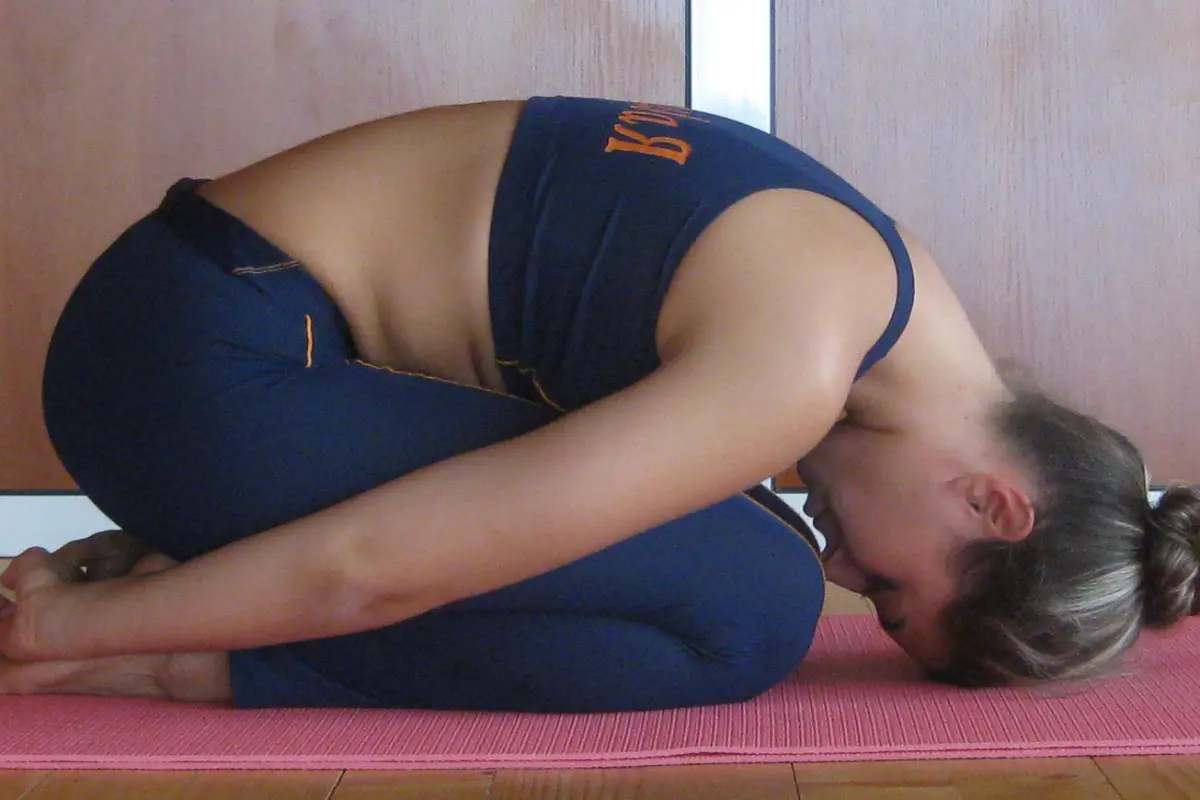
Bālāsana, child's pose, is a kneeling rest: you sit back on your heels, fold forward until the forehead rests on the floor or a cushion, and leave the arms long in front or alongside the body. It is held for a few breaths to a few minutes between harder postures. The pose is modern, first described in the twentieth century.
Every class has a moment when someone quietly folds onto their knees and lays their forehead on the mat. Child's pose is the posture of not doing: the body small, the head down, the breath slowing. Teachers offer it as a refuge you may take at any time, and learning to take it when you need it is part of a safe practice.
Steps
- Kneel on the mat with the tops of the feet flat on the floor and the big toes touching.
- Choose the width of the knees: together for a deeper fold of the back, or as wide as the mat for space for the belly and chest.
- Breathing out, sit back towards the heels and fold forward from the hips, letting the chest rest on the thighs or between them.
- Rest the forehead on the floor, on a block or on folded hands.
- Place the arms either alongside the body, palms up near the feet, or stretched forward with the palms down.
- Close the eyes and breathe slowly through the nose. Feel the breath widen the back of the ribs. Stay five breaths to two minutes.
- To come out, walk the hands back towards the knees and roll up slowly, the head coming up last.
Alignment
- The buttocks sink towards the heels; if they stay high, use a cushion between heels and buttocks rather than forcing.
- The forehead, not the top of the head, takes the weight of the head, so the neck stays long.
- The shoulders relax away from the ears. With the arms forward, let the elbows soften.
Variations
- Supported child's pose: place a bolster or two folded blankets lengthwise between the knees and lie on it, head turned to one side; change the side halfway. This is a classic posture of restorative yoga.
- Knees padded: a folded blanket under the knees and shins, or a rolled towel under the ankles if their fronts complain.
- Head supported: stack the fists or rest the forehead on a block when it does not reach the floor.
- Extended child's pose: knees wide, arms stretched far forward, a gentle stretch along the sides and shoulders.
- On a chair: sit with the knees apart and fold forward over a cushion placed on the thighs, or rest the forearms and head on a table in front of you.
Contraindications
- Knee injury or recent knee surgery: avoid the deep fold; use the chair or table version.
- Ankle problems: a rolled towel under the ankles, or another resting pose such as śavāsana.
- Pregnancy: open the knees wide so the belly has room, and use a bolster under the chest.
- Osteoporosis or low bone mass: keep the fold supported by a bolster rather than rounding deeply. A Mayo Clinic case series reported vertebral fractures after strong yoga flexion in people with low bone mass.
- Feeling of pressure in the head or difficulty breathing folded forward: raise the head on a block or bolster, or rest lying on the back instead.
In the texts
Child's pose is a modern posture. It is not among the fifteen postures of the Hatha Yoga Pradipika, nor in the list of thirty-two in the Gheranda Samhita (2.3-6). The name bālāsana appears in twentieth-century teaching. The shape itself was already used in European gymnastics: in the English edition of the Danish gymnast Niels Bukh's manual, Fundamental Gymnastics (New York, 1928), exercise 98 ends with the gymnast sitting on the heels and bending forward "with the forehead against the floor close to the knees" to relax. The historian Mark Singleton (Yoga Body, 2010) has argued that such gymnastics fed into modern posture practice. The name is easy to read: bāla (बाल) is a child, the same word as in Bāla Kṛṣṇa, Krishna as a child.
What the posture shares with the classical seats is their spirit of stillness. The vajrāsana of the Gheranda Samhita, from which child's pose is folded forward, is a kneeling seat for steadiness; child's pose turns it into rest.
Is it normal?
The feet or calves may tingle after a minute or two. Sit up, stretch the legs, and next time shorten the stay or put a cushion between the heels and the buttocks.
Related postures
Child's pose comes after cat-cow and downward-facing dog in the sequence of basic poses for beginners, and between backbends such as the cobra. All the cards: the asanas chapter.
Questions people ask
What is child's pose in yoga?
A resting position on the knees: buttocks on the heels, chest on or between the thighs, forehead on the floor, arms forward or by the sides. Teachers offer it as a pause you can take at any moment of a class, without asking permission.
How long should you hold child's pose?
Five to ten breaths as a pause between postures, and up to two or three minutes as a rest if the knees and ankles are comfortable. With a bolster under the chest, many people stay longer, as in restorative yoga.
What does child's pose stretch?
Mostly the back of the body: the muscles along the spine and, with the arms stretched forward, the sides of the trunk and the shoulders. The fronts of the ankles and the knees are folded, which is why they need padding for some people.
Why does child's pose feel so good?
Because the body is folded and supported, there is nothing to hold up, and you can feel the breath move the back of the ribs. We found no trial measuring the effect of the pose alone; the feeling of rest is what practitioners describe.
Is child's pose a yoga move?
Yes, it is taught in almost every modern style, but it is not in the old hatha texts. The name bālāsana and the pose as we know it belong to twentieth-century yoga.
Practise gently and within your limits. Yoga is learnt best with a qualified teacher; this page does not replace one.
Sources
- Balasana, Wikipedia (not described before the 20th century; variations) checked October 20, 2026
- Niels Bukh, Fundamental Gymnastics: the Basis of Rational Physical Development (New York, E. P. Dutton, 1928), translated from the second Danish edition by Emily Russell Andrews, Internet Archive checked October 20, 2026
- Mark Singleton, Yoga Body: the Origins of Modern Posture Practice (Oxford University Press, 2010), catalogue record, Wellcome Collection checked October 20, 2026
- Gheraṇḍasaṃhitā, Sanskrit text, chapter 2, list of 32 postures, 2.3-2.6 (GRETIL, University of Göttingen) checked October 20, 2026
- Sinaki M. Yoga spinal flexion positions and vertebral compression fracture in osteopenia or osteoporosis of spine: case series. Pain Practice, 2013 DOI 10.1111/j.1533-2500.2012.00545.x PMID 22448849 checked October 20, 2026