Cat-cow, the spine moving with the breath
6 min read · Updated October 20, 2026 · sources checked October 20, 2026 · Editorial: The Yogide team
- Sanskrit
- मार्जारासनMārjārāsana · bitilāsana
- Meaning of the name
- Cat pose: mārjāra, cat, and āsana, posture; the arched half is called cow pose, bitilāsana, in modern classes
- Level
- Beginner
- Family
- Spine mobility
In short
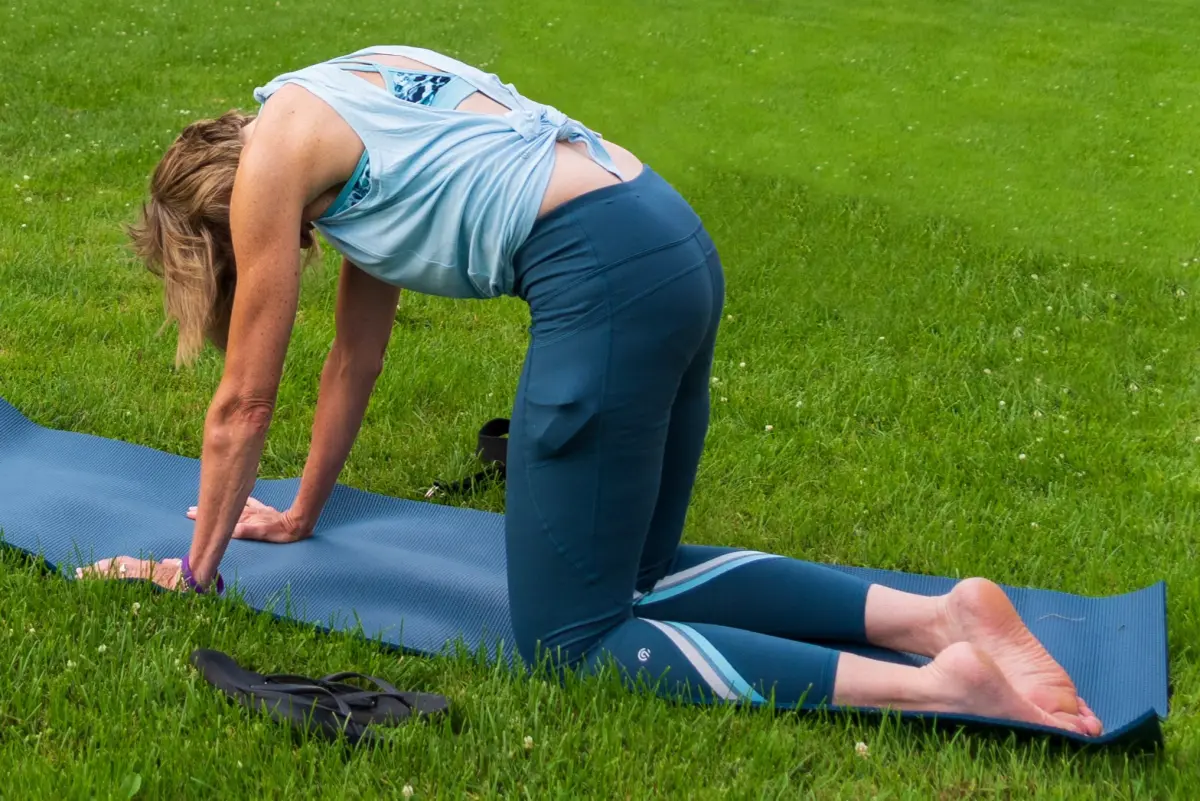
Cat-cow is a pair of movements done on hands and knees: breathing in, you let the belly sink and lift the chest and tailbone (cow); breathing out, you round the back and drop the head (cat). Repeated slowly, five to ten times, it moves the whole spine gently. It is a modern pose, not found in the hatha texts.
Watch a cat wake up: it stretches its front legs, rounds its back high, then lets it sink. Cat-cow borrows that movement and adds the one thing animals do not need to be taught, the breath. It is often the first thing done on the mat in a class, because it asks nothing of flexibility and tells you, in two breaths, how your back feels today.
Steps
- Come onto hands and knees on a mat or a folded blanket: hands under the shoulders, knees under the hips, the tops of the feet flat on the floor.
- Spread the fingers and press the whole palm into the floor. Start with a flat back, the neck long, the gaze down.
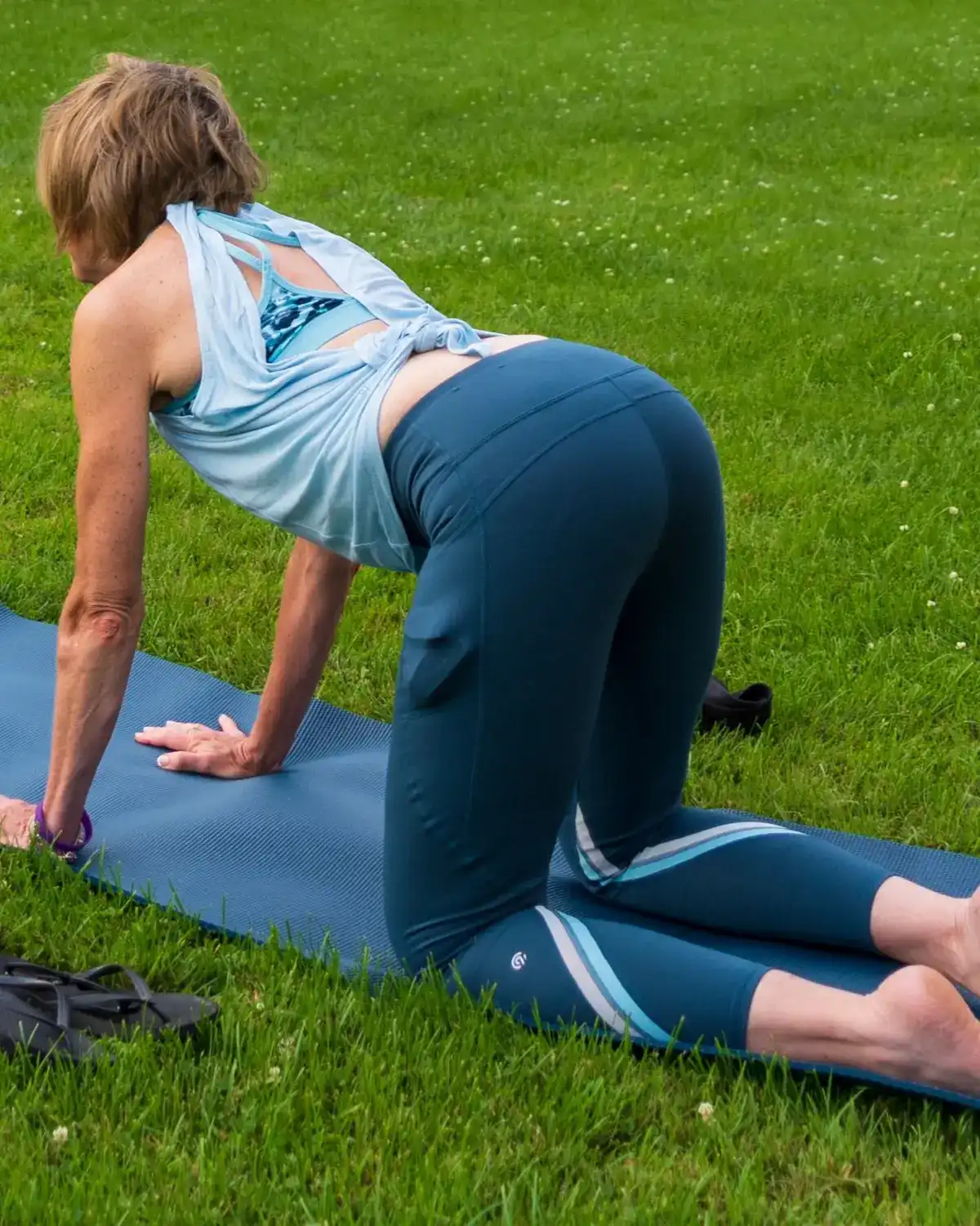
- Cow: breathing in through the nose, let the belly sink towards the floor, lift the tailbone and the chest, and bring the gaze slightly forward. Keep the back of the neck long; do not throw the head back.
- Cat: breathing out, press the floor away with the hands, round the back towards the ceiling from the tailbone to the top of the spine, and let the head drop gently, chin towards the chest.
- Continue for five to ten rounds, one breath in for cow, one breath out for cat. Move slowly enough that you feel each part of the back take its turn.
- Finish with a flat back, then sit back on the heels or rest in child's pose for a few breaths.
Alignment
- The hands stay under the shoulders and the knees under the hips throughout; the movement happens in the spine, not by rocking forward and back.
- The arms stay straight but the elbows are not locked.
- In cow, the movement comes mostly from the pelvis tilting and the chest opening, not from pinching the lower back or the neck.
- In cat, the shoulder blades spread apart as you push the floor away.
Variations
- Small range: if the back is stiff or sore, make the movement smaller; even a slight tilt of the pelvis is cat-cow.
- Knees padded: fold the mat or add a blanket under the knees if kneeling hurts.
- Wrists sensitive: come onto the fists, or onto the forearms with the elbows under the shoulders.
- Seated on a chair: sit near the front edge, hands on the knees. Breathing in, lift the chest and tilt the pelvis forward; breathing out, round the back and let the head drop. This is the version used in chair yoga.
- Standing: hands on the thighs, knees bent, the same rounding and arching.
Contraindications
- Recent back injury or surgery, or pain that spreads down a leg: ask your doctor or physiotherapist first, and keep any movement within a pain-free range.
- Osteoporosis or low bone mass: keep the rounding (cat) small and slow. A Mayo Clinic case series described vertebral fractures in people with low bone mass after strong yoga flexion positions; gentle cat-cow is not strong flexion, but the direction is the same.
- Wrist, knee or neck problems: use the forearm, padded or chair versions above, and keep the head in line with the spine.
- Pregnancy: the pose is commonly used in pregnancy; in cow, let the belly hang without pushing the lower back into a deep arch, and follow your midwife's or doctor's advice.
In the texts
Cat-cow is a modern practice. The Hatha Yoga Pradipika describes fifteen postures and the Gheranda Samhita lists thirty-two (2.3-6); neither has a cat or a cow pose. The Sanskrit names used today, mārjārāsana or biḍālāsana (both words mean "cat") and bitilāsana for the cow, belong to twentieth-century teaching. The position itself was familiar to European gymnastics: the Danish gymnast Niels Bukh's manual, published in English as Fundamental Gymnastics (New York, 1928), lists "hand knee standing", "standing on hands and knees, trunk horizontal", among its starting positions. The historian Mark Singleton (Yoga Body, 2010) has argued that gymnastics of this kind fed into modern posture practice in India; the exact route by which cat-cow entered yoga is not documented.
That does not make it any less yoga. What the movement keeps from the tradition is the link between breath and body that runs through every classical text, and the quality Patañjali asks of every posture: steady and at ease, sthira-sukham (Yoga Sutra 2.46). The meaning of the names is explained on the pose names page.
Good to know
If you lose the rhythm, stop moving and just breathe for two breaths on a flat back. Then start again, letting the breath lead.
Related postures
Cat-cow opens most sessions in the twelve basic poses for beginners and prepares downward-facing dog and the cobra. For the back in general, read yoga and back pain; for all the cards, the asanas chapter.
Questions people ask
What is cat cow?
A gentle movement of the spine on hands and knees that alternates two shapes: the back arched with the chest lifted (cow) and the back rounded with the head down (cat). Each change follows one breath. Most classes use it to warm up the back before other postures.
How to breathe in cat cow?
Breathe in through the nose as you move into cow, belly towards the floor and chest forward. Breathe out as you round into cat, pressing the floor away. Let the breath set the speed: the movement lasts as long as the breath, not the other way round.
How long to do cat cow?
Five to ten slow rounds, which takes one to two minutes, is enough as a warm-up. You can repeat it later in the session or on its own during the day. There is no need to hold either shape; the movement is the practice.
How often to do cat cow?
As often as it feels good: at the start of each session, or for a minute in the morning or after sitting for a long time. If it causes pain rather than ease, reduce the range or stop and ask a health professional.
What does cat cow work?
It moves the spine into flexion and extension, one segment after another, and asks the arms and shoulders to hold you up. We found no trial measuring its effects on its own, so take it as a gentle mobility exercise rather than a treatment.
Practise gently and within your limits. Yoga is learnt best with a qualified teacher; this page does not replace one.
Sources
- Cat/Cow pose, Wikipedia (modern Sanskrit names biḍālāsana / mārjārīāsana, bitilāsana) checked October 20, 2026
- Niels Bukh, Fundamental Gymnastics: the Basis of Rational Physical Development (New York, E. P. Dutton, 1928), translated from the second Danish edition by Emily Russell Andrews, Internet Archive checked October 20, 2026
- Mark Singleton, Yoga Body: the Origins of Modern Posture Practice (Oxford University Press, 2010), catalogue record, Wellcome Collection checked October 20, 2026
- Gheraṇḍasaṃhitā, Sanskrit text, chapter 2, list of 32 postures, 2.3-2.6 (GRETIL, University of Göttingen) checked October 20, 2026
- Svātmārāma, Haṭhayogapradīpikā, Sanskrit text, chapter 1 (GRETIL, University of Göttingen) checked October 20, 2026
- Sinaki M. Yoga spinal flexion positions and vertebral compression fracture in osteopenia or osteoporosis of spine: case series. Pain Practice, 2013 DOI 10.1111/j.1533-2500.2012.00545.x PMID 22448849 checked October 20, 2026