V
ध्यानdhyāna · meditation
Meditation, mantras and the subtle body
Updated October 16, 2026 · sources checked October 16, 2026
In short
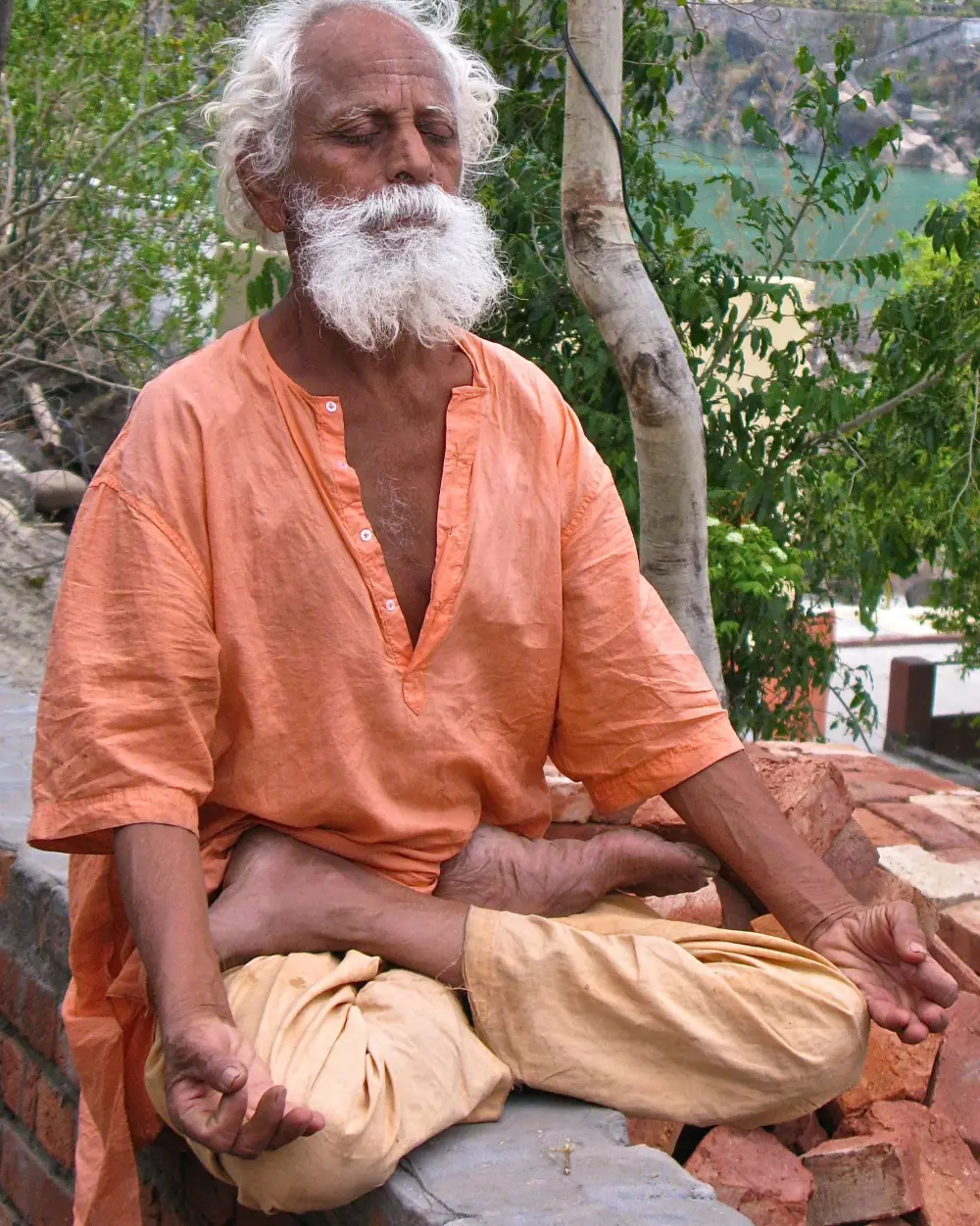
In the Yoga Sutras, meditation (dhyāna) is the seventh of eight limbs: after posture, breath and withdrawal of the senses, attention is held on one point (dhāraṇā) until it flows without interruption. Begin seated, spine upright, five minutes a day, with the breath or a mantra such as Om.
Listen: Yoga Nidra — short extract
Free to listen, no sign-up. The complete guided audio comes with the book Yoga Nidra: Practice and Scripts.
Keyboard: Space plays or pauses, the arrow keys move 10 seconds.
Chapters
Guided audio narrated with a synthetic voice (ElevenLabs). Sanskrit recitation checked line by line.
Read the transcript
Yoga nidra. A short extract.
Lie down and make yourself comfortable. Arrange the body so that you will not need to move… Let the arms rest a little away from the body, palms turned up… Let the feet fall outwards… Close your eyes.
Tell yourself silently: I am going to practise yoga nidra. I will stay awake and listen.
Become aware of the sounds around you. The farthest sounds… then sounds a little closer… then sounds in this room. Let them come and go.
Feel the body lying on the floor. The places where it touches the ground: the back of the head… the shoulders… the elbows and hands… the hips… the backs of the legs… the heels.
Now bring to mind your saṅkalpa, your resolve. One short sentence, in the present. Repeat it silently three times, with feeling.
We begin the rotation of consciousness. Let your attention go to each part as it is named. Do not move it. Just feel it.
Right hand… right thumb… index finger… middle finger… ring finger… little finger… palm… back of the hand… wrist… forearm… elbow… upper arm… shoulder… right side of the chest… right side of the waist… right hip… right thigh… knee… shin… ankle… heel… sole of the foot… top of the foot… right big toe… all the toes.
This was the beginning of Script 1, from Yoga Nidra: Practice and Scripts, on yogide.com. The full practice continues with the whole body, the breath, the images and the return.
Patañjali lists the eight limbs of yoga in Yoga Sutra 2.29: yama, niyama, āsana, prāṇāyāma, pratyāhāra, dhāraṇā, dhyāna and samādhi. Meditation is not a technique added to yoga. It is where the other limbs lead.
Dhyāna, a practice in its own right
The word ध्यान (dhyāna) comes from the root dhyai, "to contemplate, to think of". Patañjali defines it in a single line: tatra pratyayaikatānatā dhyānam (3.2), "there, the one continuous flow of the mind towards its object is meditation". The "there" is the place chosen in the step before, concentration (dhāraṇā, dhyāna and samādhi are explained together on their own page).
Long before Patañjali, the Śvetāśvatara Upaniṣad already gave practical instructions (2.8-2.10): hold the body steady with chest, neck and head in a line, draw the senses into the heart with the mind, and choose a clean, level place, pleasing to the mind, sheltered from the wind. These are still the basics of how to meditate.
The supports of meditation
The Indian traditions offer several supports for attention. You need only one.
| Support | What you do | Where to start |
|---|---|---|
| The breath | follow the natural breath, without changing it | how to meditate |
| A mantra | repeat a sacred formula aloud, in a whisper or silently | mantra meditation and japa |
| Om | chant or listen inwardly to the syllable | Om, the sacred syllable |
| A centre in the body | rest attention at the heart, the navel or between the eyebrows | the chakras from the sources |
| A guided sequence | follow a spoken sequence step by step | a 10-minute guided meditation |
Patañjali is broad-minded about the object: yathābhimata-dhyānād vā (1.39), "or by meditating on whatever appeals to you". The point is not the object but the steadiness of attention.
Beginner, intermediate, advanced: what levels mean here
Yoga schools today speak of levels. The tradition speaks of effort and maturity rather than of grades. Patañjali says that success is near for those whose ardour is intense, and that it differs again according to whether the effort is mild, middling or intense (mṛdu-madhya-adhimātra, 1.21-1.22). He also says practice becomes firmly grounded only when it is kept up for a long time, without interruption and with devotion (1.14).
In practice, on this site:
- Beginner: five to fifteen minutes a day, seated, with the breath, Om or a short mantra; no breath retention.
- Intermediate: regular daily sitting of twenty minutes or more, japa with a mala, the first steps of concentration on one point, pranayama learned slowly.
- Advanced: long or intensive practice, retreats, work with the subtle body and Kuṇḍalinī. The texts reserve this for practice under a teacher, and so do we.
The levels guide explains how the same scale applies to postures and breath.
Mantra, sound and the subtle body
This chapter also covers the sound side of meditation: Sanskrit mantras, the Gāyatrī, the Mahāmṛtyuñjaya, Om namaḥ śivāya and the japa mala of 108 beads. And it covers the subtle body as the haṭha and tantric texts describe it: prāṇa and the five vāyus, the nāḍīs, the chakras and Kuṇḍalinī. Two modern methods with Indian roots have their own pages: Transcendental Meditation and the 10-day Vipassana course.
In this chapter
Questions people ask
How long should a beginner meditate?
Five to ten minutes a day is a sound start. Patañjali stresses regularity over a long time (Yoga Sutra 1.14) rather than long sessions at the beginning.
Is meditation part of yoga or a separate practice?
In the Yoga Sutras it is part of yoga: dhyāna is the seventh of the eight limbs (2.29). Postures and breathing were taught to prepare for it.
Do I need a mantra to meditate?
No. The Yoga Sutras allow any suitable object (1.39). The breath, Om or a short mantra are the usual supports in the Indian traditions.
Sources
- Patañjali, Yogasūtra, Sanskrit text (GRETIL, University of Göttingen) checked October 16, 2026
- The Yoga Sutras of Patanjali, translated by Charles Johnston (1912), Project Gutenberg checked October 16, 2026
- Śvetāśvatara Upaniṣad, Sanskrit text (GRETIL) checked October 16, 2026
- Māṇḍūkya Upaniṣad with Gauḍapāda’s Kārikā and Śaṅkara’s commentary, Sanskrit text (GRETIL) checked October 16, 2026