I
आरम्भārambha · the beginning
Start yoga
Classical yoga asks for little equipment and a lot of regularity. Here is where to begin, whoever you are.
Updated October 17, 2026 · sources checked October 17, 2026
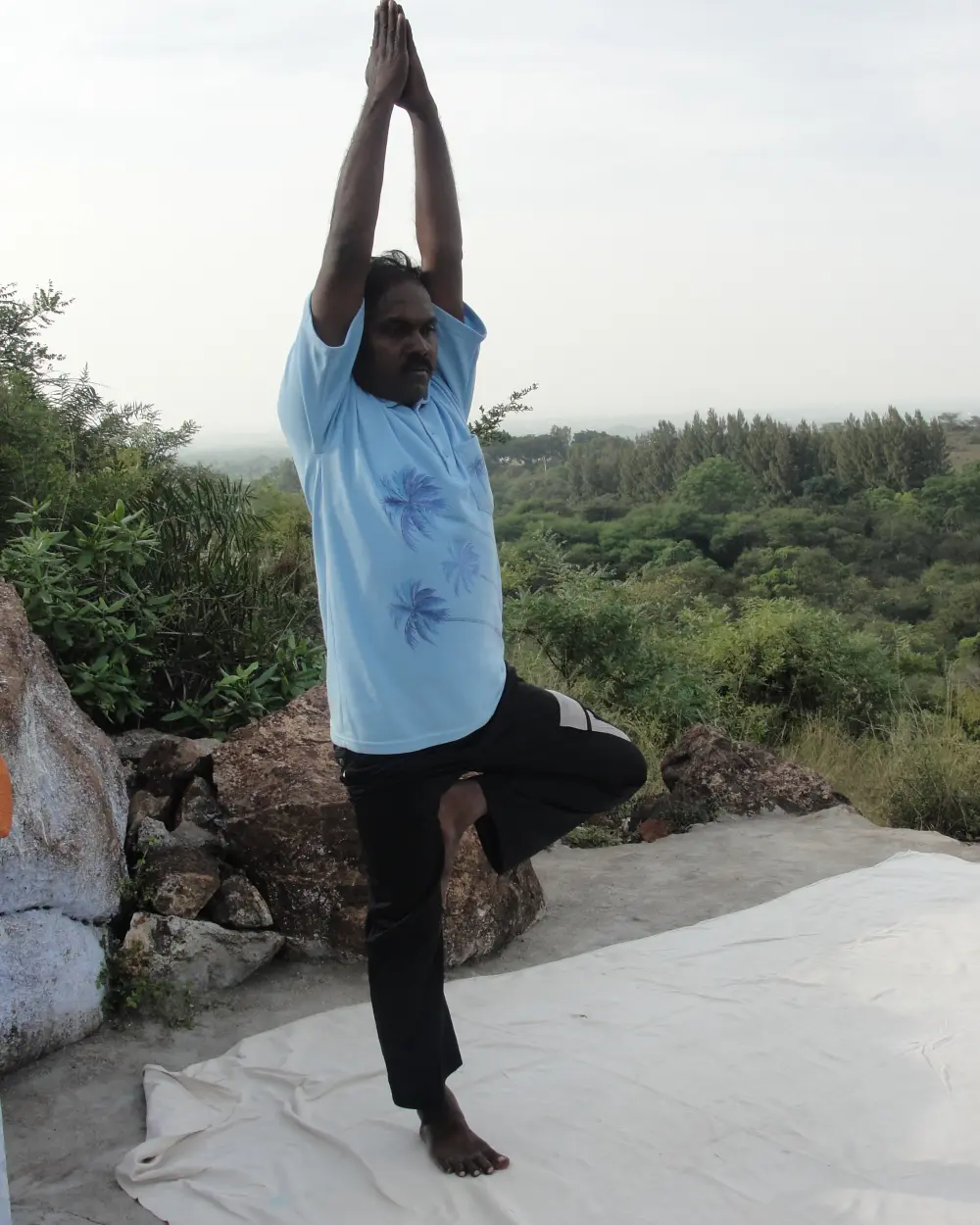
In short
To start yoga, you need a quiet corner, a non-slip mat or a folded blanket, and ten to twenty minutes a day. Begin with a few simple postures, slow breathing through the nose and a rest lying on your back, and stop anything that hurts. Regularity matters more than flexibility or length.
Patañjali defines posture in three words: sthira-sukham āsanam (Yoga Sutra 2.46), steady and comfortable. That is the beginner's compass. If a posture is neither steady nor comfortable, make it easier; if a practice cannot be kept up, make it shorter. Everything else on this page follows from that.
स्थिरसुखमासनम्
sthira-sukham āsanam
Posture is steady and comfortable.
Where to begin, according to who you are
| You are… | Begin with | Then |
|---|---|---|
| A complete beginner at home | yoga at home and the twelve basic poses | the 30-day programme |
| Short of time | a 20-minute morning practice | a fixed time every day |
| Older, or getting to the floor is hard | chair yoga | standing work with the chair, then the floor |
| Stiff, or with back pain | gentle versions, yoga for lower back pain after checking with a doctor | restorative yoga |
| Drawn to meditation more than postures | how to meditate and nāḍī śodhana | raja yoga |
| Wanting the roots and the texts | what yoga is and the yoga books worth reading | the Yoga Sutras |
| Already practising, unsure of your level | yoga levels and the level quiz | one new element at a time |
| Choosing a class or a style | home, online or studio? | the paths of yoga |
The golden rules
- Little and often. Ten to twenty minutes a day build more than one long session a week. Patañjali's condition for practice to take root is time, continuity and care (Yoga Sutra 1.14).
- Breath first. Breathe through the nose, never hold the breath. If the breath becomes short or forced, come back a little.
- No pain in the joints. A stretch in a muscle is fine; pain in a knee, the lower back, the neck or a wrist is a signal to stop.
- Empty stomach. Practise before a meal, or two to three hours after one.
- Gentle versions first. Bent knees, a block, a cushion, a chair: they are not lesser forms, they are how the posture becomes steady and comfortable.
- A teacher for the thresholds. Inversions, the lotus, breath retention and rapid breathing are learnt with a qualified teacher.
- End with rest. Five minutes in śavāsana belong to the practice, not after it.
Before your first session
The US National Center for Complementary and Integrative Health notes that the most common yoga injuries are sprains and strains, mostly of the knee and lower leg, and advises beginners to avoid extreme practices such as headstands, shoulder stands, the lotus position and forceful breathing. It also states that learning yoga on your own without supervision has been associated with increased risks. Learn the demanding practices later, with a qualified teacher.
Your first session, in fifteen minutes
- Sit on a cushion, spine upright, two minutes of slow breathing through the nose.
- Cat and cow on hands and knees, six slow rounds.
- Child's pose, five breaths.
- Mountain pose, standing, ten breaths.
- Cobra, small, three breaths, twice.
- Seated forward bend with bent knees, five breaths.
- Śavāsana, five minutes.
The detailed version, with what to wear and where to practise, is on yoga at home. For your kit, see choosing a yoga mat and what to wear; you need neither to begin.
Beginner, intermediate, advanced
In the tradition, a level is measured by regularity and discernment, not by flexibility. The Hatha Yoga Pradipika says that the young, the old, the very old, the sick and the weak all succeed if they practise without laziness (1.66 in Pancham Sinh's translation), and it insists that breath is tamed slowly, "as lions, elephants and tigers are controlled by and by" (2.15). Our page on yoga levels gives concrete benchmarks for each level, the postures, breathing and meditation that fit, and the level at which each style of yoga is accessible.
Routines and programmes
- Morning yoga: the traditional sādhanā in twenty minutes.
- 30 days of yoga: four progressive weeks, from fifteen to thirty minutes.
- Chair yoga: a complete seated session.
- Sun salutation: the twelve positions, once the basics are in place.
- Yoga for beginners in PDF: what you can print free, and our complete guides.
Then choose your path
Yoga is not one method. Hatha yoga begins with the body and breath; raja yoga with the mind; karma, bhakti and jñāna yoga with action, devotion and knowledge. Modern schools such as Sivananda, Iyengar or Ashtanga Vinyasa grew out of hatha yoga. The paths of yoga compares them in one table, and the practices of yoga lists everything a yogi does, from postures to chanting.
In this chapter
Questions people ask
How should a complete beginner start yoga?
With short daily sessions at home of ten to twenty minutes: a few beginner postures, slow nasal breathing and five minutes of rest on the back. Add a beginners' class with a qualified teacher if you can, and leave inversions and strong breathing for later.
How often should a beginner do yoga?
Two or three times a week is a good start; a short daily session is better still if it stays comfortable. Patañjali's condition for progress is practice kept up over a long time, without interruption (Yoga Sutra 1.14).
Am I too old or too stiff to start yoga?
No. The Hatha Yoga Pradipika says the young, the old and even the sick succeed if they practise without laziness. If getting to the floor is hard, chair yoga is a complete practice.
What should I avoid as a beginner?
Headstands, shoulder stands, the lotus position and forceful breathing, which the US National Center for Complementary and Integrative Health advises beginners to avoid; and any movement that causes sharp pain, numbness or dizziness.
Sources
- Yoga: What You Need To Know — National Center for Complementary and Integrative Health (NIH) checked October 17, 2026
- Patañjali, Yogasūtra, Sanskrit text, 1.14 and 2.46 (GRETIL, University of Göttingen) checked October 17, 2026
- The Yoga Sutras of Patanjali, translated by Charles Johnston (1912), Project Gutenberg checked October 17, 2026
- The Hatha Yoga Pradipika, translated by Pancham Sinh (Allahabad, Panini Office, 1914), Internet Archive checked October 17, 2026