VI
शास्त्रśāstra · teaching, scripture
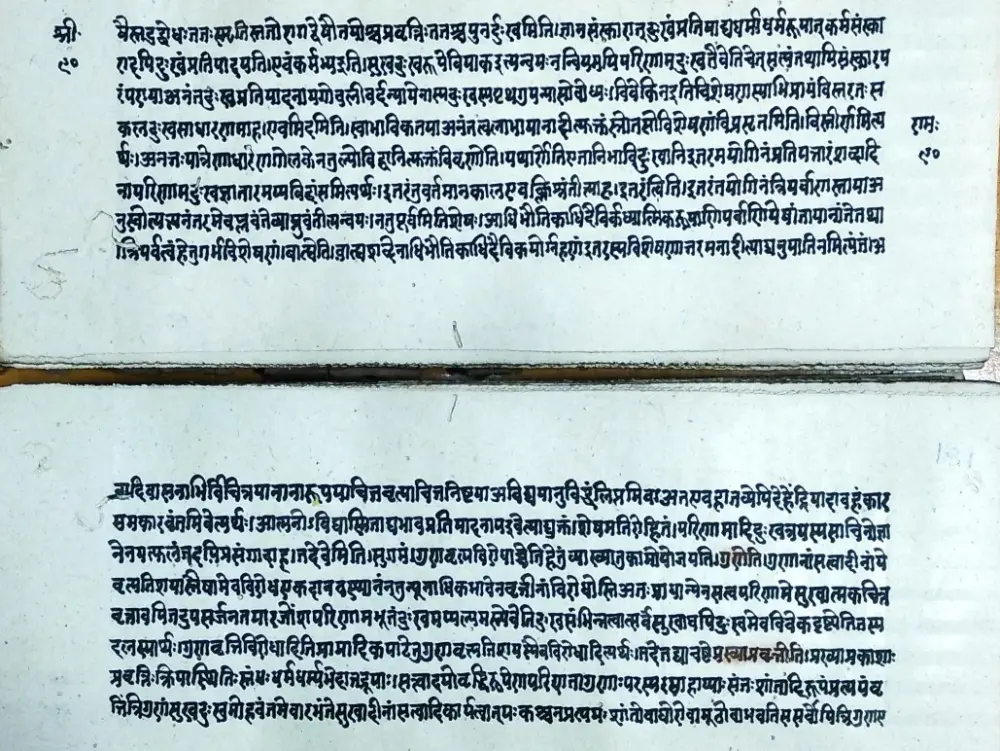
The sacred texts of yoga
Updated October 17, 2026 · sources checked October 17, 2026
In short
Four texts shape the yoga practised today: the Upanishads for the philosophy behind it, the Bhagavad Gita for action and devotion, Patañjali's Yoga Sutras for the mind, and the Hatha Yoga Pradipika for the body and breath. Most practitioners should start with the Yoga Sutras: 195 short aphorisms in four chapters.
Every quotation on Yogide gives its reference (Yoga Sutra 1.2, Bhagavad Gita 2.47, Hatha Yoga Pradipika 1.34), the Sanskrit, a transliteration you can pronounce, and our own translation. When we point to an older English translation, it is a public-domain edition, named.
The main texts at a glance
| Text | Approximate date | What you find there | Read first if… |
|---|---|---|---|
| Upanishads | the oldest from the first millennium BCE; Kaṭha, the first to define yoga, between the 5th and 1st centuries BCE (contested) | The self (ātman) and the absolute (brahman), Om, the first definitions of yoga | you want the philosophy at the root |
| Bhagavad Gita | likely 2nd-1st century BCE, within the Mahābhārata | Yoga of action, of knowledge and of devotion, taught on a battlefield | you live an active life and want a spiritual compass |
| Yoga Sutras | about 325-425 CE with its commentary (Maas); others date the sutras earlier | Yoga as a discipline of the mind, the eight limbs | you practise and want to know what yoga is |
| Hatha Yoga Pradipika | 15th century, by Svātmārāma | Postures, breath control, seals, the awakening of kuṇḍalinī | your practice is mainly āsana and prāṇāyāma |
| Gheranda Samhita | likely late 17th century | A seven-limbed hatha yoga: cleansing, 32 postures, seals, breath | you want a hatha manual with a clear progression |
Dates are those defended by scholars, often with wide margins. Tradition gives most of these texts a much older origin; we say which is which.
Where to start, by profile
- You practise postures and want the roots: the Yoga Sutras, one sutra a day, beginning with sutra 1.2. Then the Hatha Yoga Pradipika, to see where your postures come from.
- You are drawn to devotion, chanting, service: the Bhagavad Gita, then the Upanishads.
- You are training to teach: the Yoga Sutras and the Hatha Yoga Pradipika side by side: the first for the why, the second for the techniques you will teach.
- You simply want to understand who wrote the text everyone quotes: start with who was Patañjali.
A text read once is information; a text recited and returned to is svādhyāya, the study that the Yoga Sutras count among the observances.
In this chapter
Questions people ask
What is yoga philosophy?
The understanding of mind, self and freedom that underlies the practice. Its classical statement is Patañjali's Yoga Sutras, close to the Sāṃkhya school: pure awareness (puruṣa) is distinct from nature (prakṛti), which includes the mind, and yoga is the stilling of the mind so that awareness rests in itself.
Which yoga text should I read first?
For most practitioners, the Yoga Sutras: short, structured, and the source of the eight limbs. If you are drawn to devotion or to action in daily life, start with the Bhagavad Gita; if your practice is mainly postures and breath, with the Hatha Yoga Pradipika.
Can I read these texts for free?
Yes. The Sanskrit texts are on GRETIL (University of Göttingen), and older English translations in the public domain are on Project Gutenberg and the Internet Archive. Our pages give the links for each text.
Sources
- Patañjali, Yogasūtra, Sanskrit text (GRETIL, University of Göttingen) checked October 17, 2026
- Philipp A. Maas, A Concise Historiography of Classical Yoga Philosophy (2013, pre-print on Zenodo): date of the Yoga Sutras with commentary, about 325-425 CE checked October 17, 2026
- Bhagavad Gita, Wikipedia (part of the Mahābhārata, likely composed in the second or first century BCE) checked October 17, 2026
- Katha Upanishad, Wikipedia (dating contested, generally placed between the 5th and 1st centuries BCE) checked October 17, 2026
- Hatha Yoga Pradipika, Wikipedia (fifteenth-century manual by Svātmārāma) checked October 17, 2026
- Gheranda Samhita, Wikipedia (likely late seventeenth century) checked October 17, 2026
- The Yoga Sutras of Patanjali, translated by Charles Johnston (1912), Project Gutenberg checked October 17, 2026
- The Hatha Yoga Pradipika, translated by Pancham Sinh (Allahabad, Panini Office, 1914), Internet Archive checked October 17, 2026