चक्रcakra · wheel, circle
The chakras, from the sources
3 min read · Updated October 16, 2026 · sources checked October 16, 2026
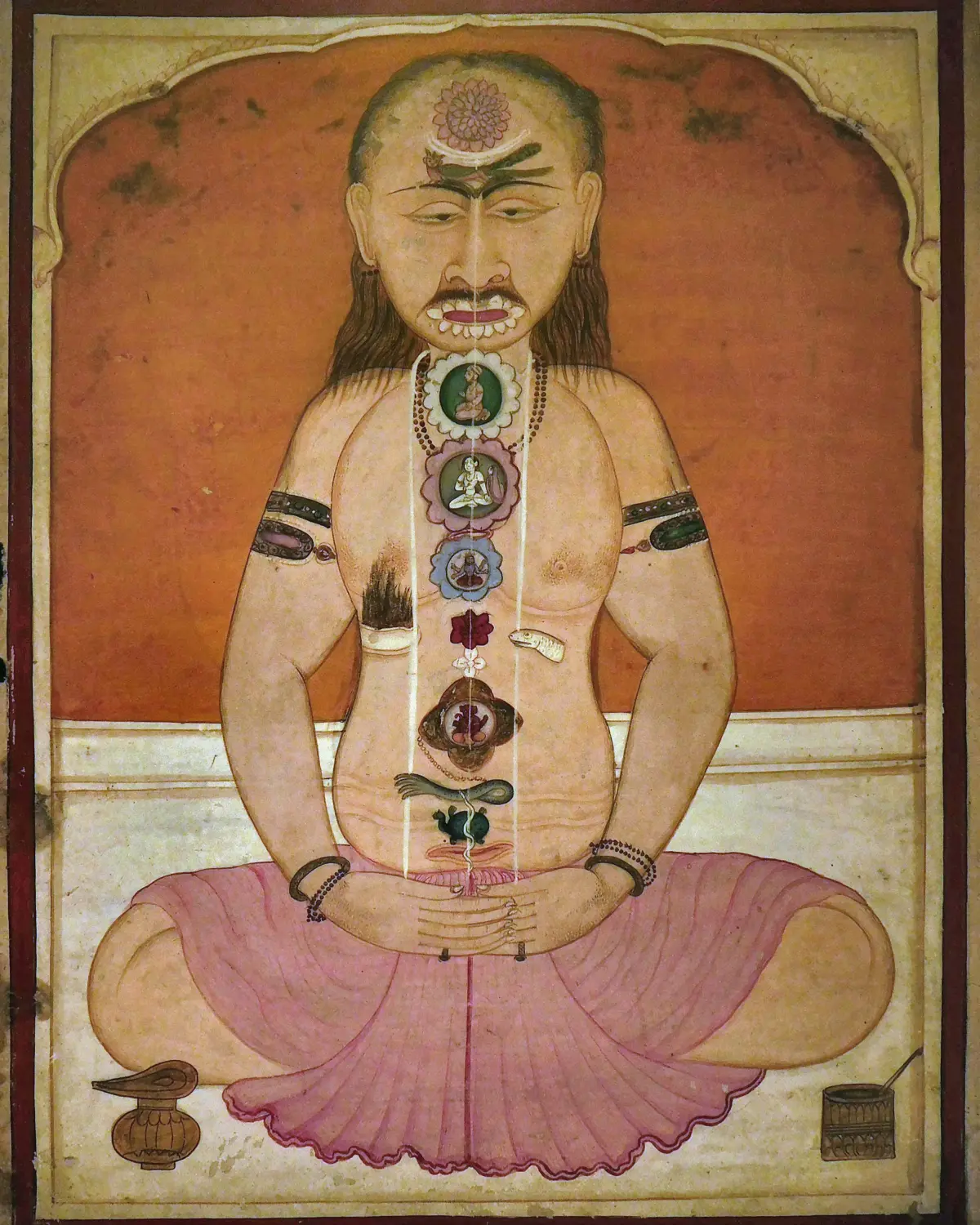
In short
The chakras are centres of the subtle body described in Indian tantric and haṭha texts. The best-known system, from the Ṣaṭ-cakra-nirūpaṇa (1577), counts six lotuses along the central channel, mūlādhāra, svādhiṣṭhāna, maṇipūra, anāhata, viśuddha and ājñā, crowned by the thousand-petalled sahasrāra: seven in all. Rainbow colours, glands and crystals are modern additions.
Few yoga words have travelled as far as chakra: posters with seven rainbow circles, essential oils, crystals, apps that promise to "balance" your energy. Behind all of this lies a real and beautiful tradition, a set of Sanskrit texts that describe centres in the body as lotuses, with petals, letters, elements, deities and seed syllables, to be visualised in meditation. This page goes back to those texts.
The word
चक्र (cakra) means a wheel, first of all the wheel of a chariot, then anything circular. In the yoga texts the centres are more often called lotuses (padma), with a pericarp in the middle and petals around it: the same image, a centre from which lines radiate. Patañjali already uses the word once, for the navel: nābhi-cakre kāya-vyūha-jñānam, "by saṃyama on the wheel of the navel, knowledge of the arrangement of the body" (Yoga Sutra 3.29).
One system among many
There is no single original system. Over roughly a thousand years, Hindu and Buddhist traditions described different sets of centres:
- Buddhist tantras, such as the Hevajra Tantra, describe four centres: navel, heart, throat, head.
- The Kubjikāmata Tantra (11.34-11.37) already gives the familiar names and places, ādhāra, svādhiṣṭhāna, maṇipūraka, anāhata, viśuddhi and ājñā, but with ten petals at the heart and twelve at the navel, the reverse of the later standard.
- The Nātha texts speak of "six centres, sixteen supports, three targets, five voids"; some count nine.
- The Ṣaṭ-cakra-nirūpaṇa, "the description of the six centres", composed in Bengal by Pūrṇānanda (completed in 1577), gives the system its most detailed form. Arthur Avalon (Sir John Woodroffe) translated it in The Serpent Power (1919), and through that book it reached the whole world.
This is why people today say "the chakras are seven": six centres plus the thousand-petalled lotus above them, in one late and very beautiful system.
The seven, according to the Ṣaṭ-cakra-nirūpaṇa
| Centre | Place | Petals | Element | Bīja | Deity | Śakti |
|---|---|---|---|---|---|---|
| मूलाधार mūlādhāra | between anus and genitals | 4, crimson | earth | लं LAṂ | Brahmā | Ḍākinī |
| स्वाधिष्ठान svādhiṣṭhāna | root of the genitals | 6, vermilion | water | वं VAṂ | Viṣṇu | Rākiṇī |
| मणिपूर maṇipūra | navel | 10, rain-cloud | fire | रं RAṂ | Rudra | Lākinī |
| अनाहत anāhata | heart | 12, bandhūka red | air | यं YAṂ | Īśa | Kākinī |
| विशुद्ध viśuddha | base of the throat | 16, smoky purple | ether | हं HAṂ | Sadāśiva | Sākinī |
| आज्ञा ājñā | between the eyebrows | 2, white | mind | ॐ OṂ | (Paramaśiva) | Hākinī |
| सहस्रार sahasrāra | above the head | 1,000, white | beyond the elements | the 50 letters | Paramaśiva |
Why fifty petals?
Add the petals of the six centres: 4 + 6 + 10 + 12 + 16 + 2 = 50. They carry exactly the fifty letters of the Sanskrit alphabet, and the thousand petals above repeat the alphabet twenty times. In the tantric view the subtle body is made of sound: the letters are powers (mātṛkā, "little mothers"). This deep idea vanishes completely in the rainbow version.
What the texts say, and what was added later
| Element | In the Sanskrit texts? | Origin |
|---|---|---|
| Centres along the axis, called cakra or padma | yes | tantric and haṭha texts, roughly 8th-16th centuries |
| Petals, letters, elements, bīja, deities | yes | Ṣaṭ-cakra-nirūpaṇa and other tantric texts |
| Exactly seven chakras | one system among others | standard after the Ṣaṭ-cakra-nirūpaṇa |
| Rainbow colours, red to violet | no | Western, twentieth century |
| One endocrine gland per chakra | no | Western esotericism, twentieth century |
| Psychological themes (security, sexuality, power, love…) | no | Jung's 1932 seminar and later authors |
| Crystals, oils, notes, frequencies | no | contemporary alternative therapies |
| "Blocked" chakras to "unblock" | no | contemporary; the texts speak of piercing and dissolving |
The historian Kurt Leland traced this Western history in Rainbow Body (2016). None of this makes modern readings worthless to those who use them, but they should not be sold as "ancient Indian wisdom".
How the texts use the chakras: meditation
The Ṣaṭ-cakra-nirūpaṇa is a manual of meditation, not of anatomy. Each description exists so that the practitioner can build the image within, repeat the seed syllable, and let it dissolve into the next centre, as Kuṇḍalinī rises along suṣumnā. A simple, respectful way to begin:
- Sit upright, breathe naturally through the nose. No retention.
- Bring attention to the base and silently repeat LAṂ a few times; then the root of the genitals, VAṂ; the navel, RAṂ; the heart, YAṂ; the base of the throat, HAṂ; between the eyebrows, OṂ. A minute or two at each place.
- Above the head, imagine a white lotus of a thousand petals; repeat nothing; rest in silence.
- Come back slowly: feel the whole body seated, then open the eyes.
Each chakra page gives the full description from the text and a short practice for that centre.
Questions people ask
What are the 7 chakras?
Mūlādhāra (base), svādhiṣṭhāna (root of the genitals), maṇipūra (navel), anāhata (heart), viśuddha (throat), ājñā (between the eyebrows) and sahasrāra (above the head), following the Ṣaṭ-cakra-nirūpaṇa.
Are the chakra colours red to violet traditional?
No. The texts give other colours: crimson, vermilion, rain-cloud, bandhūka red, smoky purple, white. The rainbow sequence is a twentieth-century Western creation.
How many chakras are there?
It depends on the text. Buddhist tantras often count four, the Kubjikāmata and other texts five or six, Nātha texts nine, some twelve or more. Seven is the number of one late, influential system.
Can chakras be blocked?
This vocabulary is modern. The texts speak of Kuṇḍalinī piercing the lotuses and knots and of elements dissolving into one another, not of blocked chakras to be unblocked with products.
Sources
- Arthur Avalon, The Serpent Power (1919): Ṣaṭ-cakra-nirūpaṇa, online edition (Wisdom Library) checked October 16, 2026
- Kubjikāmatatantra, ed. Goudriaan and Schoterman (1988), verses 11.34-11.37, Sanskrit text (GRETIL) checked October 16, 2026
- Gorakṣaśataka, edition Kuvalayananda and Shukla, Sanskrit text (GRETIL) checked October 16, 2026
- Patañjali, Yogasūtra, Sanskrit text (GRETIL, University of Göttingen) checked October 16, 2026