Adho mukha śvānāsana, downward-facing dog
3 min read · Updated October 16, 2026 · sources checked October 16, 2026
- Sanskrit
- अधोमुखश्वानासनAdho Mukha Śvānāsana
- Meaning of the name
- Downward-facing dog pose: adhas, down, mukha, face, śvāna, dog, and āsana, posture
- Level
- Beginner
- Family
- Standing and mild inversion
- In the texts
- Modern posture; described as position four of the sun salutation in The Ten-Point Way to Health (Aundh, 1938)
In short
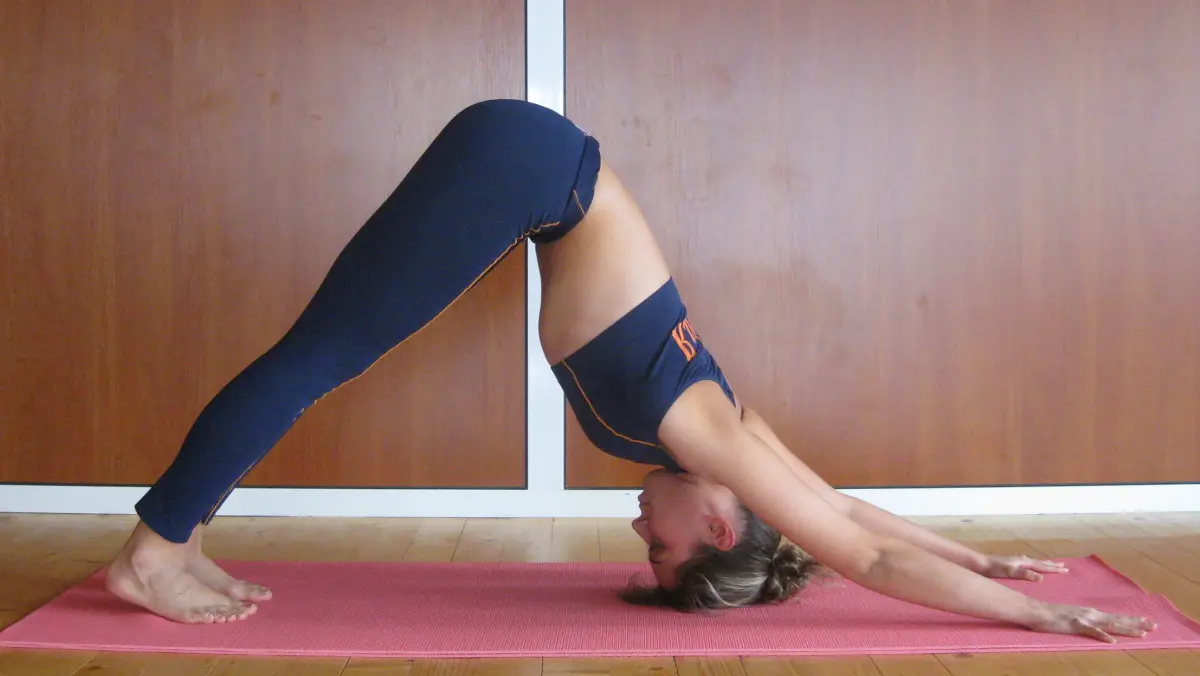
Downward-facing dog (adho mukha śvānāsana) is an inverted V: hands and feet on the floor, hips lifted high, spine long from the wrists to the sitting bones, heels moving towards the floor. Beginners keep the knees bent. Hold five to ten breaths. It is a modern posture, absent from the classical hatha texts, and a step of the sun salutation.
Watch a dog wake up: front paws stretched forward, hindquarters high, a long pull through the back. The pose is named after that stretch, and it has become the most practised posture of modern yoga, the place you return to between movements in a flowing class. It is worth learning slowly, because a good downward dog is mostly a matter of a long spine, not of flexible hamstrings.
Steps
- Come onto hands and knees, the hands a little in front of the shoulders and shoulder-width apart, the knees under the hips.
- Spread the fingers wide, middle fingers pointing forward. Press evenly through the whole hand, especially the knuckles of the index finger and thumb.
- Tuck the toes under. Exhaling, lift the knees and send the hips up and back.
- Keep the knees bent at first and lengthen the spine: belly towards the thighs, sitting bones towards the ceiling.
- Only then, if the back stays long, straighten the legs a little and let the heels move towards the floor.
- Let the head hang between the arms, ears level with the upper arms, neck relaxed. Gaze towards the knees or the navel.
- Breathe five to ten slow breaths. To come out, bend the knees and lower them to the floor, then rest in child's pose.
Alignment
- A straight line runs from the wrists through the shoulders to the hips; the back does not round.
- The shoulder blades widen and move towards the hips; the shoulders do not collapse towards the ears.
- The feet are hip-width apart and parallel; the weight is shared between hands and feet.
Variations
- Bent-knee dog (gentle version): keep the knees generously bent all the time. This is the right version for most beginners.
- Half dog at a chair or a wall: hands on the seat of a stable chair or on the wall at hip height, walk the feet back until the back is horizontal. No weight on the wrists, head not lower than the heart.
- Puppy pose: knees on the floor under the hips, hands walked forward, chest sinking towards the floor.
- Forearm dog (dolphin): forearms on the floor; a preparation for the headstand that spares the wrists but loads the shoulders more.
Contraindications
- Glaucoma, detached retina, recent eye surgery: the head-down position raises eye pressure; prefer the chair version and ask your eye specialist.
- Uncontrolled high blood pressure, history of stroke: avoid long holds with the head down; use the chair version.
- Wrist injury or carpal tunnel syndrome: use the chair or wall version, or the forearms.
- Shoulder injury: keep holds short, with bent knees, or skip.
- Late pregnancy: short holds only, or the wall version, with your midwife's or doctor's agreement.
In the texts
Downward-facing dog is a modern posture. Neither the Hatha Yoga Pradipika nor the Gheranda Samhita describes it, and none of their postures puts the body in this shape. It appears in twentieth-century Indian teaching as part of the sun salutation. An early printed description comes from the Rajah of Aundh's The Ten-Point Way to Health (London, 1938), where position four of the salutation reads: "Your body should form an inverted V." The same page warns: "Do not at first try to force your heels on to the floor or you will lame yourself." Nearly ninety years later, it is still the best advice.
Related postures
Downward dog follows the cobra and leads to plank and chaturanga in the sun salutation. It also prepares the headstand through the dolphin. Its counter-pose is child's pose or a calm seat in vajrāsana. New to yoga? Start with the basic poses for beginners. All the cards: the asanas chapter.
Questions people ask
My heels do not touch the floor. Is that a problem?
No. Most people's heels stay off the floor, sometimes for years. A long spine matters more than straight legs: bend the knees and let the heels point down without forcing.
Is downward dog an inversion?
A mild one: the head is below the heart. A 2015 study measured a clear rise in eye pressure in this pose, so people with glaucoma should ask their eye doctor and keep holds short or use the chair version.
Why do my wrists hurt in downward dog?
Usually because too much weight sits in the heels of the hands. Spread the fingers, press through the knuckles and fingertips, and send the hips further back so the legs carry more of the load.
Sources
- Rajah of Aundh (Bhawanrao Pant Pratinidhi), The Ten-Point Way to Health: Surya Namaskars, ed. Louise Morgan, J. M. Dent, London, 1938 (1956 reprint), Internet Archive checked October 16, 2026
- Jasien JV, Jonas JB, de Moraes CG, Ritch R. Intraocular pressure rise in subjects with and without glaucoma during four common yoga positions. PLoS One, 2015 DOI 10.1371/journal.pone.0144505 PMID 26698309 checked October 16, 2026
- Gheraṇḍasaṃhitā, Sanskrit text, chapter 2 (GRETIL, University of Göttingen) checked October 16, 2026
Practise gently and within your limits. Yoga is learnt best with a qualified teacher; this page does not replace one.