Hanumānāsana, the splits, and the leap of Hanumān
3 min read · Updated October 16, 2026 · sources checked October 16, 2026
- Sanskrit
- हनुमानासनHanumānāsana
- Meaning of the name
- Pose of Hanumān: Hanumān, the monkey hero of the Rāmāyaṇa, whose name means having a (broken) jaw, and āsana, posture
- Level
- Advanced
- Family
- Hip opener and forward stretch
- In the texts
- Modern posture; Hanumān's leap in the Rāmāyaṇa (critical edition 4.65, 5.1)
In short
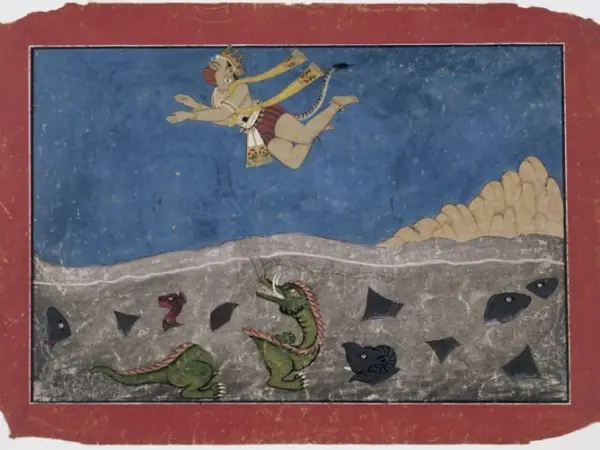
Hanumānāsana is the front splits: one leg stretched forward, the other back, hips square and lowered towards the floor, often with the arms raised. It is an advanced, modern posture to approach over months with blocks under the hips. Its name honours Hanumān, the monkey hero who, in the Rāmāyaṇa, leaps across the ocean to Laṅkā in search of Sītā.
Hanumān is perhaps the most loved figure of the Rāmāyaṇa: son of the Wind, servant and friend of Rāma, strong, humble, devoted. Across India his image stands in temples, by roadsides and on the ghats of Rishikesh, and many devotees sing the Hanumān Cālīsā on Tuesdays. The posture that bears his name stretches the body as he stretched across the ocean: one leg reaching towards Laṅkā, the other still on the shore.
Steps
- Warm up for ten to fifteen minutes: sun salutations, low lunges, and a hamstring stretch.
- Kneel, then step the right foot forward into a low lunge. Place a block on each side of the front leg.
- Shift the hips back and straighten the front leg, toes pointing up, hands on the blocks. Stay here a few breaths: this is the half splits.
- Slowly slide the right heel forward and the left knee back, lowering the hips, the weight in the hands.
- Place a bolster or a stack of blocks under the hips before you need it, so that you can rest on it.
- Keep the hips square: the back knee points to the floor, the front kneecap to the ceiling. If it is comfortable, raise the arms overhead.
- Breathe five to ten slow breaths. Come out the way you came in, hands on the blocks, and repeat on the other side.
Alignment
- The hips face forward; the back hip does not open to the side.
- The front kneecap points up; the back kneecap points down.
- The pelvis rests on support rather than hanging in the stretch.
- The breath is slow and free; a held breath means you have gone too far.
Variations
- Half splits (gentle version): back knee on the floor, front leg straight, hands on blocks. A complete posture in itself.
- Supported splits: a bolster or blocks under the front thigh and the hips, at a height where you can stay calm for a minute.
- Lunge with a twist or a raised back foot as preparation.
- Lying hamstring stretch with a strap: on the back, one leg raised with a strap around the foot; the safest preparation.
Contraindications
- Hamstring tear or groin strain, recent or old: avoid, or keep to the half splits without pain.
- Sacroiliac pain, lower-back pain: avoid.
- Hip replacement: ask your surgeon.
- Pregnancy: avoid deep splits; the hormones of pregnancy loosen the ligaments.
- Knee pain: pad the back knee with a blanket and keep the front knee slightly bent.
In the texts
Hanumānāsana is a modern posture, absent from the classical hatha texts. It appears in twentieth-century Indian teaching and is described, for example, in B. K. S. Iyengar's Light on Yoga (1966). A detail of Sanskrit: the stem of the name is hanumat, so the regular compound would be hanumad-āsana; the usual form hanumānāsana is built on the nominative Hanumān. Everyone uses it, and it is the name we keep.
The name: a broken jaw
The Rāmāyaṇa explains the name itself. The bear-king Jāmbavān reminds Hanumān of his childhood, son of the Wind and of Añjanā:
अभ्युत्थितं ततः सूर्यं बालो दृष्ट्वा महावने । फलं चेति जिघृक्षुस्त्वमुत्प्लुत्याभ्यपतो दिवम् ॥
abhyutthitaṃ tataḥ sūryaṃ bālo dṛṣṭvā mahāvane | phalaṃ ceti jighṛkṣus tvam utplutyābhyapato divam ||
Then, as a child in the great forest, you saw the sun rising and, wanting to seize it, thinking it was a fruit, you leapt and flew up into the sky.
Indra struck the child with his thunderbolt, and "his left jaw (hanu) was broken on a mountain peak; that is why you are known by the name Hanumān" (4.65.21-22). The Monier-Williams dictionary, for its part, glosses hanumat as "having (large) jaws": either way, the name is about the jaw.
The leap
In the first chapter of the Sundara Kāṇḍa, Hanumān climbs Mount Mahendra, joins his palms to the sun, to Indra, to the Wind his father and to the Self-born, then gathers himself for the leap. The text describes his preparation almost like a yoga posture: he braces his arms, sinks at the waist, draws in his feet (5.1.32), and then:
मार्गमालोकयन्दूरादूर्ध्वप्रणिहितेक्षणः । रुरोध हृदये प्राणानाकाशमवलोकयन् ॥
mārgam ālokayan dūrād ūrdhva-praṇihitekṣaṇaḥ | rurodha hṛdaye prāṇān ākāśam avalokayan ||
Looking at his path from afar, his eyes fixed upward, gazing at the sky, he held the breath within his heart.
Making a firm stance with his feet and folding back his ears, he tells the monkeys: "As an arrow released by Rāghava goes with the speed of the wind, so I shall go to Laṅkā, ruled by Rāvaṇa" (5.1.35-36). A firm base, a held breath, a fixed gaze, a body sent forward like an arrow: whoever named the splits after Hanumān chose well.
Related postures
Prepare with low lunges, Warrior I, the seated forward bend and the pigeon. Another posture born of an epic hero: Vīrabhadrāsana. More stories in the meaning of pose names. All the cards: the asanas chapter.
Questions people ask
How long does it take to do the splits?
For most adults, months or years of regular practice, and some bodies never reach the floor. With blocks under the hips, the posture is complete at any height: the floor is not the goal.
Should I warm up before hanumanasana?
Always. Ten to fifteen minutes of sun salutations, lunges and hamstring stretches. Never go into the splits cold, and never bounce.
Why is it called Hanumanasana?
Because the shape recalls Hanumān's great leap across the ocean in the Rāmāyaṇa, one leg reaching forward, the other trailing behind. The name is modern, but the story is the epic's.
Sources
- Vālmīki, Rāmāyaṇa, Sanskrit text of the critical edition, books 4 and 5 (GRETIL, University of Göttingen) checked October 16, 2026
- Monier-Williams, Sanskrit-English Dictionary (1899), entries hanu and hanumat, Cologne Digital Sanskrit Dictionaries checked October 16, 2026
- Hanuman leaps across the ocean, folio from the Guler Rāmāyaṇa series, attributed to Pandit Seu (Wikimedia Commons, public domain) checked October 16, 2026
Practise gently and within your limits. Yoga is learnt best with a qualified teacher; this page does not replace one.