Vīrabhadrāsana I, Warrior I, and the story of Vīrabhadra
4 min read · Updated October 16, 2026 · sources checked October 16, 2026
- Sanskrit
- वीरभद्रासनVīrabhadrāsana
- Meaning of the name
- Pose of Vīrabhadra: vīra, hero, bhadra, auspicious or excellent, the name of the warrior born from Śiva's anger, and āsana, posture
- Level
- Beginner
- Family
- Standing
- In the texts
- Modern posture; Vīrabhadra's story in the Bhāgavata Purāṇa 4.4-4.7
In short
Vīrabhadrāsana I, Warrior I, is a standing lunge: front knee bent over the ankle, back leg straight with the heel grounded, hips and chest facing forward, arms raised overhead. Hold five breaths on each side. The pose is modern, but its name honours Vīrabhadra, the warrior Śiva created to avenge the death of Satī at Dakṣa's sacrifice.
Few postures carry a story as dramatic as this one. Warrior I is a simple, strong lunge, practised in almost every class; its name points to one of the most powerful episodes of Purāṇic literature, a tale of insult, grief, yoga and fury, ending in forgiveness.
Steps
- Stand in mountain pose. Step the left foot back about a leg's length, or a little less.
- Turn the back foot in about 45 degrees and press its outer edge and heel into the floor. The front foot points straight ahead.
- Square the hips towards the front of the mat as far as is comfortable; the back hip moves forward, the front hip back.
- Exhaling, bend the front knee until it is above the ankle, ideally with the thigh approaching parallel to the floor.
- Inhaling, raise the arms overhead, shoulder-width apart, palms facing, or join the palms if the shoulders allow.
- Lift the chest, lengthen the lower back, let the shoulders drop away from the ears. Look forward, or up at the hands if the neck is at ease.
- Hold three to five breaths. Straighten the front leg, lower the arms, step forward and repeat on the other side.
Alignment
- The front knee stays over the ankle and in line with the second toe; it never collapses inward.
- The back leg is straight and strong; the back heel stays grounded.
- The tailbone drops slightly so that the lower back lengthens instead of arching.
- The ribs do not flare forward as the arms rise.
Variations
- Gentle version, hands on the hips: shorter stance, front knee bent less, hands on the hips. Ideal to learn the alignment.
- High lunge: back heel lifted, back foot pointing forward; easier for the hips and lower back.
- With a chair: sit on the edge of a chair, one leg forward with the knee bent, the other leg extended back to the side of the seat; arms up.
- Hands at the heart in añjali mudrā if the shoulders are tight.
- Warrior II: the hips and arms open to the side, the next pose in many sequences.
Contraindications
- High blood pressure or heart disease: keep the arms down or the hands on the hips, and the stay short.
- Knee pain: bend the front knee less and shorten the stance.
- Shoulder injury: hands on the hips or at the heart.
- Lower-back pain: use the high lunge with the back heel lifted.
- Balance problems: practise with a chair or a wall within reach.
In the texts
Warrior I is a modern posture: no classical hatha text describes it. The three warrior poses are found in twentieth-century Indian teaching and are set out, for example, in B. K. S. Iyengar's Light on Yoga (1966). The posture is named after a figure of the Purāṇas, and its story is told in full in the fourth book of the Bhāgavata Purāṇa, which we summarise here from the Sanskrit.
Satī at her father's sacrifice
Dakṣa, a patriarch of creation, holds a great sacrifice and does not invite his son-in-law Śiva, whom he despises. His daughter Satī, Śiva's wife, goes anyway and hears her father insult her husband before the gods. Unable to bear it, she sits in silence facing north, and the text describes a yogi's death: having mastered posture (jitāsanā), she balances the inward and outward breaths, raises the upward breath from the navel to the heart, the throat and the point between the eyebrows, and her body blazes up "by the fire of samādhi" (4.4.24-27).
The lock of hair
When the sage Nārada brings the news, Śiva's anger has no limit:
क्रुद्धः सुदष्टौष्ठपुटः स धूर्जटिर्जटां तडिद्वह्निसटोग्ररोचिषम् । उत्कृत्य रुद्रः सहसोत्थितो हसन्गम्भीरनादो विससर्ज तां भुवि ॥
kruddhaḥ sudaṣṭauṣṭha-puṭaḥ sa dhūr-jaṭir jaṭāṃ taḍid-vahni-saṭogra-rociṣam | utkṛtya rudraḥ sahasotthito hasan gambhīra-nādo visasarja tāṃ bhuvi ||
Enraged, biting his lips, the one with matted locks tore out a lock of hair blazing fiercely like lightning and fire; rising at once with a laugh and a deep roar, Rudra cast it on the ground.
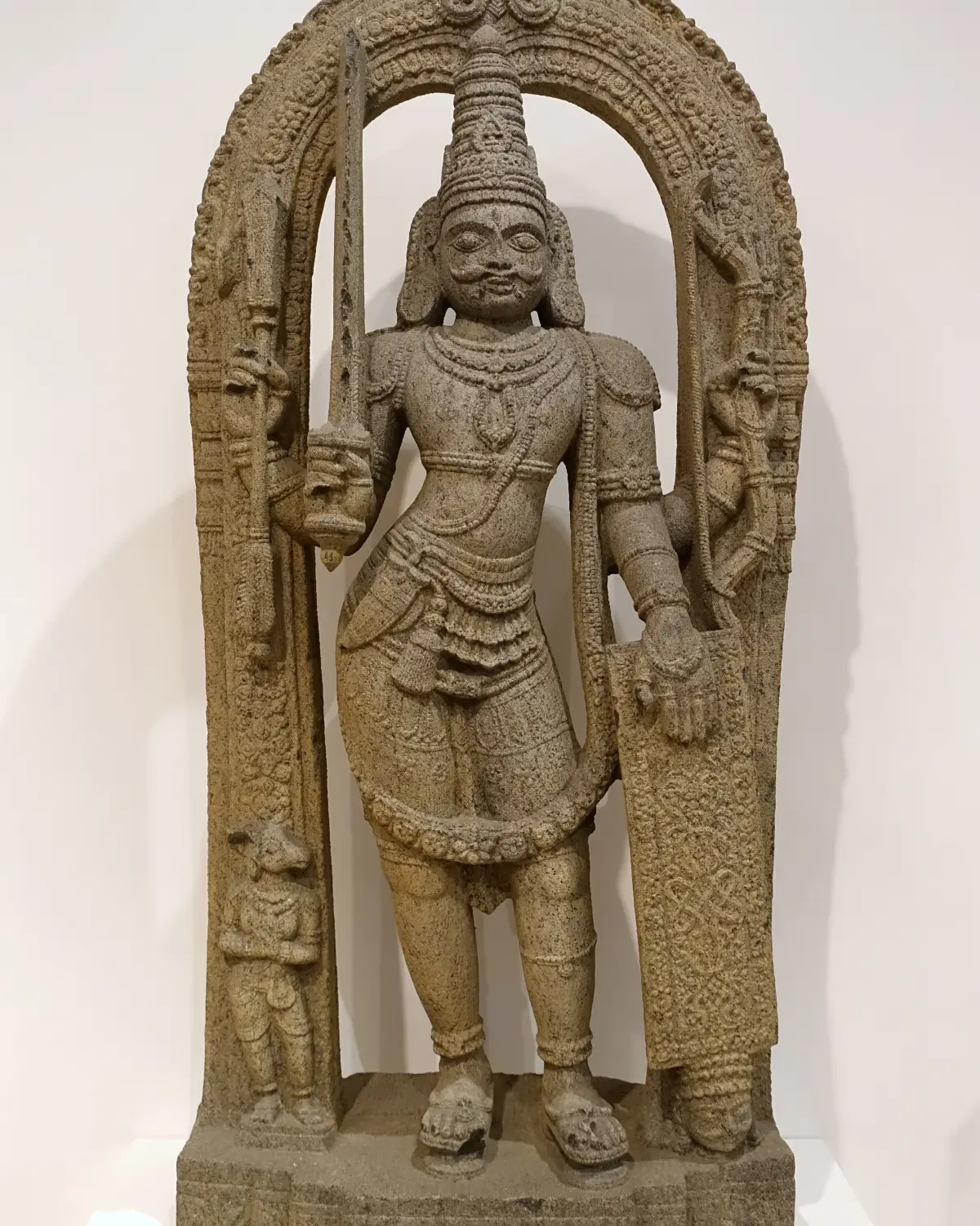
From it rises a giant who touches the sky, with a thousand arms and three blazing eyes, a garland of skulls and raised weapons (4.5.3). Hands joined, he asks: "What shall I do?" Śiva answers: "Destroy Dakṣa and his sacrifice; you are the chief of my warriors, a portion of myself" (4.5.4). In the battle that follows, the text names him: "Vīrabhadra seized Dakṣa" (4.5.17). The sacrifice is ruined and Dakṣa's head is cut off (4.5.22-26).
Forgiveness
The story does not end in vengeance. The gods appeal to Śiva, who, once appeased, restores the sacrifice and gives Dakṣa the head of a goat (4.7.3). Other Purāṇas, such as the Śiva Purāṇa, tell the episode with differences of detail. The posture shows the warrior rising, arms lifted, solidly rooted: modern teachers often describe the arms as the raised sword. That image is a teaching device, not a text.
Related postures
Warrior I follows mountain pose and pairs with the triangle; Hanumānāsana is another posture named after an epic hero. Discover more stories in the meaning of pose names, and start a first practice with the basic poses for beginners. All the cards: the asanas chapter.
Questions people ask
What is the difference between Warrior I and Warrior II?
In Warrior I, the hips and chest face the front of the mat and the arms rise overhead. In Warrior II, the hips and chest open to the side and the arms stretch out at shoulder height over the legs.
Should my back heel be on the floor in Warrior I?
In the classic form, yes, with the back foot turned in about 45 degrees. If the heel lifts or the lower back pinches, shorten the stance or practise the high-lunge version with the back heel lifted.
Who is Virabhadra?
A fierce form of Śiva. In the Bhāgavata Purāṇa, Śiva tears out a lock of his matted hair after Satī's death, and from it arises a giant warrior who destroys Dakṣa's sacrifice. Other Purāṇas tell the story with variations.
Sources
- Bhāgavata Purāṇa, Sanskrit text, book 4, chapters 4 to 7 (GRETIL, University of Göttingen) checked October 16, 2026
- Monier-Williams, Sanskrit-English Dictionary (1899), entry vīrabhadra, Cologne Digital Sanskrit Dictionaries checked October 16, 2026
- Virabhadra, Karnataka, 16th century, stone, Dallas Museum of Art (photograph, Wikimedia Commons) checked October 16, 2026
Practise gently and within your limits. Yoga is learnt best with a qualified teacher; this page does not replace one.