Śalabhāsana, the locust pose
3 min read · Updated October 17, 2026 · sources checked October 17, 2026
- Sanskrit
- शलभासनŚalabhāsana
- Meaning of the name
- Locust pose: śalabha, locust or grasshopper, and āsana, posture
- Level
- Beginner
- Family
- Backbend
- In the texts
- Gheranda Samhita 2.39 (Vasu, 1914-1915)
In short
Śalabhāsana, the locust pose, is a backbend lying on the belly: arms alongside the body, palms or fists pressing the floor, you lift both straight legs a little way off the ground while the chin stays down, like a grasshopper raising its tail. Hold three to five breaths. Beginners lift one leg at a time, the half locust.
The śalabha is the locust or grasshopper; the Monier-Williams dictionary adds "a kind of moth". Watch a grasshopper at rest and you will see the posture: the body flat, the long back legs and tail lifted. Of all backbends this is the most modest-looking and one of the most useful, because it asks the muscles of the back to do the work rather than the joints.
Steps
- Lie on the belly, chin or forehead on the mat, legs together and straight, tops of the feet on the floor.
- Place the arms alongside the body, palms down, or make fists and slide them under the front of the thighs (the Sivananda way).
- Lengthen the legs back, as if someone were gently pulling your feet.
- Breathing in, lift both legs off the floor, straight and together, keeping the hips and the chin on the floor.
- Stay three to five slow breaths, breathing through the nose. Do not hold the breath.
- Breathing out, lower the legs slowly. Rest with the head turned to one side and the arms relaxed.
- Two or three times in all.
Alignment
- The legs reach back before they rise: length first, height after.
- The buttocks firm, but the lower back does not pinch; if it does, lift less.
- The neck stays long, chin on the floor, without jamming the back of the neck.
- The hands press down evenly; the shoulders stay away from the ears.
Variations
- Half locust (gentle version): lift one leg at a time, a few centimetres, three breaths, then change sides. This is where beginners start.
- Upper-body locust: legs on the floor, lift the chest, head and arms, arms reaching back along the body or forward like wings.
- Full modern locust (intermediate): legs and chest lifted together, the arms reaching back.
- With a folded blanket under the hips, if the pubic bone or the hips press uncomfortably on the floor.
Common mistakes
- Lifting as high as possible. Height comes from the lower back pinching; length comes from the legs reaching back. Choose length.
- Holding the breath to get the legs up. Keep the breath flowing through the nose.
- Bending the knees to gain a few centimetres. Keep the legs straight and lift less.
- Throwing the head back. The chin, or the forehead, stays on the mat.
- Rushing the descent. Lower the legs as slowly as you lifted them.
Contraindications
- Pregnancy: avoid any posture lying on the belly.
- Recent abdominal surgery, a hernia, or an inflammatory bowel disease in a painful phase: avoid.
- Back injury, spondylolisthesis or acute lower back pain: practise only the half locust, very low, or not at all; ask your doctor or physiotherapist.
- High blood pressure or heart disease: lift only a little and never hold the breath; strain with the breath held raises blood pressure.
- Neck pain: rest the forehead on a folded towel rather than the chin.
In the texts
The locust is one of the postures of the Gheraṇḍa Saṃhitā, which counts it among its thirty-two (2.5-2.6). It does not appear in the Hatha Yoga Pradipika. The verse that describes it reads, in Vasu's translation: "Lie on the ground face downwards, the two hands being placed on the chest, touching the ground with the palms, raise the legs in the air one cubit high. This is called the Locust-posture" (2.39, Vasu, 1914-1915).
One detail is worth correcting. The Sanskrit text on GRETIL says the feet are raised vitasti, a span, the distance between the stretched thumb and little finger, about a dozen finger-breadths, not a cubit. A span is a much gentler lift than a cubit, and it is the right height for most people.
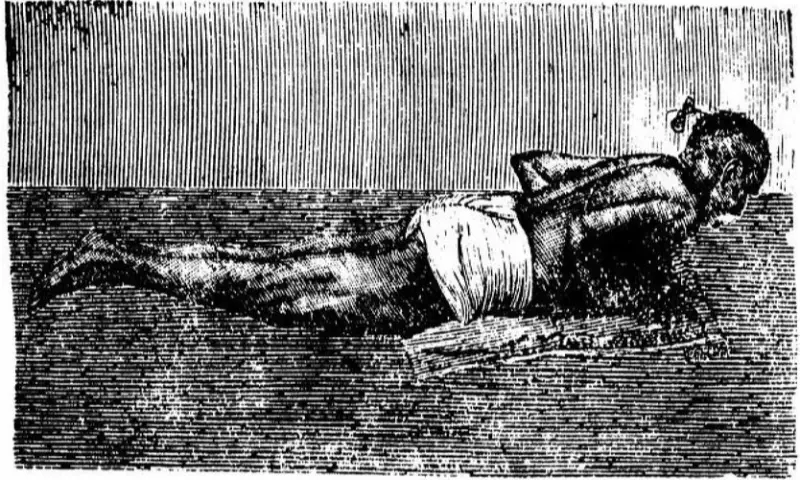
The locust also kept its place in the modern Indian schools. A yoga manual printed in India in 1905, the Yogasopana Purvacatuska, already showed an engraving of it (shown above), and in the Sivananda centres it is the seventh of the twelve basic postures, between the cobra and the bow.
Related postures
Before: the cobra, which lifts the chest, the natural partner of the locust which lifts the legs. After: the bow, which joins the two movements, then a rest in child's pose or a gentle forward bend. For the place of backbends in a practice, see the wheel and yoga for back pain. All the cards: the asanas chapter.
Questions people ask
Is locust pose good for beginners?
Yes, in its half form: lifting one leg at a time, a few centimetres, is one of the gentlest ways into backbends. Lift both legs only when the half locust is easy and the lower back is comfortable.
Should I hold my breath in locust pose?
No. Many people hold the breath to lift the legs higher. Keep breathing slowly through the nose; if you cannot, the lift is too high.
How high should the legs go?
Not high. The Gheranda Samhita says a span, about twenty centimetres. Length matters more than height: reach the legs back as they rise.
Sources
- Srisa Chandra Vasu (tr.), The Gheranda Samhita, Sacred Books of the Hindus vol. XV (1914-1915), lesson 2, verse 39, Internet Archive checked October 17, 2026
- Gheraṇḍasaṃhitā, Sanskrit text, chapter 2 (GRETIL, University of Göttingen) checked October 17, 2026
- The 12 Basic Asanas, International Sivananda Yoga Vedanta Centres (official site) checked October 17, 2026
- Salabhasana in Yogasopana Purvacatuska (1905), Wikimedia Commons, public domain checked October 17, 2026
- Monier-Williams, Sanskrit-English Dictionary (1899), entries śalabha and vitasti, Cologne Digital Sanskrit Dictionaries checked October 17, 2026
Practise gently and within your limits. Yoga is learnt best with a qualified teacher; this page does not replace one.