Matsyāsana, the fish pose
4 min read · Updated October 17, 2026 · sources checked October 17, 2026
- Sanskrit
- मत्स्यासनMatsyāsana
- Meaning of the name
- Fish pose: matsya, fish (also Viṣṇu's first incarnation), and āsana, posture
- Level
- Intermediate
- Family
- Backbend
- In the texts
- Gheranda Samhita 2.21 (Vasu, 1914-1915)
In short
Matsyāsana, the fish pose, is a backbend lying on the back: with the hands under the hips and the forearms pressing down, you lift the chest and let the crown of the head rest lightly on the floor, almost without weight. Hold three to five breaths, then lift the head before lowering the chest. With a neck problem, lie back over a bolster instead.
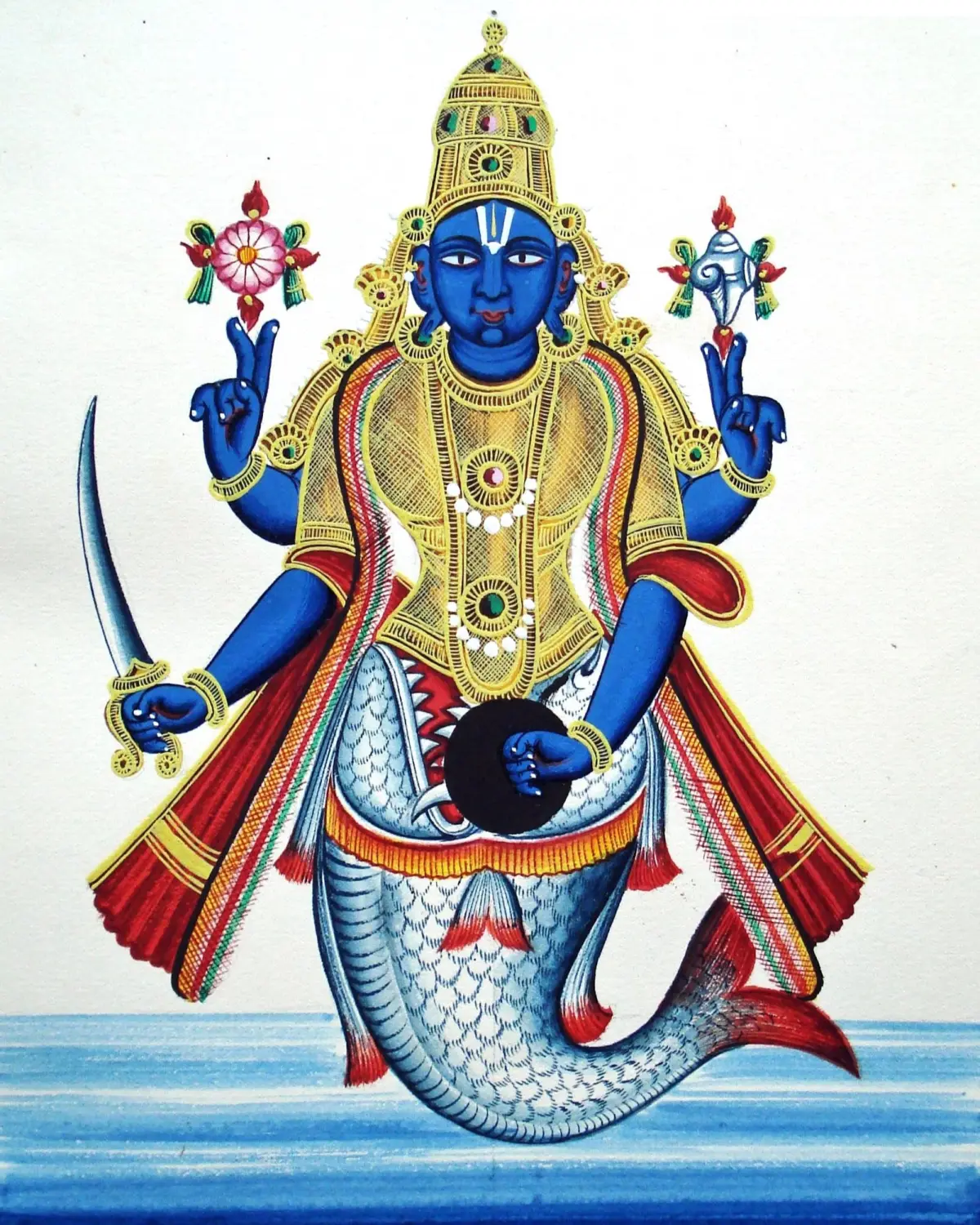
Matsya is the fish. In Indian sacred history it is also the first form Viṣṇu takes to save the world. The posture that bears its name is a quiet backbend lying on the floor, the chest lifted like the curve of a leaping fish. It is easier than it looks, as long as the neck is respected.
Steps
- Lie on your back, legs straight and together, arms alongside the body.
- Lift the hips slightly and slide the hands under them, palms down, or under the thighs. Bring the elbows close to the body.
- Pressing the forearms and elbows into the floor, breathe in and lift the chest, arching the upper back.
- Let the head tilt back and the crown come to rest lightly on the floor. The weight stays on the forearms, not on the head.
- Keep the legs active and the feet relaxed. Breathe slowly into the open chest, three to five breaths.
- To come out, press the forearms down, lift the head first, then lower the back and the head to the floor.
- Rest a few breaths, knees bent if the lower back asks for it.
Alignment
- The arch comes from the upper back and the breastbone, not from the lower back.
- The elbows stay close to the body, like the fins of a fish.
- The throat stays soft; if you cannot swallow comfortably, the head is tilted too far.
Variations
- Supported fish (gentle version): lie back over a bolster or two folded blankets placed lengthwise under the shoulder blades, the head resting on a blanket. Arms open to the sides. Stay one to five minutes.
- With a block under the head: as in the steps, but the crown rests on a block, so the neck does not have to extend fully.
- Legs crossed: the same posture with the legs in a simple cross-legged position.
- Classical form (advanced): in the lotus, lie back carefully with the help of the elbows and fold the arms above the head, as the Gheraṇḍa Saṃhitā describes. Never force the lotus.
Contraindications
- Neck injury, cervical arthritis or recent neck pain: use only the supported version, head resting.
- Lower back pain or spondylolisthesis: keep the arch small, or use the supported version.
- High or low blood pressure, glaucoma or a detached retina: avoid letting the head hang back; use the supported version and come out slowly.
- Migraine or dizziness when tilting the head back: do not practise the arched form.
- Knee problems: do not attempt the lotus form.
- Pregnancy: in the later months lying flat on the back may be uncomfortable; ask your midwife and prefer a supported, inclined version.
In the texts
The fish appears among the thirty-two postures of the Gheraṇḍa Saṃhitā, but not among the fifteen of the Hatha Yoga Pradipika (whose "fish" posture is the twist of the sage Matsyendra, see the seated twist).
मुक्तपद्मासनं कृत्वा उत्तानशयनं चरेत् । कूर्पराभ्यां शिरो वेष्ट्य मत्स्यासनं तु रोगहा ॥
mukta-padmāsanaṃ kṛtvā uttāna-śayanaṃ caret | kūrparābhyāṃ śiro veṣṭya matsyāsanaṃ tu rogahā ||
Taking the free lotus, lie on the back, encircling the head with the elbows: this is matsyāsana, which removes disease.
Vasu's 1914-1915 translation reads: "Make the Padmasana-posture (as stated in verse 8) without the crossing of the arms; lie on the back, holding the head by the two elbows. This is the Matsyasana (Fish-posture), the destroyer of diseases." The "free" lotus is the lotus without the arms crossed behind the back to hold the feet. This is a resting posture on the back, not the arched one taught today; the modern form, with the chest lifted and the crown on the floor, was standardised in twentieth-century Indian schools. In the Sivananda centres it is the fourth of the twelve basic postures, right after the plough.
Matsya, the fish who saved the Vedas
The Bhāgavata Purāṇa tells the story (8.24). At the end of an age, while Brahmā sleeps, the demon Hayagrīva steals the Vedas from his mouth. Viṣṇu takes the form of a tiny fish, a śapharī, and appears in the joined hands of the king Satyavrata as he makes a water offering in the Kṛtamālā river (8.24.9-13). The fish asks for protection, grows too large for every vessel, and warns the king of the coming flood. When the waters rise, a golden fish with a single horn appears; the king ties his boat to the horn with a great serpent as a rope, and the fish teaches him the truth as it carries the boat through the ocean (8.24.44-54). Viṣṇu then kills Hayagrīva and returns the Vedas (8.24.57). It is a lovely image to hold in the posture: a lifted chest, carried by the floor as the boat was carried by the fish.
Related postures
Before: the shoulder stand and the plough, to which the fish is the classical counter-pose. Also gentle as a heart opener after the bridge. After: a simple forward bend such as the seated forward bend, then śavāsana. All the cards: the asanas chapter.
Questions people ask
Why is fish pose done after shoulder stand?
Shoulder stand and plough flex the neck strongly; the fish arches it the other way and opens the chest. That is why the Sivananda sequence places the fish right after them, as a counter-pose.
Should my head carry weight in fish pose?
No. The forearms and elbows carry the body; the crown only touches the floor. If the neck feels compressed, place a block or a folded blanket under the head, or use the supported version over a bolster.
Is the fish pose in the old texts?
Yes, in a different form. The Gheranda Samhita (2.21) describes lying back from the lotus position and encircling the head with the arms. The modern arched version with the crown on the floor is a twentieth-century development.
Sources
- Srisa Chandra Vasu (tr.), The Gheranda Samhita, Sacred Books of the Hindus vol. XV (1914-1915), lesson 2, verse 21, Internet Archive checked October 17, 2026
- Gheraṇḍasaṃhitā, Sanskrit text, chapter 2 (GRETIL, University of Göttingen) checked October 17, 2026
- Bhāgavata Purāṇa, Sanskrit text, book 8, chapter 24 (GRETIL, University of Göttingen) checked October 17, 2026
- The 12 Basic Asanas, International Sivananda Yoga Vedanta Centres (official site) checked October 17, 2026
- Monier-Williams, Sanskrit-English Dictionary (1899), entry matsya, Cologne Digital Sanskrit Dictionaries checked October 17, 2026
Practise gently and within your limits. Yoga is learnt best with a qualified teacher; this page does not replace one.