उत्तानuttāna · lying on the back, face upward
Supine yoga poses, the postures lying on the back
6 min read · Updated October 20, 2026 · sources checked October 20, 2026 · Editorial: The Yogide team
In short
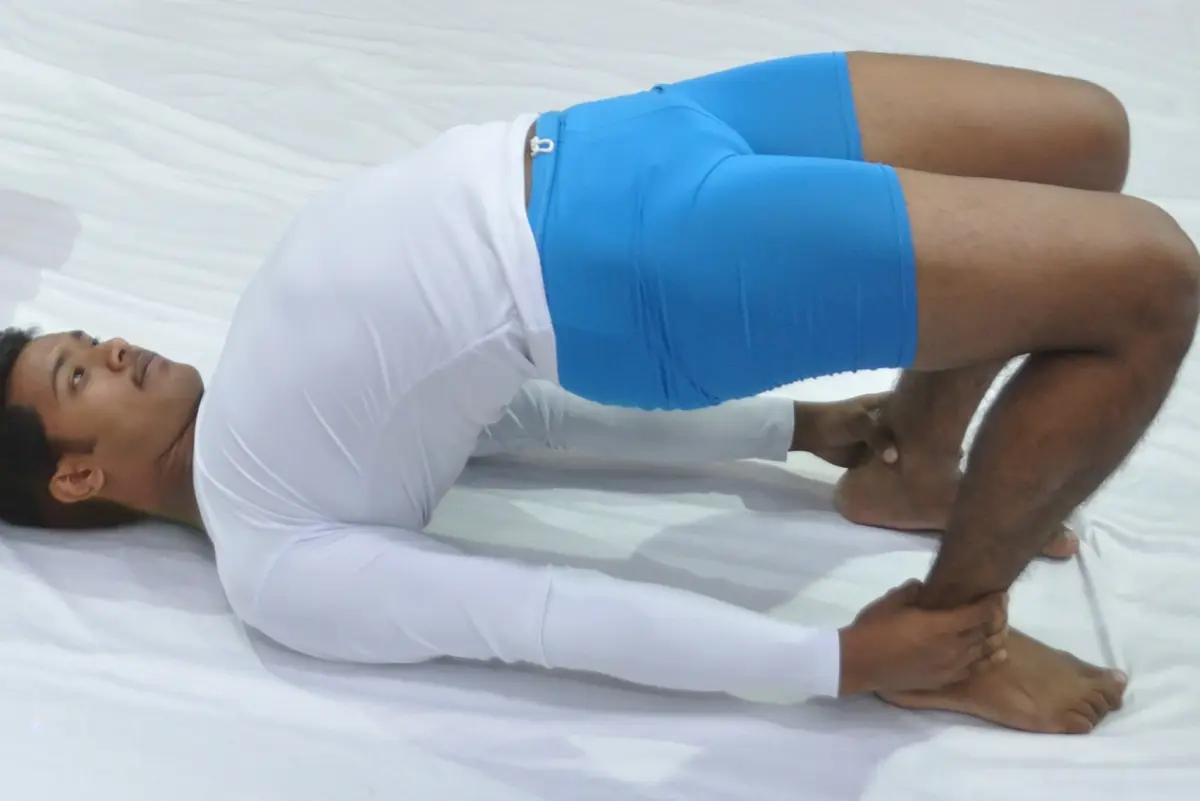
Supine yoga poses are postures done lying on the back, face up. The main ones are corpse pose (śavāsana), knees to chest, reclined twist, happy baby, reclined bound angle, bridge, fish, legs up the wall, plough and shoulderstand. They range from complete rest to inversions, so check each one's precautions, especially for the neck and in later pregnancy.
"Supine" means lying on the back, face upward. Sanskrit has an exact word for it, uttāna, and the hatha texts use it each time they put the yogi on his back. Supine postures are the quietest family of the practice: the floor holds the whole spine, the breath can drop low into the belly, and nothing has to be balanced. They are also where most sessions end.
The supine poses, from rest to inversion
| Pose | Sanskrit | What it asks | Who should adapt it | Level |
|---|---|---|---|---|
| Corpse pose | śavāsana | complete stillness, the body heavy | later pregnancy (lie on the side), reflux | beginner |
| Knees to chest | apānāsana (modern name) | hug both knees, rock gently | knee pain: hold behind the thighs | beginner |
| Reclined twist | jaṭhara parivartanāsana, gentle form | knees fall to one side, shoulders stay down | back pain: knees on a cushion, small range | beginner |
| Happy baby | ānanda bālāsana (modern name) | feet in the air, hands on the feet or shins | later pregnancy, recent hip surgery | beginner |
| Reclined bound angle | supta baddha koṇāsana | soles together, knees open, cushions under them | groin strain, later pregnancy (incline the back) | beginner |
| Reclined hand-to-big-toe | supta pādāṅguṣṭhāsana | one leg raised, a strap around the foot | hamstring injury: keep the knee bent | beginner |
| Bridge | setu bandhāsana | lift the hips from the floor, feet planted | neck pain: keep it low, never turn the head | beginner |
| Legs up the wall | viparīta karaṇī | legs resting up a wall, hips close to it | glaucoma, high blood pressure, later pregnancy | beginner |
| Fish | matsyāsana | arch the chest, top of the head lightly down or supported | neck injury, low-back pain, glaucoma | intermediate |
| Plough | halāsana | legs go over the head, feet towards the floor | neck problems, osteoporosis, glaucoma, pregnancy: avoid | intermediate |
| Shoulderstand | sarvāṅgāsana | body vertical on the shoulders | neck problems, glaucoma, heart disease, pregnancy: ask first | intermediate |
| Reclined hero | supta vīrāsana | kneel, then lie back between the heels | knee or low-back pain: stay upright on a cushion | intermediate |
| Wheel | cakrāsana | push up from the back into a full backbend | neck, wrist, back or heart problems: avoid | advanced |
The postures with a link have their own card, with steps, alignment and the full list of precautions. The others are short, simple shapes described below.
Five simple supine poses, step by step
Knees to chest. Lie on the back, draw both knees towards the chest and hold the shins or the backs of the thighs. Breathe slowly; on each exhalation the knees come a little closer. Rock gently from side to side to massage the lower back. Ten breaths.
Reclined twist. From knees to chest, open the arms in a T, palms down. Let both knees fall slowly to the right, a cushion under them if they do not reach the floor, and turn the head to the left only if the neck is comfortable. Both shoulders stay heavy. Eight breaths, then the other side.
Happy baby. From knees to chest, open the knees wider than the body, lift the soles towards the ceiling and hold the outer edges of the feet, or the shins. The lower back stays long on the floor. Gentle, not a stretch to force. Eight breaths.
Reclined bound angle. Bring the soles of the feet together and let the knees open, a cushion or a folded blanket under each knee. A bolster lengthwise under the back opens the chest. One to five minutes, breathing into the belly: our page on belly breathing explains how.
Reclined hand-to-big-toe. Bend the left knee, foot on the floor. Raise the right leg and loop a strap around the sole. Straighten the leg only as far as the back of the thigh allows, without lifting the hips. Eight breaths, then the other side. It is the safest preparation for the splits.
A short supine sequence to end any practice, or before sleep: knees to chest, reclined twist on each side, legs up the wall for three minutes, then śavāsana for five.
What the texts say about lying on the back
The Haṭhayogapradīpikā and the Gheraṇḍa Saṃhitā describe very few lying postures, and they describe them with the word uttāna. The clearest is the corpse:
उत्तानं शववद्भूमौ शयानं तु शवासनम् । शवासनं श्रमहरं चित्तविश्रान्तिकारणम् ॥
uttānaṃ śavavad bhūmau śayānaṃ tu śavāsanam | śavāsanaṃ śramaharaṃ cittaviśrāntikāraṇam ||
Lying on the ground on the back, like a corpse: this is śavāsana. Śavāsana removes fatigue and brings rest to the mind.
The Haṭhayogapradīpikā says almost the same in 1.34. In the Gheraṇḍa's list of thirty-two postures (2.3-2.6) the same posture is called mṛta, another word for corpse, and Vasu's 1914-1915 translation follows that name: mṛtāsana.
The other "uttāna" postures of the texts are not the rests of a modern class:
- Matsyāsana, the fish (Gheraṇḍa 2.21): lotus legs, lying on the back (uttāna-śayana), the head held by the elbows. Our fish card compares it with today's arched form.
- Uttāna-kūrmaka, the upturned tortoise (Haṭhayogapradīpikā 1.26, Gheraṇḍa 2.33): from the cockerel posture, arms threaded through the lotus legs, one holds the neck and rolls onto the back like a tortoise turned over.
- Uttāna-maṇḍūka, the upturned frog (Gheraṇḍa 2.35): from the frog posture, holding the head with the elbows.
The bridge, the plough, the shoulderstand, the happy baby and the reclined twist are not in these texts. As far as the published sources show, they are modern postures, spread by twentieth-century Indian teaching, and they are no less useful for that. The rest of the families are in the asanas chapter, and the twelve postures to learn first are on basic poses for beginners.
Questions people ask
What does supine mean in yoga?
Lying on the back, face upward. The opposite is prone, lying on the front, as in cobra or locust. Sanskrit has its own word for supine, uttāna, which the Monier-Williams dictionary gives as 'lying on the back, sleeping supinely or with the face upwards'.
Are supine poses good for beginners?
Many are among the easiest: corpse pose, knees to chest, reclined twist and legs up the wall need no strength or balance. Others that start on the back are not beginner postures: plough and shoulderstand load the neck, and the full wheel is an advanced backbend.
Can I do supine poses when pregnant?
From the second half of pregnancy, lying flat on the back is usually not advised: rest on your side, or with the upper body raised on a bolster. Ask your midwife or doctor.
Which supine poses are good before sleep?
The quiet ones: knees to chest, a gentle reclined twist, legs up the wall and a few minutes of śavāsana with a long exhalation. Keep inversions and strong backbends for earlier in the day.
Practise gently and within your limits. Yoga is learnt best with a qualified teacher; this page does not replace one.
Sources
- Svātmārāma, Haṭhayogapradīpikā, Sanskrit text (GRETIL, University of Göttingen), 1.26 and 1.34 checked October 20, 2026
- Gheraṇḍasaṃhitā, Sanskrit text ed. Peter Thomi (GRETIL), 2.19, 2.21, 2.33, 2.35 checked October 20, 2026
- The Gheranda Samhita, translated by Srisa Chandra Vasu, Sacred Books of the Hindus vol. XV (Allahabad, 1914-1915), Internet Archive checked October 20, 2026
- Monier-Williams, Sanskrit-English Dictionary (1899), entry uttāna, Cologne Digital Sanskrit Dictionaries checked October 20, 2026