Diaphragmatic breathing, the belly breath
6 min read · Updated October 20, 2026 · sources checked October 20, 2026 · Editorial: The Yogide team
In short
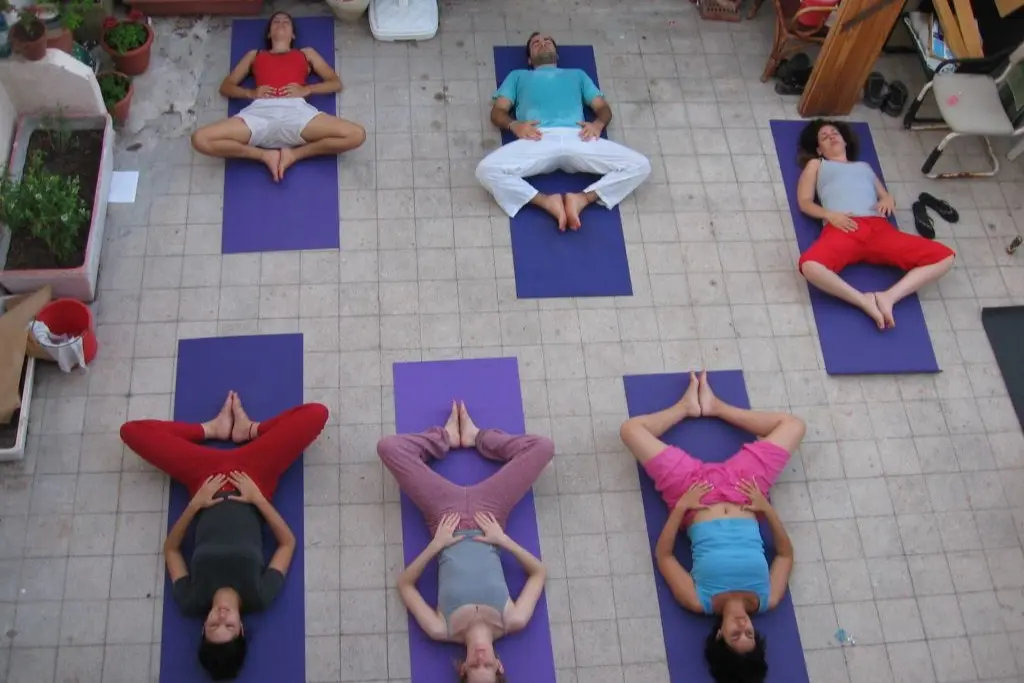
Diaphragmatic breathing, or belly breathing, means letting the diaphragm do the work: the belly rises as you breathe in through the nose and falls as you breathe out, while the chest stays almost still. Learn it lying on your back, one hand on the belly, for five minutes a day. Small studies link it to lower stress; the evidence is promising but limited.
How to do diaphragmatic breathing
- Lie on your back, knees bent, feet flat, a cushion under the head if the chin lifts. Loosen your belt.
- Place one hand on the belly, just above the navel, and the other on the upper chest.
- Breathe in through the nose, slowly. Let the hand on the belly rise; the hand on the chest moves little.
- Breathe out through the nose, a little longer than the inhalation. The belly falls back by itself: no pushing.
- Keep it quiet and small. A breath you could not hear from a metre away is the right size.
- Continue for five minutes, then breathe normally for a minute before getting up.
When this is easy lying down, practise sitting upright on a chair or a cushion, then standing, and finally during ordinary moments of the day: waiting, walking, before speaking.
What happens in the body
The diaphragm is a dome-shaped muscle that separates the chest from the abdomen. When it contracts it flattens and descends, the lungs fill from below, and the abdominal organs are pushed down and forward: the belly rises. When it relaxes, it rises back and the air leaves. The lower ribs also widen sideways; good diaphragmatic breathing is not only "belly", it is a wide, low breath.
Under stress, people tend to breathe faster and higher, with the neck and shoulder muscles. Belly breathing reverses this habit. Done slowly, it also lowers the breathing rate, and slow breathing is the part of the technique that research links most clearly to calm: our page on resonant breathing explains that rhythm.
What the studies show
| Study | Who and what | What it found | How sure |
|---|---|---|---|
| Ma, 2017: randomised trial, Beijing | 40 healthy adults; 20 sessions of diaphragmatic breathing over 8 weeks, with a real-time feedback device, about 4 breaths a minute | Less negative affect and better sustained attention than before training, and lower salivary cortisol, while the control group's cortisol did not change | One small trial, intensive and guided |
| Hopper, 2019: systematic review | Adults practising diaphragmatic breathing alone | Only 3 studies qualified (1 randomised); all showed less stress (cortisol, blood pressure or a stress scale), but they could not be pooled | Promising, very limited |
| Holland, 2012: Cochrane review of breathing exercises in COPD | 16 studies, 1,233 people with COPD | One study of diaphragmatic breathing (30 people): six-minute walk improved by 35 metres; effects on breathlessness and quality of life inconsistent across all breathing exercises | Low; no general role in COPD care |
| Eherer, 2012: randomised trial, Graz | 19 patients with non-erosive reflux or healed oesophagitis; 4 weeks of abdominal breathing training | Less time with acid in the oesophagus and better quality of life; at 9 months, those who kept practising used fewer acid-reducing drugs | One very small trial |
The honest summary: belly breathing is safe, simple and plausibly calming, and several small studies point the same way. It has not been tested in large, long trials, and it treats no disease on its own. It is a skill worth learning, not a cure.
Belly breathing in yoga
The phrase "belly breathing" is modern, and the classical texts do not describe it as a separate technique. What they ask of the breath is a quality. Patañjali defines prāṇāyāma by its effect:
बाह्याभ्यन्तरस्तम्भवृत्तिर्देशकालसंख्याभिः परिदृष्टो दीर्घसूक्ष्मः ॥
bāhyābhyantara-stambha-vṛttir deśa-kāla-saṃkhyābhiḥ paridṛṣṭo dīrgha-sūkṣmaḥ ||
Its movement is outward, inward or held; observed by place, time and number, it becomes long and subtle.
"Long and subtle" is exactly what an unforced diaphragmatic breath allows, and a hurried breath in the upper chest does not. That is why most modern teachers start here: abdominal breathing first, then the full "three-part" breath (belly, ribs, upper chest, in one wave), then the named techniques. You can follow that progression on our page of breathing exercises for beginners, then in pranayama.
Two cautions from yogic practice. Belly breathing is not kapālabhāti, where the belly is pulled in sharply on each exhalation, nor uḍḍīyāna bandha, where it is drawn in and up: both are different, stronger actions. And in yoga the belly is never pushed out by force: the breath is allowed, not made.
Common mistakes
- Pushing the belly out with the abdominal muscles. The belly should rise because the diaphragm descends, not because you inflate it.
- Breathing too deeply. Big, fast breaths can make you lightheaded. Smaller and slower is better.
- Lifting the shoulders on the inhalation. Let them stay heavy.
- Practising only when stressed. The technique works best in a crisis if you have rehearsed it on calm days.
For a guided rhythm, the breathing timer paces each inhalation and exhalation on screen.
Questions people ask
Is diaphragmatic breathing the same as belly breathing?
Yes, the two names describe the same thing. Air never goes into the belly: it goes into the lungs. When the diaphragm, the dome-shaped muscle under the lungs, contracts and descends, it pushes the abdominal organs down and forward, and the belly rises. That visible movement gave the technique its popular name.
How long should I practise belly breathing?
Five to ten minutes a day is a good start. The studies used very different doses, from a single 20-minute session to programmes of several months; the 2017 Beijing trial used 20 guided sessions over 8 weeks. Regular short practice matters more than long sessions.
Should I breathe through the nose or the mouth?
Through the nose, both in and out, unless your nose is blocked. Nasal breathing is slower and easier to keep gentle, and it is the norm in yogic breathing. Some medical protocols exhale through pursed lips, which also lengthens the exhalation.
Can belly breathing help acid reflux?
One small trial suggests it can help. In Graz, 19 patients with non-erosive reflux or healed oesophagitis were randomised; after four weeks of abdominal breathing training, time with acid in the oesophagus fell and quality of life improved. That is one trial of 19 people: talk to your doctor, and do not stop your treatment.
Why does my chest move more than my belly?
Because stress, tight clothing, sitting slumped or a habit of pulling the belly in all push the breath upward. Practise lying on your back with knees bent for a few days: in that position the belly moves more easily. Never force the belly out; let it rise.
Yogide explains what the texts and the studies say; it is not medical advice. If you have a health condition, are pregnant or feel pain, talk to your doctor before practising, and stop any posture that hurts.
Sources
- Ma X, Yue ZQ, Gong ZQ et al. The Effect of Diaphragmatic Breathing on Attention, Negative Affect and Stress in Healthy Adults. Frontiers in Psychology, 2017 DOI 10.3389/fpsyg.2017.00874 PMID 28626434 checked October 20, 2026
- Hopper SI, Murray SL, Ferrara LR, Singleton JK. Effectiveness of diaphragmatic breathing for reducing physiological and psychological stress in adults: a quantitative systematic review. JBI Database of Systematic Reviews and Implementation Reports, 2019 DOI 10.11124/JBISRIR-2017-003848 PMID 31436595 checked October 20, 2026
- Holland AE, Hill CJ, Jones AY, McDonald CF. Breathing exercises for chronic obstructive pulmonary disease. Cochrane Database of Systematic Reviews, 2012 DOI 10.1002/14651858.CD008250.pub2 PMID 23076942 checked October 20, 2026
- Eherer AJ, Netolitzky F, Högenauer C et al. Positive effect of abdominal breathing exercise on gastroesophageal reflux disease: a randomized, controlled study. American Journal of Gastroenterology, 2012 DOI 10.1038/ajg.2011.420 PMID 22146488 checked October 20, 2026
- Patañjali, Yogasūtra, Sanskrit text (GRETIL, University of Göttingen), 2.50 checked October 20, 2026