Vṛkṣāsana, the tree pose
6 min read · Updated October 20, 2026 · sources checked October 20, 2026 · Editorial: The Yogide team
- Sanskrit
- वृक्षासनVṛkṣāsana
- Meaning of the name
- Tree pose: vṛkṣa, tree, and āsana, posture
- Level
- Beginner
- Family
- Standing balance
- In the texts
- Gheranda Samhita 2.36 (Vasu, 1914-1915)
In short
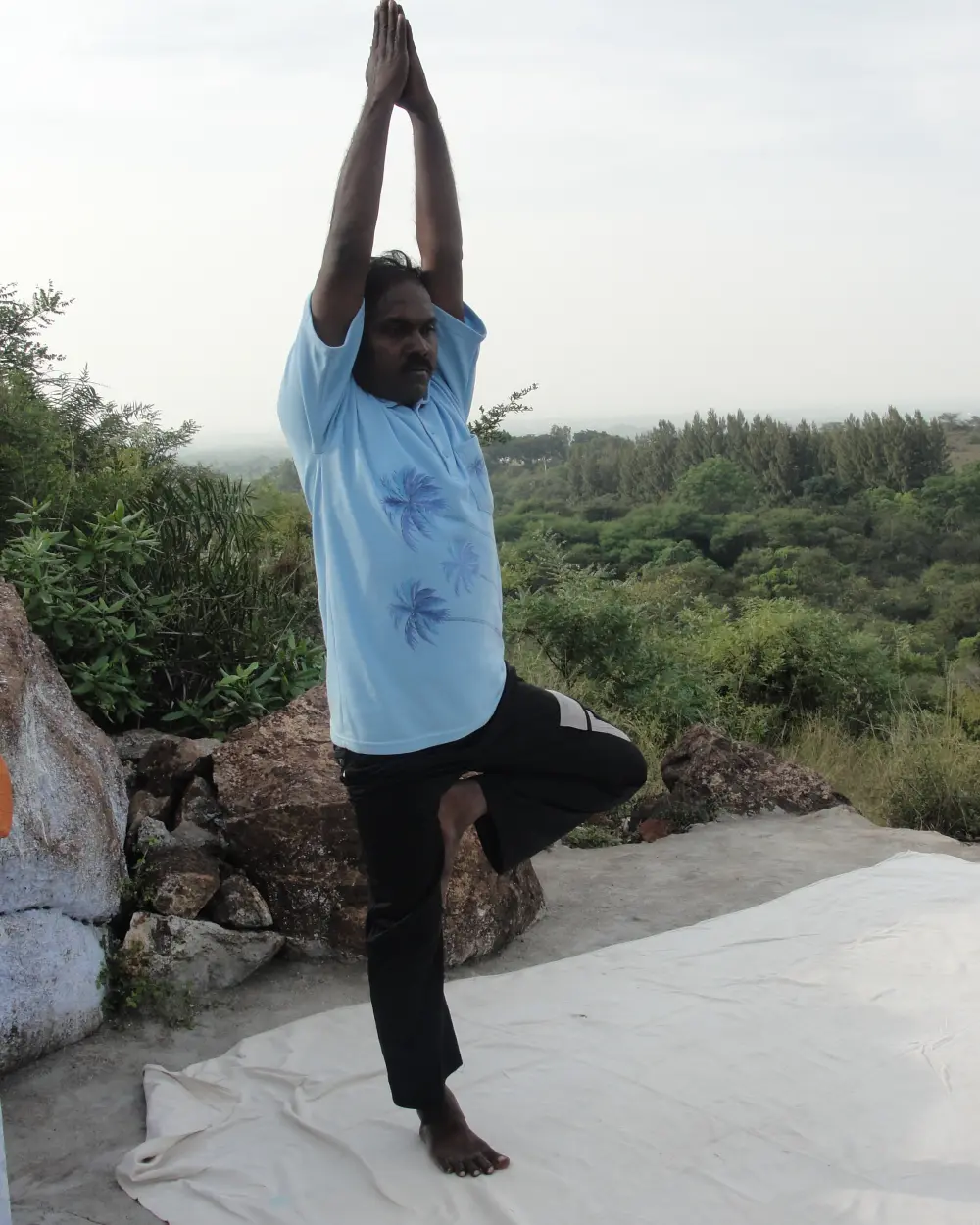
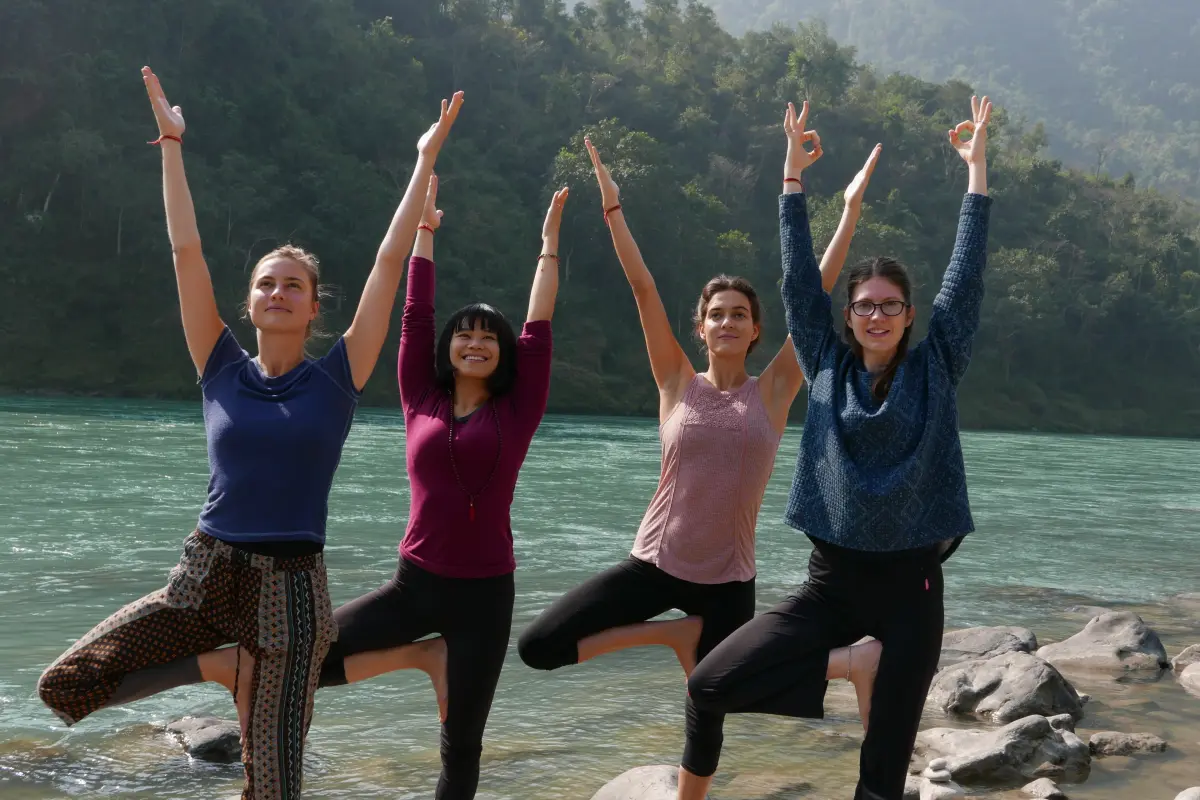
Vṛkṣāsana, the tree pose, is a balance on one leg: the sole of the other foot rests against the inner thigh, calf or ankle of the standing leg, never on the knee, and the hands join at the chest or rise above the head. Hold it for five to ten breaths on each side. The Gheranda Samhita (2.36) describes it.
Standing on one leg is an old discipline in India: sadhus have sometimes meditated in this position as an austerity, and the great seventh-century rock relief at Mamallapuram, on the Tamil coast, shows an ascetic doing penance before Śiva (Sears, 2013), a figure usually described as standing on one leg. The tree pose asks far less of you: a few breaths, a still point to look at, and the patience to fall out and start again.
Steps
- Stand in mountain pose, feet together or hip-width apart, weight even on both feet. Fix your gaze on a still point at eye level.
- Shift the weight onto the left foot. Spread its toes and feel the whole sole on the floor.
- Bend the right knee and turn it out to the side. Place the right sole on the inside of the left leg: on the ankle with the toes still on the floor, on the calf, or high on the inner thigh. Never on the knee joint.
- Press the foot and the leg gently into each other, so that the standing leg stays straight and steady without locking the knee.
- Bring the palms together in front of the chest, or raise the arms above the head, palms joined or shoulder-width apart.
- Breathe calmly through the nose for five to ten breaths. A little swaying is normal.
- Lower the foot slowly, stand evenly for a breath, then repeat on the other leg.
Alignment
- The pelvis stays level and faces forward; the hip of the bent leg does not hitch up.
- The standing leg is long and active, the knee soft rather than pushed back.
- The spine rises from the pelvis; the shoulders stay relaxed even with the arms up.
- The gaze is soft but steady: when the eyes move, the body follows.
Variations
- At the wall: stand with one side next to a wall and rest a hand on it. This is the safest way to begin, and the version suggested for older practitioners.
- Foot low: heel on the inner ankle, toes on the floor, like a kickstand.
- With a chair: hold the back of a sturdy chair in front of you with one or both hands.
- Lying down: on the back, the sole of one foot against the inner thigh of the other leg, a block under the bent knee. All the shape, none of the balance.
- Half lotus tree: the top of the foot in the hip crease of the standing leg. A more advanced version that loads the knee; only if the half lotus is easy for you.
Contraindications
- Low blood pressure or vertigo: keep the arms down, the eyes open, and stay close to support.
- Knee injury on the bent leg: keep the foot low on the ankle; never press on the knee.
- Pregnancy: balance changes as the belly grows; practise next to a wall.
- Recent ankle sprain: wait until you can stand on that foot without pain.
What the studies show
We found no trial testing tree pose on its own. What has been studied is yoga for older adults, where standing balances like this one are a regular part of the sessions. A 2016 meta-analysis of six trials with 307 people aged 60 and over found a small improvement in balance (Hedges' g 0.40) and a medium improvement in mobility. The authors note that it is not yet shown whether these gains prevent falls. For a full seated and supported practice in later life, see chair yoga.
In the texts
The tree is classical, and unusual: it is the only clearly standing posture among the thirty-two of the Gheranda Samhita. One verse describes it:
वामोरुमूलदेशे च याम्यं पादं निधाय तु । तिष्ठति वृक्षवद्भूमौ वृक्षासनमिदं विदुः ॥
vāmoru-mūla-deśe ca yāmyaṃ pādaṃ nidhāya tu | tiṣṭhati vṛkṣavad bhūmau vṛkṣāsanam idaṃ viduḥ ||
Placing the right foot at the root of the left thigh, one stands on the ground like a tree: this they know as vṛkṣāsana.
A small word carries a whole world view: the right foot is called yāmya, "belonging to Yama", the god of the south; the Monier-Williams dictionary gives both "southern" and "the right hand". Facing east, as the Gheranda Samhita asks the yogi to sit for breathing practice (5.33), the south is on the right. Srisa Chandra Vasu's 1914-1915 translation reads: "Stand straight on one leg (the left), bending the right leg, and placing the right foot on the root of the left thigh; standing thus like a tree on the ground, is called the Tree-posture." The verse says nothing of the arms: the joined palms and raised arms of today are later additions.
Related postures
The tree grows out of mountain pose and belongs to the twelve basic poses for beginners. After it, the triangle keeps you standing; the Gheranda Samhita page presents the text it comes from. All the cards: the asanas chapter.
Questions people ask
What does tree pose represent?
A tree rooted in the ground: the Gheranda Samhita says the yogi 'stands on the ground like a tree'. The standing foot is the root, the spine the trunk, the arms the branches; the image is of steadiness while the top sways a little.
How long should you hold tree pose?
Five to ten slow breaths on each leg is a good start. Holding longer is less important than staying calm and upright; come down as soon as you have to grip or hold your breath, then try the other side.
Is tree pose difficult?
It is a beginner pose, but balance varies from day to day and with age, tiredness or medication. With the foot low on the ankle and a hand on the wall, almost anyone who can stand safely can practise it.
What does tree pose help with?
It trains standing balance on one leg. Reviews of yoga programmes for people over 60, which include standing balances, show a small improvement in balance; no trial has tested tree pose on its own, and yoga alone has not been shown to prevent falls.
How to improve tree pose?
Fix the gaze on one still point at eye level, spread the toes of the standing foot, press foot and thigh into each other, and start with the foot on the ankle. Practising a little every day helps more than holding long once a week.
Yogide explains what the texts and the studies say; it is not medical advice. If you have a health condition, are pregnant or feel pain, talk to your doctor before practising, and stop any posture that hurts.
Sources
- Gheraṇḍasaṃhitā, Sanskrit text, 2.36 vṛkṣāsana (GRETIL, University of Göttingen) checked October 20, 2026
- The Gheranda Samhita, translated by Srisa Chandra Vasu (Sacred Books of the Hindus, vol. XV, Panini Office, 1914-1915), Internet Archive checked October 20, 2026
- yāmya, Monier-Williams Sanskrit-English Dictionary (1899), p. 851: southern; the right hand (Cologne Digital Sanskrit Dictionaries) checked October 20, 2026
- Tamara I. Sears, From Guru to God: Yogic Prowess and Places of Practice in Early-Medieval India, in Debra Diamond (ed.), Yoga: The Art of Transformation (Smithsonian, 2013), pp. 46-57 checked October 20, 2026
- Descent of the Ganges (Mahabalipuram), Wikipedia (the ascetic standing on one leg, Arjuna or Bhagīratha) checked October 20, 2026
- Tree pose (Vrikshasana), Wikipedia (one of the few standing poses of medieval hatha yoga; variations) checked October 20, 2026
- Youkhana S, Dean CM, Wolff M et al. Yoga-based exercise improves balance and mobility in people aged 60 and over: a systematic review and meta-analysis. Age and Ageing, 2016 DOI 10.1093/ageing/afv175 PMID 26707903 checked October 20, 2026