Mālāsana, the garland pose
5 min read · Updated October 20, 2026 · sources checked October 20, 2026 · Editorial: The Yogide team
- Sanskrit
- मालासनMālāsana
- Meaning of the name
- Garland pose: mālā, garland, necklace or rosary, and āsana, posture
- Level
- Beginner
- Family
- Squat and hip opener
In short
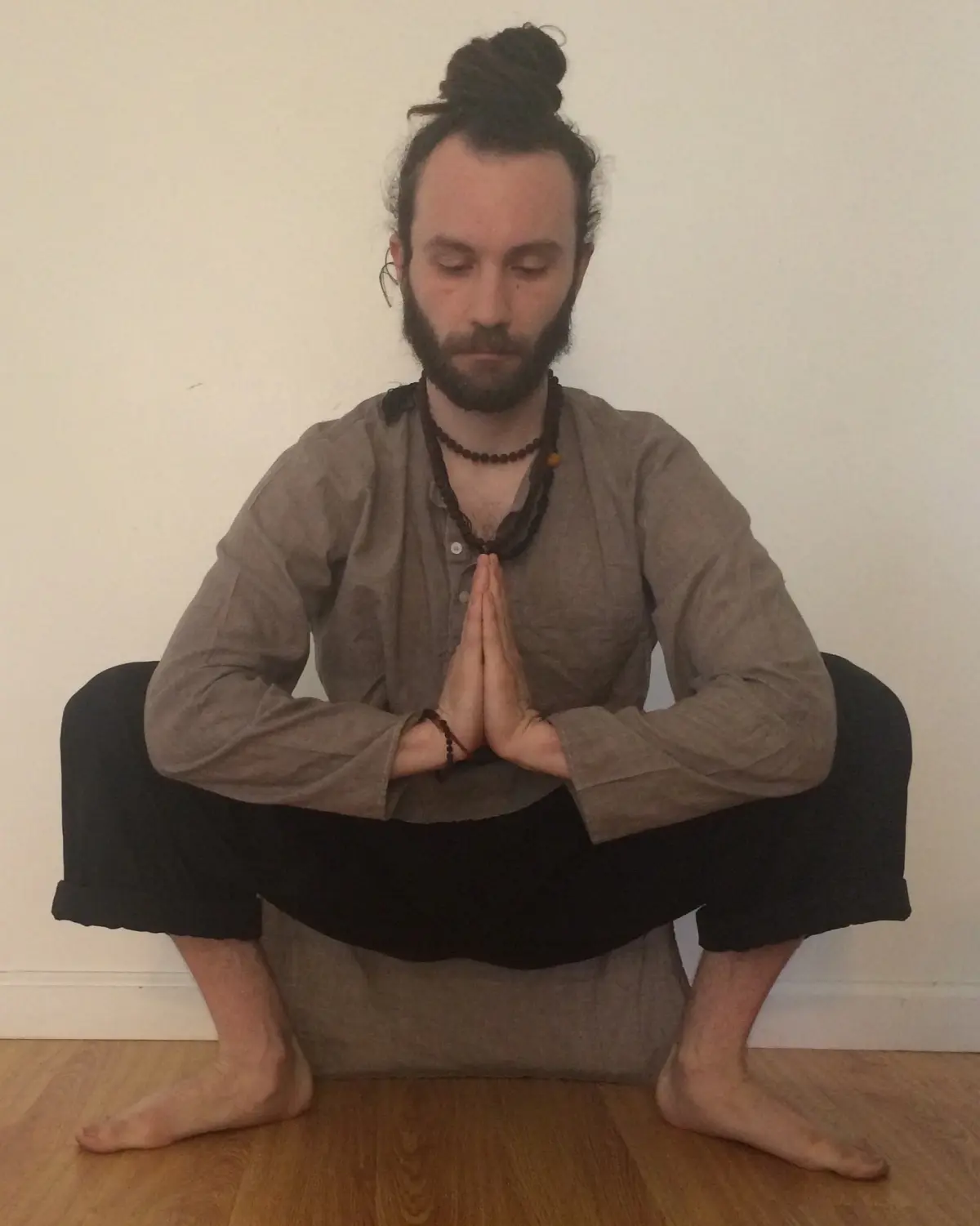
Mālāsana, the garland pose, is a deep squat: feet a little wider than the hips, toes turned slightly out, heels down if possible, the hips sinking below the knees and the palms joined in front of the chest, elbows pressing the knees apart. Hold five to ten breaths. The name comes from modern teaching, not the old hatha texts.
Squatting is the ordinary way of resting, working and waiting in much of the world, and children everywhere drop into it without thinking. Adults who have spent their lives on chairs often lose it. Mālāsana gives it back, slowly, with the help of a blanket and a block.
Steps
- Stand with the feet a little wider than the hips, toes turned slightly out.
- Bend the knees and lower the hips slowly towards the floor, keeping the heels down if you can.
- Let the hips sink below the knees. If the heels lift, place a rolled blanket or a folded mat under them.
- Bring the palms together in front of the chest (añjali mudrā) and place the elbows inside the knees. Press the elbows and knees gently against each other.
- Lengthen the spine, lift the chest, and keep the neck in line.
- Breathe calmly for five to ten breaths.
- To come out, place the hands on the floor and sit down, or straighten the legs slowly with the hands on the thighs.
Alignment
- The knees point in the same direction as the toes; they do not fall inward.
- The weight is spread over the whole foot, not tipped onto the toes.
- The chest lifts; the lower back lengthens instead of collapsing.
- The shoulders stay relaxed even as the elbows press out.
Variations
- Heels supported: a rolled blanket, a folded mat or a wedge under the heels. This is the most useful prop for this pose.
- Seated squat: one or two blocks under the buttocks, so the hips rest at the bottom of the squat. You can stay much longer this way.
- Holding on: hold the door frame, a heavy table or a partner's hands, so the weight can go back without falling.
- Back to the wall: slide down a wall into the squat.
- Iyengar's garland: feet together, trunk folded forward between the knees, arms wrapping around the shins or the back. An advanced form; learn it with a teacher.
Contraindications
- Knee injury, meniscus or ligament problem, recent knee surgery: avoid, or practise only the supported seated squat with professional advice.
- Ankle injury: use the heel support, or wait.
- Hip replacement: deep hip bending may be restricted; ask your surgeon.
- Pregnancy: squatting is common in pregnancy, but ask your midwife or doctor, especially in late pregnancy or if you have been told to avoid deep squats.
- Lower back pain: keep the chest lifted and use a block under the hips.
In the texts
Mālāsana is a modern posture name. Neither the Hatha Yoga Pradipika nor the thirty-two postures of the Gheranda Samhita (2.3-6) contain it. The name has been used for at least three different shapes:
| Name | Shape | Where |
|---|---|---|
| Mālāsana (Iyengar) | squat, feet together, trunk folded, arms around the legs like a garland | Light on Yoga (1966) |
| Upaveśāsana, often called mālāsana | squat, feet apart, palms joined at the chest | modern classes, mostly in the West |
| Mālāsana (older manuscript) | a pose balanced on the hands, today's bhujapīḍāsana | the 19th-century Śrītattvanidhi of Mysore |
Mālā (माला) is a garland or necklace, and also the string of beads used for mantra repetition, the mālā of 108 beads; B.K.S. Iyengar explained the name by the arms "hanging from the neck like a garland". The everyday squat itself needs no text: it is still a familiar way of sitting in India.
Related postures
Mālāsana opens the hips like the pigeon and prepares the forward folds such as the seated forward bend. From the squat, the hands go to the floor for the crow. For the knees, read yoga, arthritis and knees; all the cards: the asanas chapter.
Questions people ask
What is malasana?
In most classes, a deep yoga squat with the palms joined at the chest and the elbows inside the knees. In B.K.S. Iyengar's Light on Yoga, the name belongs to a harder squat with the feet together and the arms wrapped around the legs like a garland.
Why is malasana so hard for me?
Usually because the ankles do not bend far enough for the heels to stay down, or the hips and knees are not used to deep bending. It is a matter of daily habit more than strength: a rolled blanket under the heels and a block under the hips make it possible today.
How long to hold malasana?
Five to ten breaths to begin, then rest by sitting down. With a block under the hips, many people stay one or two minutes comfortably. Come out at once if a knee hurts.
What does malasana stretch?
Mainly the ankles (calves and Achilles tendons), the groins and inner thighs, and the lower back when the trunk leans forward. It also asks the knees and hips to bend fully, which is why they must be free of pain.
Is malasana safe?
For healthy knees, with the heels supported and no pain, yes. It loads the knees in full bending, so people with a knee injury, meniscus problem or recent knee surgery should avoid it or ask a physiotherapist first.
Practise gently and within your limits. Yoga is learnt best with a qualified teacher; this page does not replace one.
Sources
- Malasana, Wikipedia (Iyengar's Malasana I and II in Light on Yoga; upaveśāsana, the squat with añjali mudrā; Sritattvanidhi) checked October 20, 2026
- Gheraṇḍasaṃhitā, Sanskrit text, chapter 2, list of 32 postures, 2.3-2.6 (GRETIL, University of Göttingen) checked October 20, 2026
- Svātmārāma, Haṭhayogapradīpikā, Sanskrit text, chapter 1 (GRETIL, University of Göttingen) checked October 20, 2026
- mālā, Monier-Williams Sanskrit-English Dictionary (1899), p. 813: a wreath, garland, crown; a string of beads, necklace, rosary (Cologne Digital Sanskrit Dictionaries) checked October 20, 2026