Uṣṭrāsana, the camel pose
5 min read · Updated October 20, 2026 · sources checked October 20, 2026 · Editorial: The Yogide team
- Sanskrit
- उष्ट्रासनUṣṭrāsana
- Meaning of the name
- Camel pose: uṣṭra, camel, and āsana, posture
- Level
- Intermediate
- Family
- Backbend
- In the texts
- Modern kneeling form (20th century); a different, face-down camel in the Gheranda Samhita 2.41 (Vasu)
In short
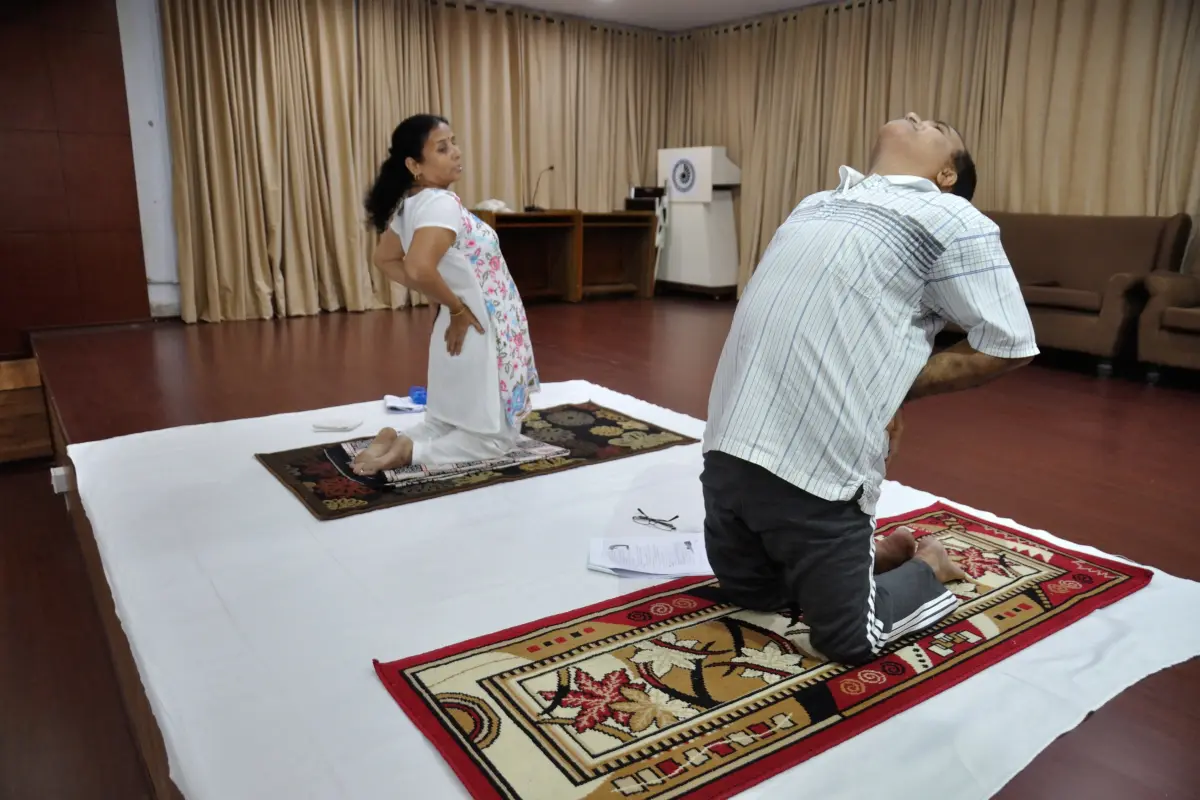
Uṣṭrāsana, the camel pose, is a kneeling backbend: hips stacked over the knees, you lift the chest and lean back, the hands supporting the lower back or reaching for the heels, the neck long. Hold three to five breaths. The kneeling form is modern; the Gheranda Samhita (2.41) gives the name to a different, face-down posture.
The camel folds onto its knees to rest and to be loaded. The modern camel pose begins on the knees too: from there, the chest lifts and opens before the body tilts back. It is one of the deepest backbends many practitioners do, and one that rewards patience more than courage.
Steps
- Kneel on a folded mat or blanket, knees hip-width apart, thighs vertical, the tops of the feet on the floor (or the toes tucked under, which raises the heels).
- Place the hands on the back of the pelvis, fingers pointing down, thumbs on the sacrum.
- Breathing in, lengthen the spine and lift the chest towards the ceiling, as if the breastbone were drawn up and forward.
- Breathing out, keep the hips over the knees and lean back slowly, the hands supporting the lower back. Keep the chin slightly tucked at first. This is the half camel; for many people it is the whole pose.
- If it is comfortable, reach back one hand at a time to the heels. Keep the thighs vertical; do not let the hips sink back.
- Let the neck lengthen. The head may follow the arch only if the neck feels free; otherwise keep the chin towards the chest.
- Stay three to five breaths. To come out, bring the hands back to the pelvis, tuck the chin, and rise on an exhalation, the head last. Rest in child's pose.
Alignment
- The hips stay stacked over the knees; the thighs press forward.
- The bend is spread through the whole spine, especially the upper back, rather than folding at one point of the lower back.
- The shoulder blades move towards each other and down; the chest stays lifted.
- The knees stay hip-width apart, not splaying.
Variations
- Half camel: hands on the lower back throughout. Most of the opening, much less strain.
- Toes tucked: heels higher, so the hands reach them sooner.
- Blocks: two blocks standing beside the calves, hands on the blocks instead of the heels.
- At the wall: knees close to a wall, thighs and pelvis touching it, so the hips cannot slide back.
- Supported preparation: lie back over a bolster under the shoulder blades, as in the supported fish pose, to open the chest without effort.
Contraindications
- Neck problems: keep the chin tucked, never let the head hang.
- Lower back pain, disc problems, spondylolisthesis: avoid, or practise only the half camel under the guidance of a teacher or physiotherapist.
- Uncontrolled high blood pressure, dizziness, migraine: avoid.
- Knee injury: avoid kneeling poses, or pad the knees thickly and check with a professional.
- Pregnancy: deep backbends are not advised, especially in the second half of pregnancy.
In the texts
As far as the published sources show, the kneeling camel is a modern posture: it is described in the twentieth century by two pupils of T. Krishnamacharya, K. Pattabhi Jois in his Ashtanga sequences and B.K.S. Iyengar in Light on Yoga (1966).
The name, however, is old, and it designated something else. The Gheranda Samhita counts an uṣṭrāsana among its thirty-two postures (2.41), but it is done lying face down. Srisa Chandra Vasu's translation, in the public domain, reads:
From the texts
"Lie on the ground face downwards, turn up the legs and place them towards the back, catch the legs with the hands, contract forcibly the mouth and the abdomen. This is called the Camel-posture." (Gheranda Samhita 2.41, Vasu, 1914-1915)
That older camel is close to what we now call the bow. Earlier still, the commentary (bhāṣya) on Patañjali's Yoga Sutra lists, among the classical ways of sitting, uṣṭraniṣadana, "the camel's way of sitting" (on 2.46), without describing it. Three texts, one animal, three postures: a good reason to read every name in its source, as explained on the pose names page.
Related postures
Prepare the camel with the cobra, the bridge and the bow; after it, rest in child's pose. Deeper backbends: the wheel. For safety in general, read is yoga safe?; all the cards: the asanas chapter.
Questions people ask
Is camel pose hard?
The full pose, hands on the heels, is an intermediate backbend that needs open hip flexors and a mobile upper back. The half camel, hands on the lower back, is accessible to most people after some months of gentle backbends such as the cobra and the bridge.
How long to hold camel pose?
Three to five calm breaths, then come up slowly and rest. Repeat once or twice rather than staying long. If the breath becomes short or the lower back pinches, come out at once.
What does camel pose stretch?
The front of the body: the front of the thighs and hips, the belly, the chest and the fronts of the shoulders. It asks the upper back to extend, which is why the effort should not all fall into the lower back or the neck.
Is camel pose dangerous?
Like any deep backbend, it can strain the lower back or the neck if it is forced or the head is dropped back abruptly. With the half version, a long neck and a slow exit, the risk is low; people with the conditions listed below should avoid it.
Who should avoid camel pose?
People with a recent back or neck injury, a disc problem, spondylolisthesis, uncontrolled high blood pressure, dizziness, a knee injury, or in later pregnancy. Ask a doctor or physiotherapist first if any of these apply.
Practise gently and within your limits. Yoga is learnt best with a qualified teacher; this page does not replace one.
Sources
- Gheraṇḍasaṃhitā, Sanskrit text, 2.41 uṣṭrāsana (GRETIL, University of Göttingen) checked October 20, 2026
- The Gheranda Samhita, translated by Srisa Chandra Vasu (Sacred Books of the Hindus, vol. XV, Panini Office, 1914-1915), 2.41, Internet Archive checked October 20, 2026
- Pātañjalayogaśāstra, Yoga Sutra with the bhāṣya, 2.46: list of seats including uṣṭraniṣadana (GRETIL, University of Göttingen) checked October 20, 2026
- Ustrasana, Wikipedia (modern kneeling form described by Pattabhi Jois and in Iyengar's Light on Yoga, 1966; blocks beside the calves) checked October 20, 2026