Which mat for hot yoga, and why grip and hygiene matter
10 min read · Updated October 22, 2026 · sources checked October 19, 2026 · Editorial: The Yogide team

In short
For hot yoga, choose a mat whose surface still holds when wet, or lay an absorbent cotton or microfibre towel over the mat you own: that is the traditional answer to sweat. One study measured about a litre of sweat an hour in experienced Bikram practitioners, so absorption and washing matter as much as grip. Check for latex if you are allergic, and never share a damp mat.
The short answer
The mat for hot yoga is the one that still holds your hands when it is wet, that soaks up sweat instead of letting it pool, and that you can wash after every class. That is three jobs, and no single material does all three well: dense rubber grips when dry, cotton absorbs, plastics wash easily. So the honest answer is usually a pair of things, a mat and an absorbent layer on top, rather than one miraculous product. This page ranks nothing and sells no mats. It explains why the hot room changes the problem, what to look for, and what the Indian tradition did long before rubber existed.
If you are choosing your first mat for ordinary practice, read choosing a yoga mat first: thickness, length and material are covered there and are not repeated here.
Why the hot room changes the mat
Hot yoga, as the 2025 systematic review by Willmott and colleagues defines it, is any yoga practised at 25 °C or above. Across the 43 studies they gathered, with 942 participants, a single hot session raised body temperature and heart rate compared with the same yoga unheated, without raising the energy cost. The heat does one thing to your mat above all: it makes you sweat onto it.
How much? In a laboratory study, Pate and Buono followed 24 practitioners through a standard 90-minute Bikram class. Novices lost sweat at a rate of 0.6 kg an hour on average; experienced practitioners, who worked harder and reached higher heart rates, lost 1.1 kg an hour, about a litre of sweat an hour. Over a 90-minute class, that comes to roughly 0.9 kg of water for a novice and about 1.65 kg for an experienced practitioner, landing on your skin, your clothes and the surface under your hands.
Two consequences follow:
- Grip disappears with wet skin on a smooth surface. A mat that feels secure in a cool studio can turn into a slide in downward-facing dog once the palms are wet. The problem is not the mat's dry grip but what it does when a film of sweat sits between you and it.
- Light-headedness and dizziness are common. In an online survey of 157 hot yoga practitioners by Mace and Eggleston, a self-reported convenience sample recruited through yoga websites and forums, just over half reported at least one adverse event; feeling light-headed (61 %) and dizziness (60 %) were the most common, then nausea (35 %) and dehydration (34 %). The survey does not report falls or fainting. Still, a surface you can trust matters more when your head is less reliable than usual.
What to look for
Four questions, in this order.
- Does it hold when wet? Textured or open surfaces, cork, and woven cotton or microfibre tops are made to be gripped damp; smooth, closed-cell plastics are not. If you already own a smooth mat, you do not need to replace it: add the layer described below.
- Does it absorb? Sweat that pools makes any surface slippery. Something must take the water in: a cotton rug, a microfibre towel, or a mat with an absorbent top layer.
- Can you wash it after every class? Not wipe: wash. A towel goes in the machine; a cotton rug too. A rubber or plastic mat is wiped with a damp cloth and mild soap, then dried flat before rolling. A hot yoga mat that cannot be dried properly is a hygiene problem, not an equipment choice.
- What is it made of? Natural rubber grips well but is the source of latex. MedlinePlus says latex is the milky fluid of the tropical rubber tree, that a reaction can start within minutes, from a rash to asthma, and that people with the allergy should avoid latex and look for latex-free versions. If that is you, read the label, and check the backing of cork mats too.
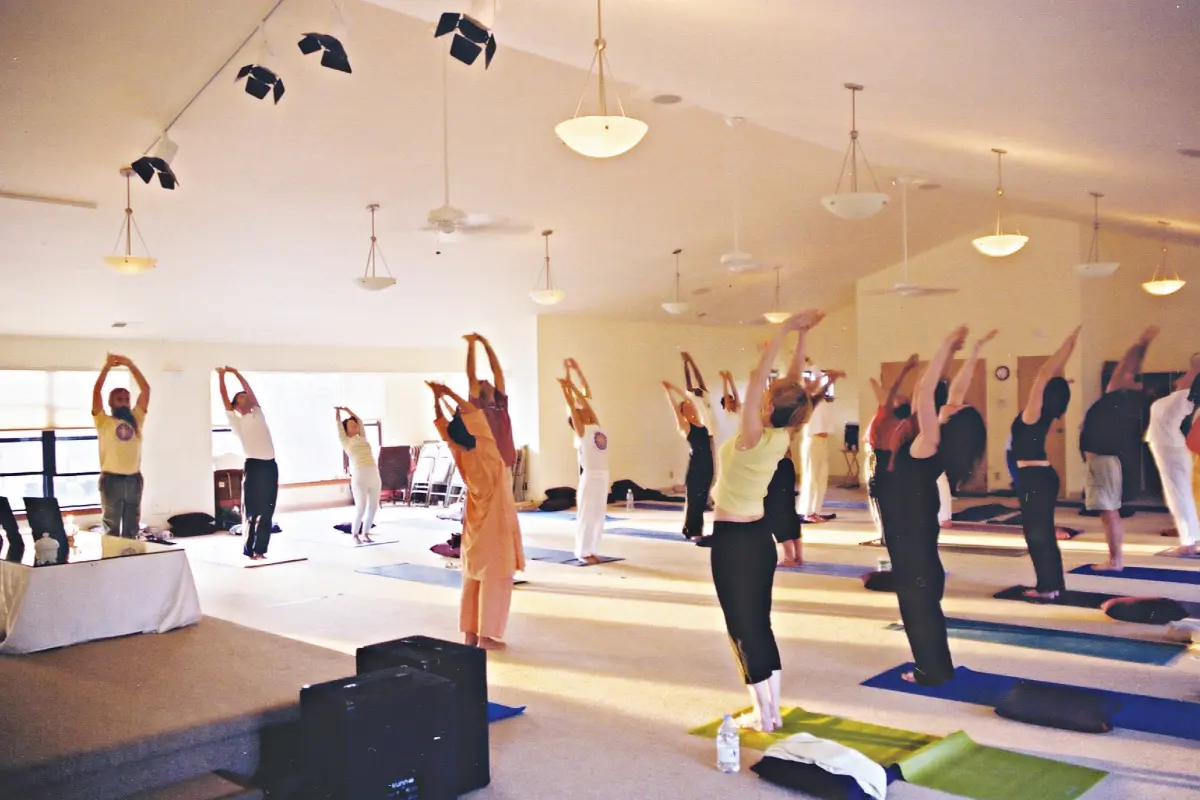
Three set-ups that work
A mat you own, with a towel on top. The simplest and the most common. Lay the mat, unroll a cotton or microfibre towel over the full length, and press it flat with your hands before the class begins. Fold the corners under the mat if the towel creeps. The towel absorbs, the mat cushions. Wash the towel after every class.
A mat with an absorbent top. Mats sold for hot yoga usually bond an absorbent layer to a rubber or plastic base. Convenient, often heavier, and the whole thing has to be dried after class, not just the top. Worth it if you practise hot yoga several times a week; not necessary to begin.
A cotton rug over the seat, the Indian way. Long before rubber, the practice surface in India was woven cotton, and it still is in many ashrams: a durrie or a folded blanket. A cotton rug laid over a non-slip mat absorbs sweat, dries on a line, and goes in the wash like a towel. It is also the oldest answer to the problem of a sweating body on a seat.
What you do not need: a mat chosen by its pattern, or one bought because a studio sells it. Ask the studio one practical question instead: how are the rental mats cleaned, and how often. A studio that answers precisely is a studio that has thought about the hot room.
Hygiene: your own mat, dried and washed
Warm, wet and shared is the combination that skin infections like. The CDC's page on ringworm, last reviewed in January 2026, lists among the ways it spreads skin-to-skin contact, shared objects such as towels and bedsheets, and shared surfaces such as locker-room floors; it names excessive sweating as a risk factor and ringworm of the feet as athlete's foot. Its prevention advice is plain: keep skin clean and dry, and "do not share sports gear or other personal items (like towels or socks)". The NHS gives the same rules for athlete's foot: do not walk barefoot in changing rooms and showers, do not share towels, socks or shoes, and dry your feet, particularly between the toes.
For a hot yoga practitioner, that translates into a short routine:
- Bring your own mat and towel; borrow a studio mat only with a full-length towel over it, and never when you have a skin or nail infection.
- After class, hang the towel and the mat to dry rather than rolling them wet in a bag. Wash the towel before the next class.
- Wear flip-flops between the hot room and the shower, and dry your feet before socks.
- Wipe the mat with mild soap and water at home; follow the maker's instructions for natural materials that do not tolerate soaking.
The classical tradition says the same thing in one word. The Bhagavad Gita, after telling the yogi to practise constantly, alone and in seclusion (6.10), begins its description of the seat with śucau deśe, "in a clean place"; śuci (शुचि) in Monier-Williams is "clear, clean, pure", literally and figuratively, and also "shining". The same verse asks for a seat that is sthira, steady:
शुचौ देशे प्रतिष्ठाप्य स्थिरमासनमात्मनः । नात्युच्छ्रितं नातिनीचं चैलाजिनकुशोत्तरम् ॥
śucau deśe pratiṣṭhāpya sthiram āsanam ātmanaḥ / nātyucchritaṃ nātinīcaṃ cailājinakuśottaram
In a clean place, having set up for himself a steady seat, neither too high nor too low, of cloth, a skin and kuśa grass laid one upon another.
Clean and steady: the whole of mat hygiene and mat grip, in a text that never saw a heated studio. The next verse (6.12) adds the purpose: sitting on that seat, with the mind one-pointed, one practises yoga ātma-viśuddhaye, for the purification of oneself. The surface is cared for because the practice is.
In the room: what to do, in order
- Arrive early and lay the mat and towel before the room fills, so you can press the towel flat and settle rather than hurry.
- Drink before, not only during. Keep water within reach of the mat.
- Test the grip in the first downward-facing dog. If the hands creep forward, stop, dry them and the towel's top edge, and re-press the towel. Do not fight a sliding surface for a whole class.
- Sit or lie down the moment you feel light-headed. On the figures above, that happens to many people in a hot room. Śavāsana on your own mat is always allowed; leave the room if the signs listed at the top appear.
- Afterwards, dry everything, and change out of wet clothes rather than sitting in them. What to wear so the clothes themselves do not become the slipping surface is covered in what to wear for yoga.
If any of this conflicts with a health condition or a medicine you take, the general precautions in is yoga safe? and a word with your doctor come before the hot room, not after.
The Begin Yoga at Home: 30 Days programme is practised at room temperature. The postures of the hot sequence come from the hatha yoga taught in Calcutta, and the heated studio was added in the United States in the 1970s, as the hot yoga guide explains. The programme's chapter on setting up your space, time and kit, and its table of precautions, give you the same postures without the sweat problem to solve.
Questions people ask
What yoga mat is best for hot yoga?
There is no single best mat, and this page ranks none. What a hot room demands is a surface that keeps its grip when wet, a layer that absorbs sweat, and a material you can wash after every class. Any mat that meets those three needs, with a towel if necessary, is a hot yoga mat.
Do I need a special yoga mat for hot yoga?
Not necessarily. A standard mat with a cotton or microfibre towel laid over it does the same job as a mat sold for hot yoga: the towel absorbs the sweat and gives your hands something dry to press into. Buy a dedicated mat only if you practise hot yoga regularly and the towel keeps sliding.
Can I use a regular yoga mat for hot yoga?
Yes, as long as you add an absorbent layer and wash it afterwards. Smooth closed-cell mats become slippery as soon as sweat pools on them, and that is where hands slide forward in downward-facing dog. A towel over the mat, pressed flat before the class starts, solves most of it.
How do I keep a hot yoga mat clean?
Wash the towel after every class, wipe the mat with a damp cloth and mild soap, and let both dry fully before rolling them. The CDC lists shared surfaces and shared items such as towels among the ways ringworm and athlete's foot spread, and excessive sweating as a risk factor, so your own mat, dried and washed, is the hygiene rule.
Which mat for hot yoga if I am allergic to latex?
Avoid natural rubber, which is the source of latex. MedlinePlus says a reaction can start within minutes of contact and advises people with the allergy to avoid latex and look for latex-free versions of products. A cotton rug, a cork top on a latex-free base, PVC or TPE are the usual alternatives; read the label, not the marketing.
Sources
- Pate JL, Buono MJ. The physiological responses to Bikram yoga in novice and experienced practitioners. Alternative Therapies in Health and Medicine, 2014 PMID 25141359 checked October 19, 2026
- Mace C, Eggleston B. Self-Reported Benefits and Adverse Outcomes of Hot Yoga Participation. International Journal of Yoga Therapy, 2016 DOI 10.17761/1531-2054-26.1.49 PMID 27797657 checked October 19, 2026
- Willmott AGB et al. Hot Yoga: A Systematic Review of the Physiological, Functional and Psychological Responses and Adaptations. Sports Medicine Open, 2025 DOI 10.1186/s40798-025-00917-7 PMID 41032153 checked October 19, 2026
- About Ringworm (how it spreads, risk factors, prevention), Centers for Disease Control and Prevention, last reviewed 6 January 2026 checked October 19, 2026
- Athlete's foot, NHS (how it spreads and how to stop it coming back), reviewed 29 April 2024 checked October 19, 2026
- Heat exhaustion and heatstroke, NHS (signs, first aid, when to call 999), reviewed 28 May 2026 checked October 19, 2026
- Latex Allergy, MedlinePlus, US National Library of Medicine, updated 30 November 2025 checked October 19, 2026
- Bhagavadgītā, critical edition (Bhandarkar Oriental Research Institute), Sanskrit text, 6.11-6.12 (GRETIL, University of Göttingen) checked October 19, 2026
- Monier-Williams, Sanskrit-English Dictionary (1899), entry śuci, Cologne Digital Sanskrit Dictionaries checked October 19, 2026