सूर्यनमस्कारsūrya-namaskāra · salutation to the sun
Sūrya namaskāra A and B, the Ashtanga sun salutations
5 min read · Updated October 18, 2026 · sources checked October 18, 2026 · Editorial: The Yogide team
In short
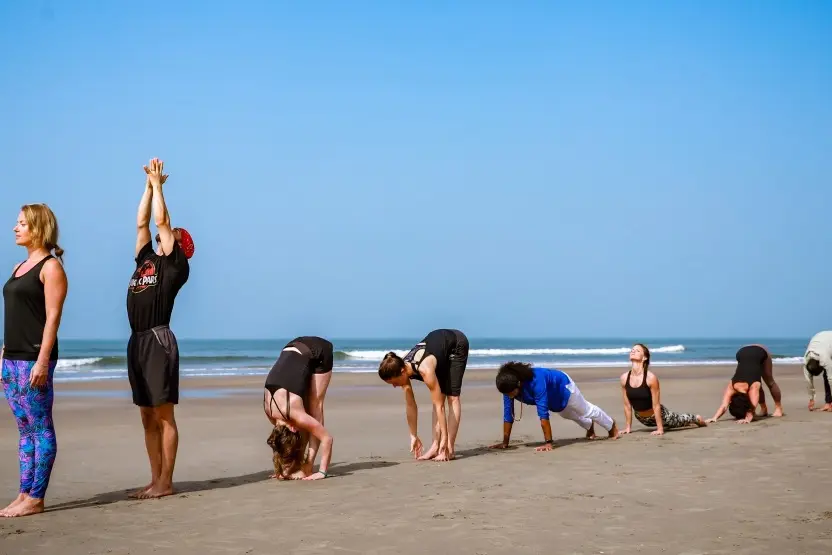
In Ashtanga vinyasa yoga, every practice opens with five sun salutations A and five B. A has nine counted movements (vinyāsa) and B seventeen, each made on one inhale or one exhale, with five breaths in downward dog. B adds the chair pose (utkaṭāsana) and the warrior (vīrabhadrāsana A) on each side. Each movement has a fixed gaze point.
The sun salutations A and B are the doorway of Ashtanga vinyasa yoga: every practice in the Mysore tradition begins with five of each, before the standing poses. They differ from the twelve-position sūrya namaskāra most taught in India: there is no lunge, and every movement is counted, in Sanskrit, on one breath.
The method: vinyāsa, breath and gaze
Vinyāsa means "putting or placing down", "movement, position (of limbs)" and "arrangement" (Monier-Williams): here, each movement is placed on a single breath, inhale or exhale, and counted. The breath is slow, even and audible, through the nose. Each movement also has its dṛṣṭi, a fixed point for the eyes:
- aṅguṣṭha-madhye: between the thumbs, arms raised;
- nāsāgre: the tip of the nose;
- bhrū-madhye: between the eyebrows;
- nābhi-cakre: the navel.
Sun salutation A: nine vinyāsa
| Count | Breath | Movement | Gaze |
|---|---|---|---|
| ekam (1) | inhale | raise the arms overhead, palms together | thumbs |
| dve (2) | exhale | fold forward, hands to the floor (uttānāsana) | nose |
| trīṇi (3) | inhale | lift the head, lengthen the spine | between the eyebrows |
| catvāri (4) | exhale | step or float back, lower into caturaṅga | nose |
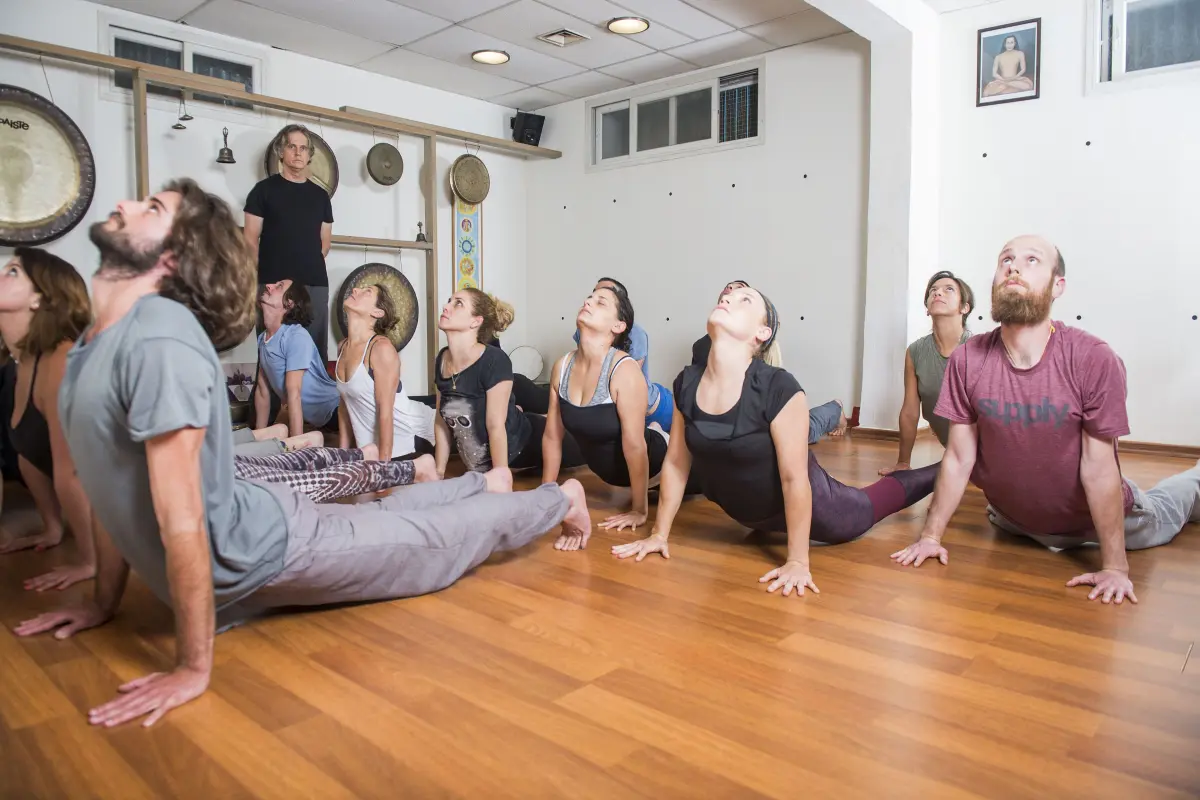
| pañca (5) | inhale | upward-facing dog | between the eyebrows |
| ṣaṭ (6) | exhale | downward-facing dog, stay five breaths | navel |
| sapta (7) | inhale | step or float forward, lift the head | between the eyebrows |
| aṣṭau (8) | exhale | fold forward | nose |
| nava (9) | inhale | come up, arms overhead | thumbs |
| (samasthiti) | exhale | lower the arms, stand still | nose |
Sun salutation B: seventeen vinyāsa
B follows the same logic, with two additions: the chair pose (utkaṭāsana, knees bent, arms raised) at the beginning and the end, and the warrior (vīrabhadrāsana A) on each side, each followed by a vinyāsa through caturaṅga and upward dog.
| Count | Breath | Movement | Gaze |
|---|---|---|---|
| 1 | inhale | bend the knees, raise the arms: utkaṭāsana | thumbs |
| 2 | exhale | fold forward, hands to the floor | nose |
| 3 | inhale | lift the head, lengthen the spine | between the eyebrows |
| 4 | exhale | step or float back, caturaṅga | nose |
| 5 | inhale | upward-facing dog | between the eyebrows |
| 6 | exhale | downward-facing dog | navel |
| 7 | inhale | turn the left heel in, right foot forward between the hands, rise into vīrabhadrāsana A, arms up | thumbs |
| 8 | exhale | hands down, right foot back, caturaṅga | nose |
| 9 | inhale | upward-facing dog | between the eyebrows |
| 10 | exhale | downward-facing dog | navel |
| 11 | inhale | right heel in, left foot forward, vīrabhadrāsana A on the left side | thumbs |
| 12 | exhale | hands down, left foot back, caturaṅga | nose |
| 13 | inhale | upward-facing dog | between the eyebrows |
| 14 | exhale | downward-facing dog, stay five breaths | navel |
| 15 | inhale | step or float forward, lift the head | between the eyebrows |
| 16 | exhale | fold forward | nose |
| 17 | inhale | bend the knees, arms up: utkaṭāsana | thumbs |
| (samasthiti) | exhale | straighten the legs, lower the arms | nose |
The counts, breaths and gaze points above are those published by AYI (ashtangayoga.info), which documents the method as taught in Mysore.
How to learn them
- Learn A first, slowly, until the breath and the movement start and end together. In a traditional Mysore-style class, a beginner may be given only the sun salutations for the first days.
- Then add B. Start with one or two rounds of each, not five, and rest in śavāsana afterwards.
- Count to yourself in Sanskrit or in your own language: the count is what keeps the breath and the movement together.
- To see how long your rounds take at your pace, use the sun salutation calculator.
Questions people ask
What is the difference between sun salutation A and B?
A is the shorter one: nine vinyāsa, from standing to downward dog and back. B has seventeen: it begins and ends in the chair pose (utkaṭāsana) instead of with straight legs, and inserts the warrior pose (vīrabhadrāsana A), right side then left, each followed by a vinyāsa through the push-up and upward dog.
How many sun salutations A and B do you do in Ashtanga?
Five of each at the start of every practice, in the Mysore tradition: five A, then five B, before the standing sequence.
How long do 5 A and 5 B take?
About a quarter of an hour at four seconds per inhale or exhale: roughly 6 minutes 40 seconds for five A and 9 minutes 20 seconds for five B. The sun salutation calculator does the sum for your own pace.
Practise gently and within your limits. Yoga is learnt best with a qualified teacher; this page does not replace one.
Sources
- Surya Namaskara A: vinyāsa count, breath, dṛṣṭi and five breaths in Adho Mukha Śvānāsana — AYI, ashtangayoga.info checked October 18, 2026
- Surya Namaskara B: the seventeen vinyāsa with count, breath and dṛṣṭi — AYI, ashtangayoga.info checked October 18, 2026
- Traditional practice series: five rounds of A and five repetitions of B at the start of practice — AYI, ashtangayoga.info checked October 18, 2026
- Monier-Williams, Sanskrit-English Dictionary (1899), entry vinyāsa, Cologne Digital Sanskrit Dictionaries checked October 18, 2026
- Yoga: What You Need To Know — National Center for Complementary and Integrative Health (NIH), last updated August 2023 checked October 18, 2026