अष्टाङ्ग विन्यासaṣṭāṅga vinyāsa · eight limbs, linked placing
Ashtanga vinyasa yoga, from Mysore to the world
6 min read · Updated October 16, 2026 · sources checked October 16, 2026
In short
Ashtanga vinyasa yoga is the method taught by K. Pattabhi Jois (1915-2009) in Mysore, who learnt from T. Krishnamacharya. It links fixed sequences of postures with the breath, a steady gaze and the bandhas. Students learn the primary series pose by pose, usually in Mysore-style classes where each person practises at their own pace under a teacher.
Every morning before sunrise, in a hall in Mysore, dozens of people move through the same postures in near silence, each at their own pace, the only sound the breath. This is ashtanga vinyasa yoga as K. Pattabhi Jois taught it for more than sixty years, and as his students carried it to every continent. Here is where it comes from, what a class is really like, and what the sources do and do not support.
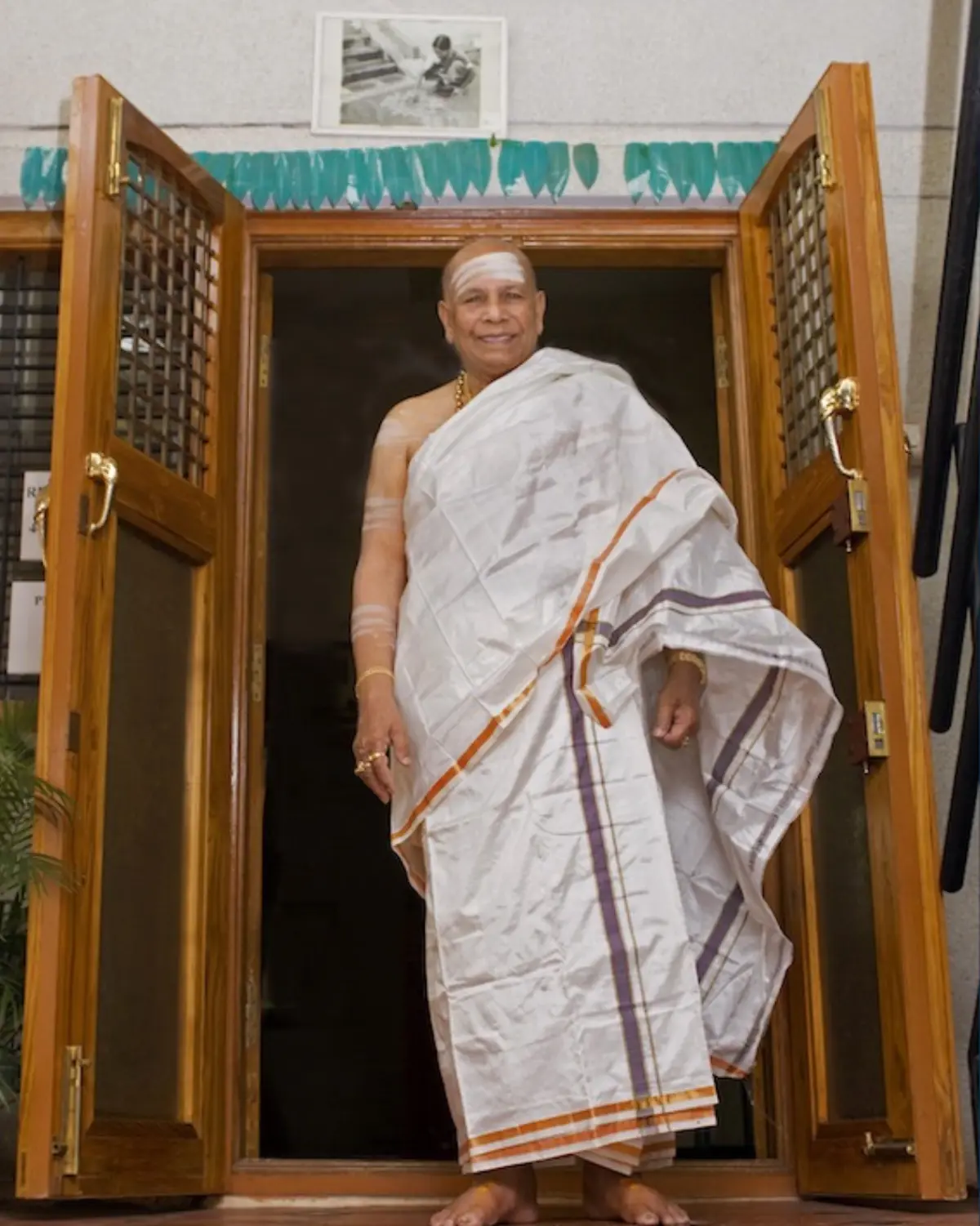
The name: eight limbs, and a linked placing
Aṣṭāṅga means "eight limbs". The name comes from the Yoga Sutra of Patañjali, which lists the limbs of yoga in one sentence:
यमनियमासनप्राणायामप्रत्याहारधारणाध्यानसमाधयोऽष्टावङ्गानि
yama-niyamāsana-prāṇāyāma-pratyāhāra-dhāraṇā-dhyāna-samādhayo 'ṣṭāv aṅgāni
Restraints, observances, posture, breath regulation, withdrawal of the senses, concentration, meditation and absorption are the eight limbs.
Pattabhi Jois insisted that the postures are only the third of these limbs: the series are a door into the eight limbs of yoga, not a replacement for them. Vinyāsa (vi + nyāsa) means placing, arrangement, a set disposition of the limbs (Monier-Williams). In this method it names the counted movements, each tied to one inhalation or one exhalation, that carry the body into and out of every posture.
The lineage: Krishnamacharya, Jois, Sharath
- T. Krishnamacharya (1888-1989) taught yoga in Mysore under the patronage of the Maharaja Krishnaraja Wadiyar IV; his yogaśālā in a wing of the Jaganmohan Palace opened on 11 August 1933. His teaching for the young men of the palace was dynamic, with flowing transitions between postures.
- K. Pattabhi Jois (1915-2009) met Krishnamacharya at a demonstration in Hassan in 1927, at the age of twelve, and studied with him in Mysore in the 1930s. He taught yoga at the Sanskrit College of Mysore from 1937 to 1973 and founded the Ashtanga Yoga Research Institute in his home in Lakshmipuram in 1948. A larger shala opened in Gokulam in 2002. His book Yoga Mālā, written in Kannada (usually dated 1958), appeared in English in 1999.
- From the 1970s, Western students came to Mysore, and Jois travelled abroad from 1974; his four-month stay in Encinitas, California, in 1975 is often cited as the start of ashtanga in America.
- After his death in 2009, his grandson R. Sharath Jois (1971-2024) led the teaching, later at his own Sharath Yoga Centre in Mysuru; he died on 12 November 2024 during a teaching tour in the United States. Our page on Mysore sets out the shalas as they stand today.
A hard fact belongs in an honest page. Former students have published accounts of sexual abuse by Pattabhi Jois, often during adjustments, from 2010 onward and in more detail from 2018, and in 2019 Sharath Jois publicly acknowledged that he had seen his grandfather give "improper adjustments" (sources in Wikipedia's article on Jois). It is one reason to ask any teacher how they handle hands-on adjustments and consent.
The Yoga Korunta: what the sources allow us to say
Jois taught that the sequences came from an ancient text, the Yoga Korunta (also spelt Kurunta), which Krishnamacharya said he had studied with his own teacher, Rāmamohana Brahmacārī, in the Himalaya. The evidence is thin:
- no manuscript has ever been produced; Krishnamacharya is reported to have said the copy was eaten by ants;
- Krishnamacharya's own books, Yoga Makaranda (1934) and Yogāsanagaḷu (about 1941), describe nearly all the postures of the primary series without citing it;
- the scholar Norman Sjoman, in The Yoga Tradition of the Mysore Palace, argued that the sequences were created in Mysore rather than inherited, and Jois's son Manju Jois has said that Krishnamacharya created them.
The fairest reading: the series are a twentieth-century creation of Krishnamacharya and Jois, built from older hatha postures and from the needs of their students. That does not make them less valuable. It makes them what they are, a living method from Mysore, not a five-thousand-year-old script.
The six series
| Series | Sanskrit name | Meaning | For whom |
|---|---|---|---|
| Primary | Yoga cikitsā | yoga therapy | everyone starts here |
| Intermediate | Nāḍī śodhana | cleansing of the channels | after the primary is steady |
| Advanced A to D | Sthira bhāga | steadiness, strength | very few practitioners |
Each practice opens with sun salutations, five rounds of A and five of B in the usual count (see Surya Namaskar A and B), continues with a standing sequence, then the series the student is working on, and ends with a fixed closing sequence: shoulderstand, plough, fish, headstand, lotus and rest.
Tristhāna: three places of attention
The method rests on three things held together, called tristhāna:
- The breath: slow, even, audible, inhaling and exhaling through the nose, the same length in and out. Many teachers call it ujjāyī; Sharath Jois said in 2011 and again in 2013 that ujjāyī proper is a prāṇāyāma, not the breath of the postures.
- The posture, held for about five breaths, with its counted vinyāsa in and out.
- The gaze (dṛṣṭi): a fixed point for each posture, such as the tip of the nose, the navel or the hand.
The bandhas, mūla bandha and uḍḍīyāna bandha, are held throughout. Sharath Jois put it simply: without bandhas the breathing is not correct.
What a class looks like
Mysore style
The traditional class is called "Mysore style". Everyone arrives within a time window, practises the sequence they have been given, at their own pace, and the teacher walks the room to help and correct. A beginner may be given only the sun salutations and a few standing postures, then sent to rest; new postures are added when the last one is steady. The room is quiet; in Mysore, Sharath Yoga Centre closes on Sundays and on full and new moon days. Sharath Yoga Centre's published FAQ says its regular classes are open to all levels, including absolute beginners, and that chanting classes are mandatory for its students.
Led classes
In a led class, the teacher counts the vinyāsas aloud in Sanskrit and the whole room moves together. Jois introduced them later in his teaching, usually twice a week alongside Mysore practice. Outside Mysore, many studios offer mostly led classes.
Who it suits, and the level
Ashtanga is demanding: a full primary series commonly takes between one and two hours, with many jump-throughs, forward bends and the half-lotus postures of the seated sequence. It suits people who like a fixed daily practice and want to see slow progress in the same sequence. It suits less well someone who wants variety, has knee or wrist problems, or cannot practise several times a week. On the levels of practice, it starts at "beginner" in Mysore style but quickly asks for an intermediate base.
Before you start
- Practise on an empty stomach, early in the day if you can.
- Learn chaturanga and downward dog slowly; they come back dozens of times.
- Six days a week is the traditional rhythm, but three regular days are better than six forced ones.
Finding an authentic class
Ashtanga has no single licensing body. To check a teacher:
- ask where and with whom they studied, for how long, and whether they practise themselves every day;
- if they claim an authorisation from a Mysore shala, check it on that shala's published list (Sharath Yoga Centre publishes one);
- look for a real Mysore-style programme, not only led classes, and a teacher who explains how adjustments are given;
- be wary of a "Mysore certificate" sold in a few weeks.
For the style on its own, read how a Mysore-style class works. For the other heirs of Krishnamacharya, see Iyengar yoga and viniyoga; for the flowing styles that grew from ashtanga, vinyasa yoga and power yoga. All the schools and paths: the paths of yoga.
Questions people ask
Is ashtanga yoga good for beginners?
It can be, if you learn it the traditional way: in a Mysore-style class, where the teacher gives you only the first postures and adds more as you are ready. Jumping into a full led primary series on day one is what tires and injures beginners.
What is the difference between ashtanga and vinyasa yoga?
Ashtanga follows fixed series in a set order, always the same. Vinyasa or flow classes borrow its breath-linked transitions but change the sequence from class to class at the teacher's choice.
Why is ashtanga called ashtanga?
Pattabhi Jois named his method after the eight limbs (aṣṭa-aṅga) of Patañjali's Yoga Sutra 2.29: ethics, observances, posture, breath, withdrawal of the senses, concentration, meditation and absorption. The postures are the third limb, not the whole of it.
Does the Yoga Korunta really exist?
No manuscript has ever been shown. Krishnamacharya said he had learnt from it, and Jois cited it as the source of the sequences, but Krishnamacharya's own books do not quote it, and historians consider the claim unverifiable.
Sources
- Frequently Asked Questions, Sharath Yoga Centre, Mysuru (official site, updated 29 July 2025) checked October 16, 2026
- R. Sharath Jois (1971-2024), Sharath Yoga Centre (official site) checked October 16, 2026
- K. Pattabhi Jois, Wikipedia (birth 1915, Sanskrit College 1937-1973, institute 1948, Yoga Mala, accounts of abuse from 2010, Sharath Jois 2019) checked October 16, 2026
- Ashtanga vinyasa yoga, Wikipedia (series, Mysore style, tristhana, Yoga Korunta) checked October 16, 2026
- Tirumalai Krishnamacharya, Wikipedia (yogashala at the Jaganmohan Palace, opened 11 August 1933) checked October 16, 2026
- Patañjali, Yogasūtra, Sanskrit text, sūtra 2.29 (GRETIL, University of Göttingen) checked October 16, 2026