Partner and group yoga poses: which are safe for two, three or more?
9 min read · Updated October 21, 2026 · sources checked October 19, 2026 · Editorial: The Yogide team
In short
Safe partner poses for two or three people are the ones where everyone keeps their own feet or seat on the floor: back-to-back seated breathing, the double seated forward bend, partner tree, a supported boat. Lifts and acrobatic shapes belong in a class with a spotter. No classical yoga text describes a posture done by two people. This is a modern practice, so learn it slowly.
The short answer
Safe partner poses are the ones where everyone keeps their own seat or feet on the floor and can leave the shape alone, without help. That rules in breathing back to back, the double seated forward bend, partner tree, a supported boat, and side-by-side bridge and relaxation. It rules out, for home practice, every pose where one person carries the other: flying poses, stacked pyramids, double headstands. Those belong to acrobatics and need a third person trained to spot.
One honest point before the poses. No classical text of yoga describes a posture done by two people. The Haṭhayogapradīpikā names fifteen postures in its first chapter, every one of them solitary, and says Śiva taught eighty-four. Partner yoga is a modern practice, built from solo asanas by teachers of the last decades. That does not make it bad yoga. It means you should judge it by Patañjali's measure for any posture, not by how impressive it looks:
स्थिरसुखमासनम् । प्रयत्नशैथिल्यानन्तसमापत्तिभ्याम् ।
sthira-sukham āsanam | prayatna-śaithilyānanta-samāpattibhyām |
Posture is steady and at ease. It comes from the loosening of effort and from absorption in the infinite.
If a partner pose is neither steady nor at ease for both of you, it is not yet a yoga pose. It is a trick, and the body of the weaker partner pays for it.
Easy yoga poses for 2 people
These are the poses to begin with. Each one is a solo asana from the asanas chapter shared between two bodies. Practise on a mat each, with bare feet, and keep the breath slow through the nose.
- Breathing back to back. Sit cross-legged with your spines touching. Close the eyes and feel your partner's back move with the breath. Let the two rhythms settle into one. This is the whole of partner yoga in miniature: attention to another body without doing anything to it.
- Double seated forward bend. Sit back to back. One of you folds forward over straight or bent legs, as in the seated forward bend, while the other leans back onto that curved spine, arms open. The leaning partner gives only the weight the folding partner asks for. Change roles.
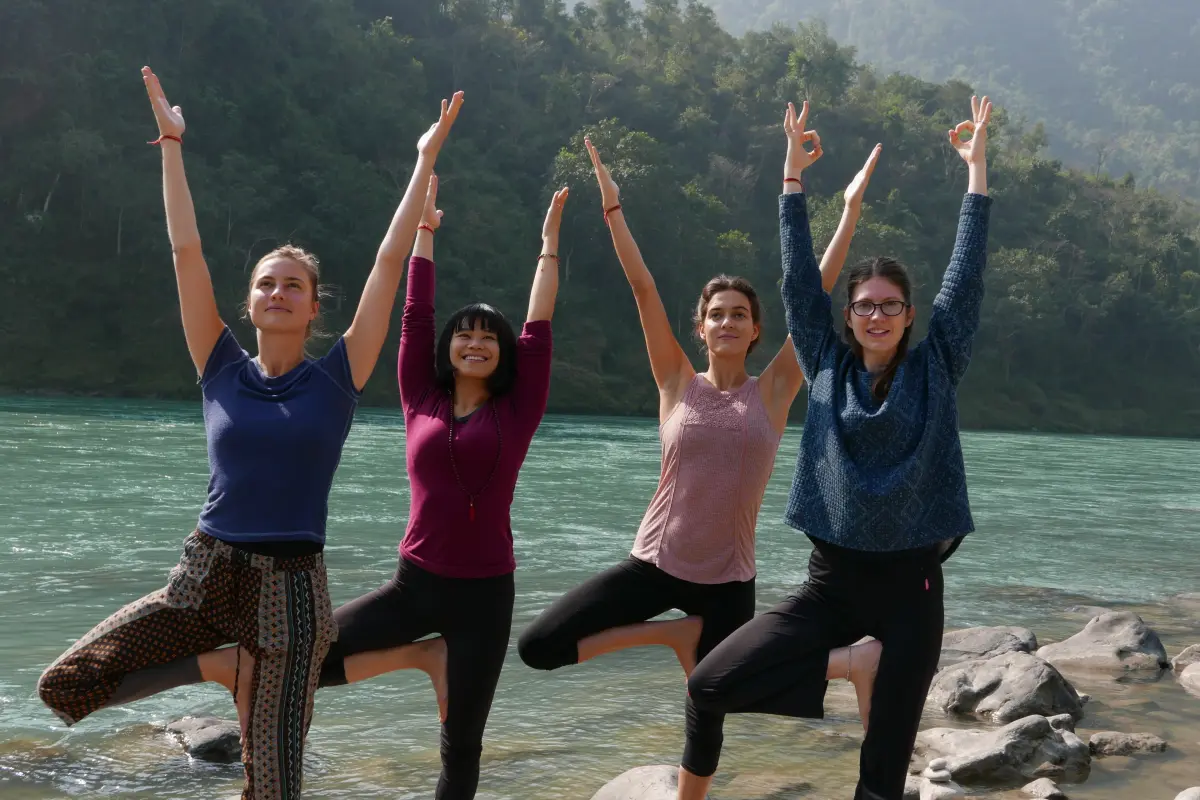
- Partner tree. Stand side by side, inner arms around each other's waist, outer foot on the inner ankle or calf, never on the knee. Press the outer palms together overhead. Two trees share a root and fall less.
- Seated twist, hand in hand. Sit cross-legged facing each other, knees close. Each of you reaches across with the right hand to hold the partner's left hand, then turns the chest to the right. The held hand gives a gentle lengthening, not a pull.
- Supported boat. Sit facing each other, knees bent, holding hands. Press the soles of your feet together and straighten the legs upward only as far as both backs stay long. If a back rounds, bend the knees again.
- Bridge and rest, side by side. Lie on your backs and lift the hips into the bridge together, then lie in śavāsana next to each other. Ending together is part of the practice.
Stay in each shape for a handful of slow breaths, then change sides or roles. Leave every pose as carefully as you entered it: many strains happen on the way out, and with a partner there are two ways out to coordinate.
Yoga poses for 3 people
Group poses work on the same rule, with one extra care: three people have three different ranges of motion, so the gentlest person sets the depth.
- Seated circle. Sit cross-legged in a circle, knees touching, hands resting on the neighbours' knees. Breathe together for a while before anything else.
- Three trees in a line. Stand in a row, each hand on the shoulder of the person beside you, outer feet raised. The middle person is supported on both sides and should be the one who finds balance hardest.
- Chain of forward bends. Sit in a line, each person facing the back of the next. The first folds forward; the second rests the front of the body on that back; the third rests on the second. Build the chain from the front and dismantle it from the back.
- Flat pyramid. Two people in downward-facing dog side by side, the third in child's pose between them, not on top of them. The stacked version, where the third person's feet rest on the others' lower backs, loads two spines with a body's weight and is not a beginners' shape.
With more than three people, keep to circles and lines of these same poses. The bigger the group, the simpler the shape should be.
Hard yoga poses for 2: the flying poses
The images that come up when you search for hard yoga poses for two are flying poses: one person lies on the back, feet in the air, and lifts the other on the soles of the feet and the hands. These come from acroyoga, a practice that pairs yoga with partner acrobatics, and they have three roles, not two. The base lies on the ground, the flyer goes up, and the spotter stands beside them to catch a fall. Without a spotter, a flying pose is a lift with no safety.
One survey read today, of German yoga practitioners, gives two reasons not to learn them from a video. In it, practising only by self-study without supervision was associated with a higher risk of both acute and chronic adverse effects, and hand-, shoulder- and headstands were the practices most often linked to acute effects. Flying poses put the flyer upside down on a moving support, which is harder than any of those. So the order is: floor-level partner poses at home for some months, then a class where a teacher spots the first flights. Our page on whether yoga is safe gives the full picture of who gets hurt and how.
What the studies say about practising in pairs
Research on partner yoga is thin, and we found no trial of acrobatic partner poses on PubMed today. What exists comes from hospitals, where oncologists have tested a "dyadic yoga" programme in which a patient and a family member practise together. Its content is close to the easy poses above: joint loosening with synchronised breathing, postures with relaxation, breathing exercises, meditation, and "dyadic postures, physical touch (e.g., holding hands, partner stretches, and breathing exercises)", taught by certified instructors. The protocol excludes the forward bend and downward-facing dog because the head goes below the heart. In a pilot randomised trial of 26 dyads, patients having chest radiotherapy who followed fifteen sessions with a family member walked further on the six-minute walk test and reported better physical and social function than patients on the waiting list. Their caregivers showed smaller, borderline gains in vitality and in role functioning. With 26 pairs, this is a feasibility study, not proof. A later three-arm trial then found that caregivers reported more subjective benefit when they practised alone than with the patient. Read together, the studies support what the tradition would say anyway: practising with someone can be good, and it is not automatically better than practising by yourself.
A first session for two, in order
- Sit back to back and breathe together until the rhythms meet.
- Partner tree, each side.
- Double seated forward bend, both roles.
- Seated twist hand in hand, both directions.
- Supported boat, with bent knees if either back rounds.
- Bridge side by side.
- Śavāsana side by side, in silence.
If you are both new to yoga, learn the solo versions first from the twelve basic poses for beginners, then share them. If one of you is more experienced, that person follows, not leads: the deeper range belongs to whoever has less.
What to ask a teacher or a doctor
Ask a partner yoga teacher three things before the first class: whether they spot every lift themselves, whether they teach the base, flyer and spotter roles separately before combining them, and whether they adapt poses for different heights and weights. A teacher who answers easily has thought about your spine. Ask a doctor before any partner work if you have a back or neck condition, osteoporosis, high blood pressure, glaucoma, a recent operation, or if you are pregnant, and tell the teacher as well. For choosing between home practice and a class, see home, online or studio.
The Asana Atlas gives the solo card for every posture named on this page, with the Sanskrit name, the steps, the gentle version and the contraindications written before each one, which is what you need to know before you share a pose with another body.
Questions people ask
What are easy yoga poses for 2 people?
Start with poses where both of you stay seated or standing on your own feet: breathing back to back, the double seated forward bend, partner tree with palms touching, and a seated twist holding each other's hand. Nobody carries anybody, and each of you can leave the pose on your own at any moment.
Are there yoga poses for 3 people?
Yes, and the safe ones are flat on the floor: a seated circle breathing together, three trees in a line with hands on shoulders, and a chain of forward bends where each person rests on the back of the next. Stacked pyramids and double lifts are acrobatics and need a trained spotter.
What are hard yoga poses for 2, and should we try them at home?
Hard partner poses are the flying ones, where one person lies on the back and lifts the other on feet and hands. They come from acroyoga, not from hatha yoga, and need three people: a base, a flyer and a spotter. Learn them in a class. A survey of German practitioners linked self-study without supervision to more adverse effects, and hand-, shoulder- and headstands were the practices most often involved.
Can two beginners do yoga poses for 2 people at home?
Two beginners can safely do the floor-level poses on this page: breathing, seated stretches, tree, bridge and relaxation side by side. Agree on a word that means stop, pull gently rather than push, and keep the head above the heart if either of you has high blood pressure or glaucoma. Leave lifts, headstands and shoulder stands until a teacher has seen you both.
Practise gently and within your limits. Yoga is learnt best with a qualified teacher; this page does not replace one.
Sources
- Patañjali, Yogasūtra, Sanskrit text (GRETIL, University of Göttingen) checked October 19, 2026
- Svātmārāma, Haṭhayogapradīpikā, Sanskrit text (GRETIL, University of Göttingen) checked October 19, 2026
- Yoga: What You Need To Know — National Center for Complementary and Integrative Health (NIH), last updated August 2023 checked October 19, 2026
- Cramer H, Quinker D, Schumann D et al. Adverse effects of yoga: a national cross-sectional survey. BMC Complementary and Alternative Medicine, 2019 DOI 10.1186/s12906-019-2612-7 PMID 31357980 checked October 19, 2026
- Milbury K, Liao Z, Shannon V et al. Dyadic yoga program for patients undergoing thoracic radiotherapy and their family caregivers: results of a pilot randomized controlled trial. Psycho-Oncology, 2019 DOI 10.1002/pon.4991 PMID 30659739 checked October 19, 2026
- Milbury K, Li J, Weathers SP et al. A research protocol for a pilot, randomized controlled trial designed to examine the feasibility of a dyadic versus individual yoga program for family caregivers of glioma patients undergoing radiotherapy. Pilot and Feasibility Studies, 2019 DOI 10.1186/s40814-019-0479-5 PMID 31367462 checked October 19, 2026
- Milbury K, Whisenant M, Weathers SP et al. Dyadic versus individual delivery of a yoga program for family caregivers of glioma patients undergoing radiotherapy: results of a 3-arm randomized controlled trial. Cancer Medicine, 2023 DOI 10.1002/cam4.5514 PMID 36468605 checked October 19, 2026