जलनेतिjala-neti · nasal cleansing with water
Does a neti pot help with allergies?
12 min read · Updated October 21, 2026 · sources checked October 19, 2026 · Editorial: The Yogide team
In short
Yes, modestly. A Cochrane review of 14 trials found that saline nasal irrigation may reduce allergic rhinitis symptoms for up to three months, in adults and children, with no reported adverse effects, though the evidence is low quality. The rinse washes pollen and mucus out of the nose; it does not treat the allergy itself. Use only distilled, sterile or boiled and cooled water.
The short answer
Yes, a neti pot can help with allergies, and the help is modest and honest: it washes pollen, dust and mucus out of the nose, so you breathe more freely for a while. It does nothing to the allergy itself. The immune system goes on reacting to the pollen, and the next time you walk through a park the nose fills again. That is why the trials below find a real but small gain in symptoms, and why the U.S. Food and Drug Administration lists allergies among the reasons people rinse while asking you to return to your health care provider if symptoms are not relieved or get worse.
In hatha yoga the rinse is jala neti, one of the six cleansing actions. The texts describe it as a preparation for breathing practice, not as a remedy for hay fever; what it can do for an allergic nose, we know from the studies.
What the studies show
The Cochrane review, 2018. Head and colleagues searched for randomised trials of saline irrigation in allergic rhinitis and found fourteen, with 747 participants: seven trials in children (499 participants) and seven in adults (248). No trial followed people beyond three months. Compared with no rinsing, saline "may improve patient-reported disease severity" at up to four weeks (standardised mean difference −1.32; 407 participants; 6 studies) and from four weeks to three months (SMD −1.44; 167 participants; 5 studies). Both findings were graded low quality, which in Cochrane language means the true effect may be substantially different. Two trials, 240 children, reported no adverse effects in either group, and three reported only that the saline groups had none, without data on the controls. When saline was added to a steroid nasal spray, the review could not say whether it added anything over the spray alone: SMD −0.60 at up to four weeks (32 participants, 2 studies) and −0.32 from four weeks to three months (58 participants, 2 studies), both very low quality. Saline added to an oral antihistamine rested on a single trial of 14 adults, too little to judge. Compared with a steroid spray alone, the review could not tell which did more.
The authors' conclusion, quoted as they wrote it: saline irrigation "may reduce patient-reported disease severity compared with no saline irrigation at up to three months in both adults and children with allergic rhinitis, with no reported adverse effects."
An earlier meta-analysis, 2012. Hermelingmeier and colleagues pooled ten trials, more than 400 participants in all, of regular rinsing over a limited period of up to 7 weeks, and reported a 27.66% improvement in nasal symptoms, a 62.1% reduction in medicine consumption, a 31.19% faster mucociliary clearance and a 27.88% improvement in quality of life. Those figures look bigger than they are: they are averages across trials that measured different things, over shorter courses than the Cochrane trials, and the Cochrane team, working six years later with stricter rules and follow-up to three months, kept the direction of the result but not the confidence. The 2012 authors also found no evidence that regular daily rinsing harms health or causes unexpected side effects, and recommended isotonic saline as a complementary therapy.
Put together: rinsing probably eases an allergic nose, it may let some people use fewer tablets and sprays, it is well tolerated when the water is safe, and nobody has shown that it does more than that.
How a neti pot helps allergies, and what it cannot do
The Cochrane review says the mechanism is "not fully understood" but "commonly proposed" to be mechanical: "clearance of mucus (saline thins mucus and helps to clear it out)" and "removal of airborne allergens and inflammation mediators such as histamine". The authors add that at some concentrations saline may improve the beating of the cilia, the small hairs that move mucus along. Salt water makes the mucus thinner, so it leaves more easily, and carries some of the pollen out with it. That is the whole of it. There is no drug in the pot, and the allergy, which the NHS describes as a reaction to pollen that cannot be made to go away, is untouched.
If the mechanism is mechanical, three things follow, and they match what practitioners describe, though no trial has timed them. Any relief should come quickly, because the nose is physically clearer. It should not last, because exposure continues. And it should be largest when there is a lot to wash out, after a morning outdoors in the season the NHS says runs from late March to September in Britain, and smallest when the nose is already clean.
How often to use a neti pot for allergies
The Cochrane review sets no frequency. In its words, "the duration of treatment ranged from seven days to three months", and no data were available beyond three months. The review sorted the trials by volume: "very low", under 5 ml per nostril, as with a misting spray (five trials); "low", 5 to 59 ml (two trials); and "high", 60 ml or more (four trials). Eight trials used hypertonic saline and five isotonic. Its subgroup analyses by volume and by salt strength were "inconclusive due to heterogeneity", and the review did not directly compare one kind of saline with another. A neti pot belongs to the high-volume group.
For home practice, a reasonable rhythm during pollen season is:
- Morning: one rinse, half a pot per side, as the jala neti page describes. This is also the traditional place of neti in a hatha morning, before pranayama.
- After coming indoors on a day with a lot of pollen: a second rinse, if the first clearly helped. The NHS advises showering and changing clothes after being outside; the nose is part of the same logic.
- Better not just before lying down: water that has not drained from the sinuses tends to run out later, when the head is down. This is practical advice from teachers, not a trial result.
- Not more than that without a reason. The FDA gives no frequency; if you are rinsing to manage a medical problem, your doctor or pharmacist should set it.
How to use it correctly during allergy season
- Make an isotonic saline. A ready-made sachet is the simplest way. If you measure salt yourself, use the proportion given on the jala neti page and dissolve it completely; plain water stings an allergic lining, and too much salt irritates it.
- Check the temperature with a drop on the inside of the wrist: body-warm, never hot.
- Lean over a sink, tilt the head to one side with forehead and chin level, and breathe through the mouth throughout.
- Pour slowly into the upper nostril and let the water run out of the lower one. If the nose is so swollen that nothing flows, stop. Forcing it pushes water towards the ears.
- Change sides, then blow gently through both nostrils without pinching either.
- Dry the nose: bend forward, let the sinuses drain, breathe out softly a few times standing, then bending to each side. Wait until the nose is dry before any breathing exercise.
- Wash the pot after each use and, as the FDA advises, dry the inside with a paper towel or let it air-dry between uses. A damp pot is where the wrong things grow.
- If you use a nasal spray, ask your pharmacist whether to rinse before or after it. Rinsing immediately after a spray washes the medicine out.
Which neti pot for allergies?
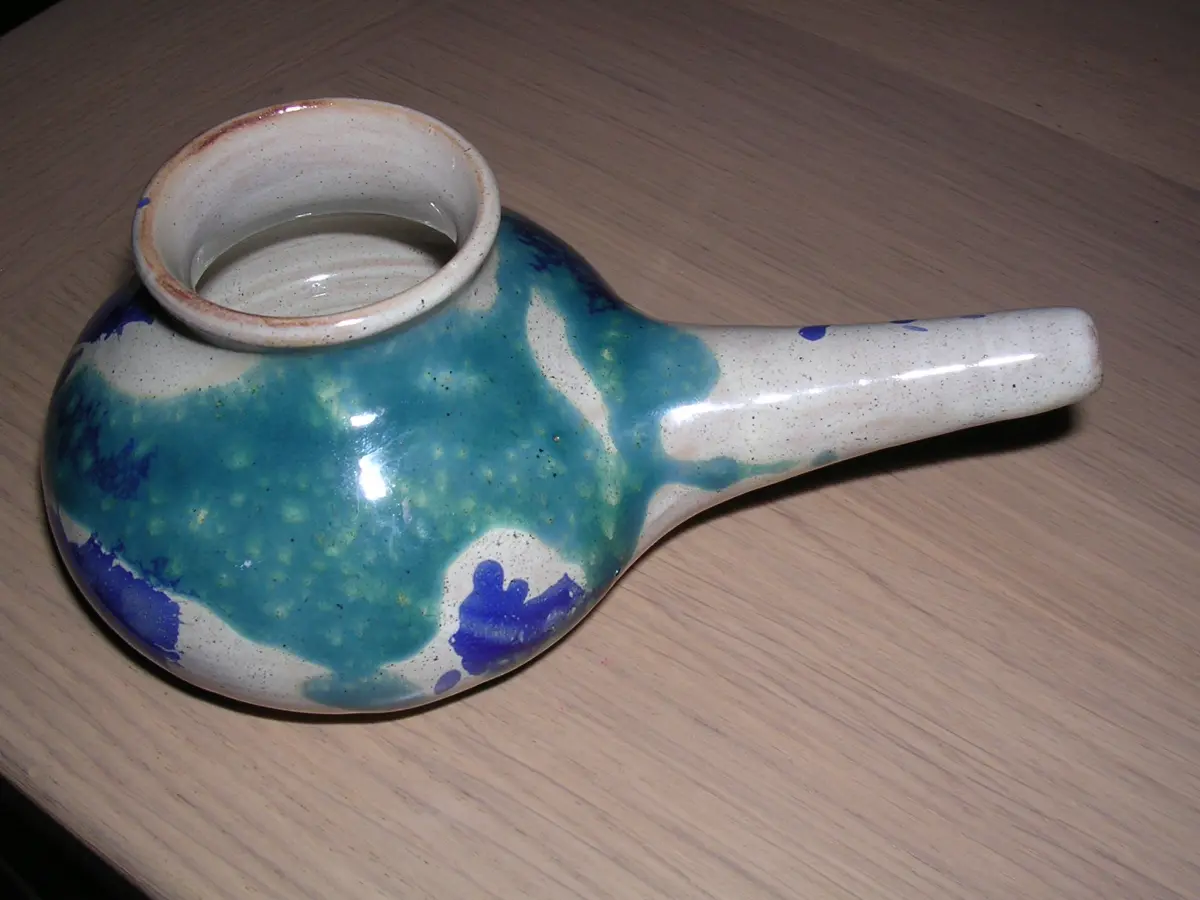
None of the trials compared pots, and the review did not rank devices. It never uses the words "neti pot": it describes rinsing "with low positive pressure from a spray, pump or squirt bottle, with a nebuliser or with gravity-based pressure in which the person instils saline into one nostril and allows it to drain out of the other", which is exactly what a pot does. Among the included trials, one used a bulb syringe and one a positive-pressure applicator. For allergies the useful distinction is volume: a pot or squeeze bottle sends far more water through the nose than a spray, and the review notes some evidence that higher pressure and volume reach the sinuses better. Beyond that, choose a pot you can wash thoroughly and dry completely, with a spout that seals your nostril without pressing. A ceramic or stainless lota, the kind sold in any Indian bazaar, does the job as well as anything newer. The price of the pot has nothing to do with the result; the water and the salt have everything.
What the texts say
The Haṭhayogapradīpikā knows neti with a thread, not water:
सूत्रं वितस्तिसुस्निग्धं नासानाले प्रवेशयेत् । मुखान्निर्गमयेच्चैषा नेतिः सिद्धैर्निगद्यते ॥
sūtraṃ vitasti-susnigdhaṃ nāsānāle praveśayet | mukhān nirgamayec caiṣā netiḥ siddhair nigadyate ||
Let him pass a well-oiled thread, a span long, into the nasal passage and draw it out through the mouth: this the siddhas call neti.
कपालशोधिनी चैव दिव्यदृष्टिप्रदायिनी । जत्रूर्ध्वजातरोगौघं नेतिराशु निहन्ति च ॥
kapāla-śodhinī caiva divya-dṛṣṭi-pradāyinī | jatrūrdhva-jāta-rogaughaṃ netir āśu nihanti ca ||
It cleanses the skull and bestows divine sight; neti swiftly destroys the host of diseases born above the collarbones.
"Diseases born above the collarbones" is the medieval text's own category, and a running, itching nose would have belonged to it. The text is not a trial, and the trials above are the measure of what we can honestly claim today. The water rinse from nostril to nostril, jala neti (jala, "water, any fluid", in Monier-Williams), is the gentler form taught in ashrams now, and the one you can learn alone once you know the water rule.
When a neti pot is not enough, and what to ask
See a pharmacist, as the NHS suggests, when rinsing alone does not keep the season bearable: antihistamines and steroid nasal sprays are the usual next step, and immunotherapy exists for people who respond to nothing else. See a doctor if symptoms get worse or do not improve with pharmacy medicines, if fever, nosebleeds or headaches appear while you are rinsing, or if the "allergy" is on one side only, which is not how pollen behaves. Two concrete questions to take with you: whether a daily rinse fits your case, and in which order to rinse and spray.
If you learn jala neti in a yoga school, ask the teacher where the water comes from before you touch the pot. Our page on neti pots and sinus infections covers the other reason people reach for the pot, and the health chapter holds the same line everywhere between what the texts promise and what the trials show.
The Pranayama manual goes beyond the rinse: it sets neti at the start of a complete morning sequence, from the cleansing actions through the first breathing practices, with the precautions written before each one and the water rule on the page where you need it.
Questions people ask
Is a neti pot good for allergies?
It is a reasonable comfort measure. In the 2018 Cochrane review, people with allergic rhinitis who rinsed with saline reported less severe disease than those who did not, at up to four weeks and from four weeks to three months, and the trials that recorded side effects found none in the saline groups. The authors graded the evidence low quality, so the effect is probable, not certain, and the allergy itself is unchanged.
How often should I use a neti pot for allergies?
The Cochrane review sets no frequency; its trials ran from seven days to three months, with none followed beyond that. In practice, once in the morning is the hatha yoga habit, with a second rinse after coming indoors on a high-pollen day if it clearly helps. If you rinse for a medical reason, ask your doctor or pharmacist how often, and whether to rinse before or after a nasal spray.
What is the best neti pot for allergies?
No trial has ranked pots. The Cochrane review never names the neti pot; it describes rinsing with a spray, pump or squirt bottle, a nebuliser, or by gravity from one nostril out of the other, which is what a pot does, and its authors describe the effect as mechanical: thinning mucus and washing out allergens. What matters is a pot you can clean and dry completely, water that is distilled, sterile or boiled, and salt at the right strength.
How does a neti pot help allergies?
By washing, not by medicine. The Cochrane authors write that the mechanism is not fully understood but is commonly held to be mechanical: clearance of mucus, and removal of airborne allergens and inflammation mediators such as histamine. Salt water thins the mucus so it leaves more easily and carries some of the pollen out with it. The immune reaction that causes the allergy continues, which is why the rinse eases symptoms rather than ending them.
Can a neti pot help a child with allergies?
Seven of the fourteen trials in the Cochrane review were in children, 499 of them, with the same modest result as in adults. The FDA says some children as young as 2 with nasal allergies could use a rinsing device if a paediatrician recommends it, and that very young children may not tolerate it. Ask the paediatrician first, and prepare the water exactly as for an adult.
Yogide explains what the texts and the studies say; it is not medical advice. If you have a health condition, are pregnant or feel pain, talk to your doctor before practising, and stop any posture that hurts.
Sources
- Head K, Snidvongs K, Glew S et al. Saline irrigation for allergic rhinitis. Cochrane Database of Systematic Reviews, 2018 DOI 10.1002/14651858.CD012597.pub2 PMID 29932206 checked October 19, 2026
- Hermelingmeier KE, Weber RK, Hellmich M, Heubach CP, Mösges R. Nasal irrigation as an adjunctive treatment in allergic rhinitis: a systematic review and meta-analysis. American Journal of Rhinology & Allergy, 2012 DOI 10.2500/ajra.2012.26.3787 PMID 23168142 checked October 19, 2026
- Is Rinsing Your Sinuses With Neti Pots Safe? U.S. Food and Drug Administration (updated 28 April 2025) checked October 19, 2026
- How to Safely Rinse Sinuses, Naegleria fowleri Infection, Centers for Disease Control and Prevention (16 July 2025) checked October 19, 2026
- Hay fever, NHS (reviewed 21 March 2024) checked October 19, 2026
- Svātmārāma, Haṭhayogapradīpikā, Sanskrit text (GRETIL, University of Göttingen) checked October 19, 2026
- Monier-Williams, Sanskrit-English Dictionary (1899), entry jala, Cologne Digital Sanskrit Dictionaries checked October 19, 2026