इतिहासitihāsa · 'so indeed it was', history
A history of yoga, from the Vedas to today
5 min read · Updated October 17, 2026 · sources checked October 17, 2026
In short
Yoga took shape in ancient India among Vedic seers and wandering ascetics. The first clear definitions appear in the Upanishads (Kaṭha Upaniṣad, roughly 5th-3rd century BCE); Patañjali's Yoga Sutras systematised it around 400 CE; hatha yoga, with its postures and breath, appears from the 11th century; and modern postural yoga grew in 20th-century India before spreading worldwide.
"Yoga is five thousand years old." You will read it everywhere, and it is the one sentence about yoga's history that the sources do not support. The real story is longer in some ways, shorter in others, and far more interesting: a discipline of the mind born among Vedic seers and wandering ascetics, written down in the Upanishads, systematised by Patañjali, transformed by tantra and hatha yoga, and reborn in twentieth-century India before travelling the world. Here it is, period by period, with the dates scholars actually defend.
Good to know
Indian dates are uncertain because most texts were composed and transmitted orally for centuries before they were written down. When we give a century, read "roughly"; when scholars disagree, we say so.
Before the texts: the Indus seals
In 1928 or 1929, excavators at Mohenjo-daro, a city of the Indus Valley Civilisation in present-day Pakistan, found a small steatite seal showing a horned figure seated with bent legs, surrounded by animals. The excavation director, Ernest Mackay, assigned it to a period now placed around 2350-2000 BCE.
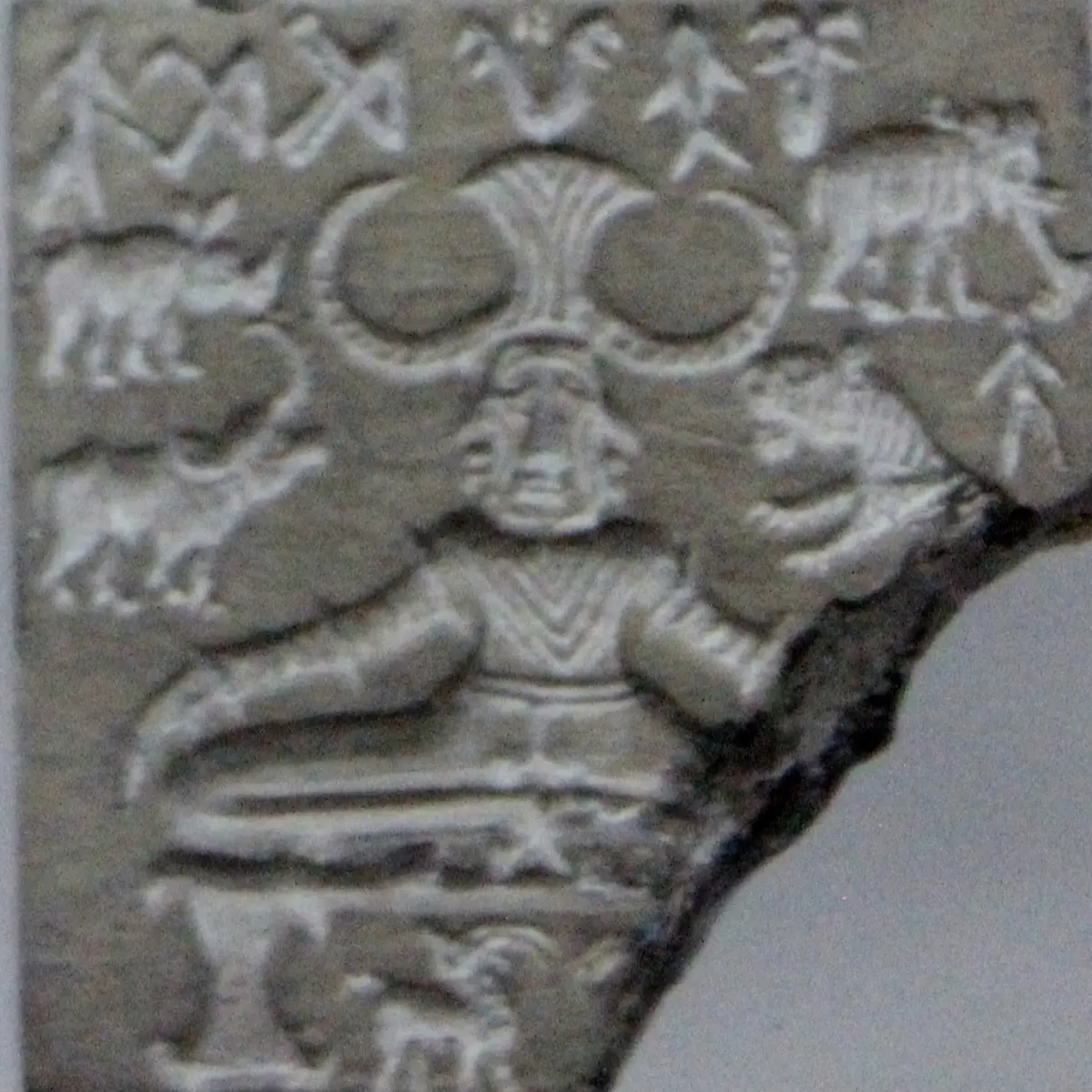
The archaeologist John Marshall, who led the excavations of the Indus sites, called the figure a "proto-Śiva", Lord of Animals (Paśupati), seated "in a typical yoga attitude". The name stuck, and so did the idea that yoga goes back to the Indus. Later scholars, among them Doris Srinivasan, Geoffrey Samuel and Wendy Doniger, have questioned almost every element of this reading. Honest conclusion: the seal shows a seated figure; whether it is a yogi, a god or a ritual posture cannot be known while the Indus script remains undeciphered.
The Vedic age: yoking and the long-haired sages
The Vedas, codified roughly between 1200 and 900 BCE, use yuj in its concrete sense: horses yoked to a chariot. They do not describe yoga as a method. But they already know ascetics on the edge of the ritual world, like the long-haired keśin of a famous hymn:
मुनयो वातरशनाः पिशङ्गा वसते मला । वातस्यानु ध्राजिं यन्ति यद्देवासो अविक्षत ॥
munayo vātaraśanāḥ piśaṅgā vasate malā | vātasyānu dhrājiṃ yanti yad devāso avikṣata ||
The silent sages, girdled with the wind, wear soiled garments of tawny colour; they follow the rush of the wind, when the gods have entered them.
The muni, "the silent one", is the ancestor of every yogi who will sit in silence by the Ganges. See the Vedas.
The Upanishads and the ascetics: yoga gets its definition
Between roughly the sixth and third centuries BCE, in the Ganges basin, new movements of renouncers (śramaṇa) appear: the Buddha, the Jains, the Ājīvikas. Scholars such as Geoffrey Samuel see the earliest yogic practices developing in these same ascetic circles. In the Brahmanical tradition, the Upanishads write the first definitions:
- The Kaṭha Upaniṣad, probably composed between the fifth and third centuries BCE, calls yoga "the steady holding of the senses" (6.11), and pictures the body as a chariot whose horses are the senses.
- The Śvetāśvatara Upaniṣad describes the seat, the upright body, the restrained breath and a quiet place sheltered from the wind (2.8-2.10): the first manual of meditation.
- The Maitrāyaṇīya Upaniṣad, a little later, names a sixfold yoga with breath control, withdrawal of the senses, meditation, concentration, reasoning and absorption.
An outside witness confirms that this was a living practice. Onesicritus, who came to India with Alexander the Great in the fourth century BCE, described ascetics near Taxila who stood, sat or lay naked and motionless in "different postures" (quoted by Strabo, Geography 15.1.63-65).
The epics and the Gita: yoga for those who act
In the Mahābhārata, the great epic, yoga leaves the forest. The Bhagavad Gita teaches that one can be a yogi in the middle of action: "yoga is skill in action" (2.50), and it names three ways, action, devotion and knowledge, that became karma yoga, bhakti yoga and jñāna yoga. See what is yoga? for its definitions.
Patañjali: the classical system
Around 400 CE, according to the dating of the Indologist Philipp Maas (others place the sutras earlier), Patañjali gathered the yoga of his time into 195 concise aphorisms with a commentary, the Pātañjalayogaśāstra. Its definition, "yoga is the stilling of the movements of the mind" (1.2), and its eight limbs became the classical frame. Its reach was wide: in the early eleventh century the Persian scholar Al-Bīrūnī, who lived in India for years, translated it into Arabic. Read the Yoga Sutras.
Tantra and bhakti: the body and the heart
From roughly the fifth century CE, tantric traditions, Śaiva, Śākta and Buddhist, brought new elements: mantra, initiation, visualisation, and a subtle body of channels (nāḍī), centres (cakra) and the coiled power kuṇḍalinī. At the same time, the devotional movement begun by the Tamil poet-saints spread across India, and the Bhāgavata Purāṇa joined meditation to love of Kṛṣṇa. See tantra yoga and the chakras.
Hatha yoga: postures, breath and seals
Around the turn of the second millennium, a new method emerged, which its texts call haṭha, "force". It works through the body: postures, breath retention, locks and seals, cleansing actions.
| Century | Text | What it brings |
|---|---|---|
| 11th | Amṛtasiddhi | the earliest known text teaching hatha methods |
| 13th | Dattātreyayogaśāstra | hatha yoga named as one of four yogas |
| 15th | Haṭhayogapradīpikā of Svātmārāma | the classic synthesis: 15 postures, 8 kumbhakas, 10 mudrās |
| 17th-18th | Gheraṇḍa Saṃhitā | 32 postures, 25 mudrās, a sevenfold path |
| 1737 | Joga Pradīpikā of Jayatarāma | a hatha manual in a Hindi idiom with 84 postures, painted one by one in a manuscript of 1830 |
These texts still say that hatha is for the sake of rāja yoga, the stilled mind. Read hatha yoga.
The modern renaissance, from Chicago to Rishikesh and Mysore
- 1890s. Swami Vivekananda tours the United States and Europe and publishes Raja Yoga (1896), which introduces Patañjali to a wide Western readership. He leaves the postures aside.
- 1918 and 1924. Shri Yogendra (who founded The Yoga Institute near Bombay in 1918) and Swami Kuvalayananda begin to study and teach postures in a modern, health-oriented way; Kuvalayananda founds Kaivalyadhama at Lonavla in 1924 and the journal Yoga Mīmāṃsā.
- 1920s. The Rajah of Aundh popularises the sun salutation as a daily exercise.
- 1924 and 1936. Swami Sivananda settles in Rishikesh and founds the Divine Life Society there in 1936, on the bank of the Ganges (Sivananda yoga).
- 1933. T. Krishnamacharya opens a yogaśālā in the Jaganmohan Palace of Mysore; his students include K. Pattabhi Jois and B.K.S. Iyengar.
- 1948 and 1966. Pattabhi Jois founds his institute in Mysore (ashtanga yoga); Iyengar publishes Light on Yoga.
- 1968. The Beatles stay at Maharishi Mahesh Yogi's ashram in Rishikesh for a meditation course, and the town becomes world-famous.
Scholars such as Mark Singleton have shown that twentieth-century postural yoga also absorbed elements of Indian wrestling and European gymnastics. That does not make it less Indian; it makes it a living tradition.
Yoga today
On 11 December 2014 the United Nations General Assembly proclaimed 21 June the International Day of Yoga (resolution 69/131), celebrated every year since 2015. In 2016 UNESCO inscribed yoga on the Representative List of the Intangible Cultural Heritage of Humanity. Rishikesh, Mysore and Munger remain places of pilgrimage for practitioners; see Rishikesh and Mysore.
The whole story in one table
| Period | Approximate dates | Key sources |
|---|---|---|
| Indus Valley seals | c. 2350-2000 BCE | the "Paśupati" seal (interpretation contested) |
| Vedic age | c. 1200-900 BCE (codification) | Ṛgveda 10.136, the keśin hymn |
| Upanishads, śramaṇas | c. 6th-3rd century BCE | Kaṭha, Śvetāśvatara; Buddha, Jains |
| Epics | turn of the era | Mahābhārata, Bhagavad Gita |
| Classical yoga | c. 400 CE (Maas) | Yoga Sutras with commentary |
| Tantra, bhakti | from c. 5th century CE | Śaiva and Śākta tantras, Bhāgavata Purāṇa |
| Hatha yoga | 11th-18th centuries | Amṛtasiddhi, Haṭhayogapradīpikā, Gheraṇḍa Saṃhitā |
| Modern yoga | 1890s to today | Vivekananda, Kuvalayananda, Krishnamacharya, Sivananda |
| International recognition | 2014, 2016 | UN Day of Yoga, UNESCO |
What remains uncertain
- The date of almost every early text, often by several centuries.
- Whether yoga's roots are mainly Vedic, mainly śramaṇa, or, as most scholars now think, a meeting of both.
- What the Indus figure represents.
What is certain is enough to be proud of: one of the longest continuous traditions of inner discipline in the world, documented in its own language for more than two thousand years. To read it in the sources, start with the paths of yoga and the sacred texts themselves.
Questions people ask
How old is yoga?
The word yoga in its spiritual sense is attested from the first millennium BCE, in the Upanishads. Ascetic practices described in the Rig Veda are older. Claims that yoga is '5,000 years old' rest on the interpretation of Indus Valley seals, which many scholars now reject.
Who is the father of yoga?
The hatha tradition names Śiva as its first teacher: the Hatha Yoga Pradipika opens by saluting Ādinātha, the first lord, who taught hatha yoga (1.1). Patañjali is often called the father of classical yoga because his Yoga Sutras gave it its classical form, but he compiled older teachings rather than inventing them.
When did yoga come to the West?
Swami Vivekananda toured the United States and Europe in the 1890s and published Raja Yoga in 1896. Postural yoga spread mainly after the Second World War, through teachers trained in India such as Iyengar, Pattabhi Jois and Sivananda's disciples.
Is modern yoga the same as ancient yoga?
Only in part. Ancient yoga was mainly a discipline of the mind and the senses, with a few seated postures. The many standing and flowing postures of today were developed in the twentieth century, building on hatha yoga.
Sources
- History of yoga, Wikipedia (Vedas, Upanishads, Onesicritus, tantra, Al-Biruni, Joga Pradipika 1737 and its 1830 manuscript, modern yoga) checked October 17, 2026
- Pashupati seal, Wikipedia (Mohenjo-daro, Mackay's dating, Marshall's proto-Shiva reading and its critics) checked October 17, 2026
- Ṛgveda, Sanskrit text, ed. Aufrecht, hymn 10.136 (GRETIL, University of Göttingen) checked October 17, 2026
- Kaṭha Upaniṣad, Sanskrit text (GRETIL, University of Göttingen) checked October 17, 2026
- Svātmārāma, Haṭhayogapradīpikā, Sanskrit text, 1.1 (GRETIL, University of Göttingen) checked October 17, 2026
- Śvetāśvatara Upaniṣad, Sanskrit text, 2.8-2.10 (GRETIL, University of Göttingen) checked October 17, 2026
- Yoga Sutras of Patanjali, Wikipedia (Philipp A. Maas: Pātañjalayogaśāstra about 400 CE) checked October 17, 2026
- James Mallinson and Mark Singleton, Roots of Yoga (Penguin Classics, 2017) checked October 17, 2026
- Swami Vivekananda, Raja Yoga (1896), Internet Archive checked October 17, 2026
- Ashtanga vinyasa yoga, Wikipedia (Mark Singleton on wrestlers' and gymnasts' exercises in Krishnamacharya's system) checked October 17, 2026
- Kaivalyadhama, Wikipedia (founded by Swami Kuvalayananda in 1924, journal Yoga Mimamsa) checked October 17, 2026
- Sivananda Saraswati, Wikipedia (Rishikesh 1924, Divine Life Society 1936) checked October 17, 2026
- The Beatles in India, Wikipedia (Rishikesh, February 1968) checked October 17, 2026
- United Nations, International Day of Yoga, 21 June (resolution 69/131, 11 December 2014) checked October 17, 2026
- UNESCO, Yoga, Representative List of the Intangible Cultural Heritage of Humanity (2016) checked October 17, 2026