धर्मdharma · what upholds; order, duty, right conduct
Dharma, what holds the world together
6 min read · Updated October 20, 2026 · sources checked October 20, 2026 · Editorial: The Yogide team
In short
Dharma comes from the verb dhṛ, to hold, to support: it is what upholds the world and a life. It means right order, duty, law, virtue and truth; the Bṛhadāraṇyaka Upaniṣad says that dharma is truth. In the Bhagavad Gita, svadharma is one's own duty: 'better one's own dharma, though imperfect, than another's well done' (3.35). It is the first of the four aims of life.
Few words are harder to translate than dharma. English has tried "duty", "law", "religion", "righteousness", "virtue", "the way", and each catches only a part. This page goes back to the root of the word and to the texts that use it, so that you can hear it as a yogi would.
The word: what holds
धर्म (dharma) comes from the verb dhṛ, to hold, to bear, to support. The Rig Veda already has the older form dharman, "support, foundation". Monier-Williams opens his long entry with "that which is established or firm", then "statute, ordinance, law", "usage, practice, prescribed conduct, duty", "right, justice", "virtue, morality, religion".
All these meanings come back to one image: dharma is what holds things together. The order by which the seasons return, the duty that holds a family, the justice that holds a society, the truthfulness that holds a person: each is dharma.
Dharma is truth
The Bṛhadāraṇyaka Upaniṣad tells how the creator, finding that the powers he had made were not enough, created something higher than royal power: dharma. "There is nothing higher than dharma," it says; through it, even a weak man can prevail over a strong one, as with the help of a king. And then:
यो वै स धर्मः सत्यं वै तत् ।
yo vai sa dharmaḥ satyaṃ vai tat |
That which is dharma is truly truth.
The text continues: "That is why, of one who speaks the truth, people say 'he speaks dharma', and of one who speaks dharma, 'he speaks the truth'; for the two are one." In yoga terms, dharma and satya, the second yama, cannot be separated.
The Gita: a book that begins with dharma
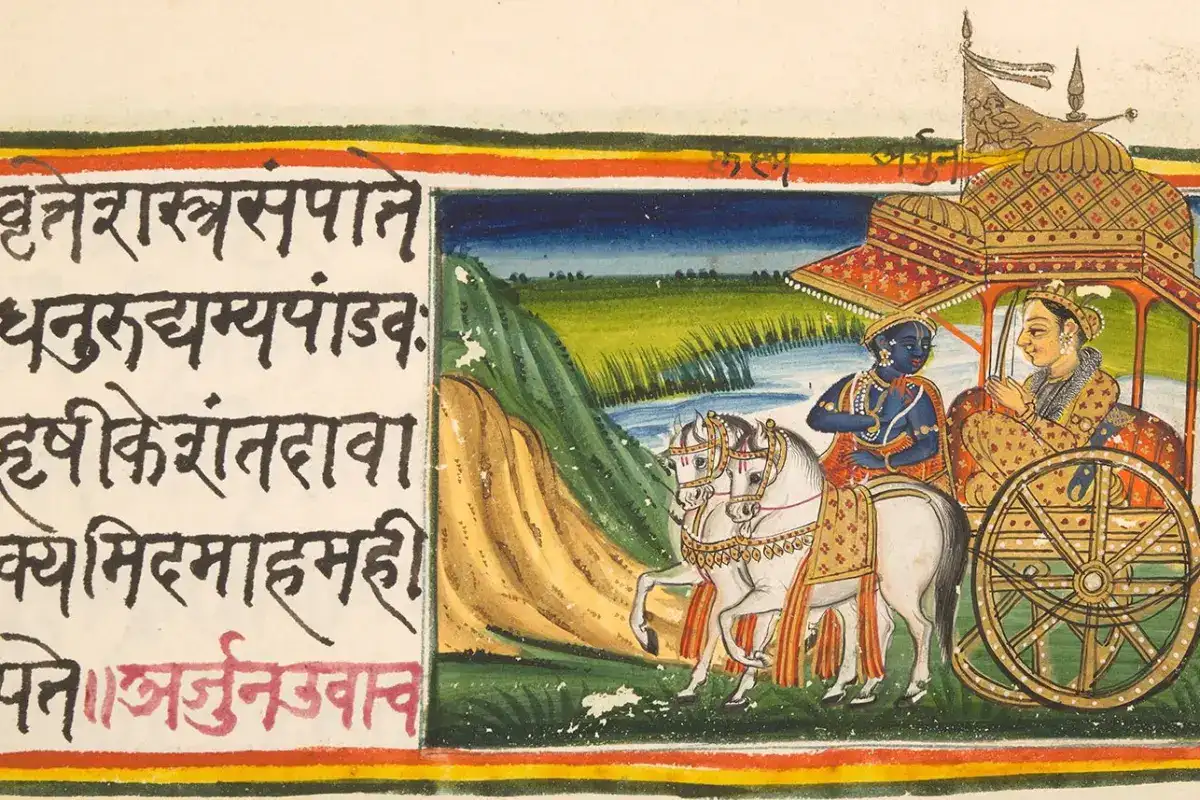
The Bhagavad Gita opens with the word: dharma-kṣetre kuru-kṣetre, "on the field of dharma, on the field of the Kurus" (1.1). And the whole dialogue begins because Arjuna no longer knows what his dharma is. Facing his own kin in battle, he tells Kṛṣṇa that his mind is "confused about dharma" (dharma-saṃmūḍha-cetāḥ, 2.7) and asks to be taught.
The answer has several layers. The best known is svadharma, one's own dharma:
श्रेयान्स्वधर्मो विगुणः परधर्मात्स्वनुष्ठितात् । स्वधर्मे निधनं श्रेयः परधर्मो भयावहः ॥
śreyān svadharmo viguṇaḥ paradharmāt svanuṣṭhitāt | svadharme nidhanaṃ śreyaḥ paradharmo bhayāvahaḥ ||
Better one's own dharma, though imperfect, than the dharma of another, well performed. Better to die in one's own dharma; the dharma of another brings danger.
The first line returns, almost word for word, at 18.47. For Arjuna, a warrior, svadharma meant fighting a just war. The Gita bound svadharma to the social order of its time, and that link to birth is not something we need to adopt. But the principle speaks to anyone: a life borrowed from someone else, however brilliant, is less true than your own, however modest.
The Gita also gives dharma a cosmic dimension. Kṛṣṇa says that "whenever dharma declines and adharma rises", he takes form, age after age, to protect the good and re-establish dharma (4.7-8). And at the very end comes the most surprising verse: sarva-dharmān parityajya mām ekaṃ śaraṇaṃ vraja, "abandoning all dharmas, take refuge in me alone" (18.66). Beyond every duty, the last word goes to surrender.

The ten marks of dharma
Dharma is not only a matter of social roles. The Manusmṛti, a law book that is otherwise very much of its time, gives a list of ten marks of dharma that the verse just before (6.91) asks the twice-born to cultivate in all four stages of life:
धृतिः क्षमा दमोऽस्तेयं शौचमिन्द्रियनिग्रहः । धीर्विद्या सत्यमक्रोधो दशकं धर्मलक्षणम् ॥
dhṛtiḥ kṣamā damo 'steyaṃ śaucam indriya-nigrahaḥ | dhīr vidyā satyam akrodho daśakaṃ dharma-lakṣaṇam ||
Steadiness, forgiveness, self-control, not stealing, purity, restraint of the senses, understanding, knowledge, truthfulness and freedom from anger: these ten are the marks of dharma.
Notice how close this list is to the yamas and niyamas of yoga: not stealing, purity, truthfulness, restraint. The ethical core of dharma and of yoga is the same.
Dharma in the Yoga Sutras: a different sense
Patañjali uses the word in a technical, philosophical sense. For him a dharma is a property or state of a substance (dharmin): in Vyāsa's example, clay takes the form of a lump, then of a pot, new and then old, without ceasing to be clay (3.13-3.14). And the highest samādhi of the text is called dharma-megha, "the cloud of dharma" (4.29). So when you meet the word in the Yoga Sutras, do not read "duty": read "property", "nature".
Dharma and the four aims of life
Indian tradition names four aims of human life (puruṣārtha): dharma, artha (wealth and means), kāma (pleasure and love) and mokṣa (liberation). Dharma comes first because it sets the frame: wealth and pleasure are legitimate when pursued within dharma. Mokṣa, liberation, lies beyond the other three.
Finding your own dharma: questions to sit with
The texts give no test that tells you your svadharma. They give principles. A few questions, to take into meditation or a notebook:
- What holds? Which commitments in your life hold others up: children, parents, students, colleagues? Dharma starts there.
- Is it true? Following Bṛhadāraṇyaka 1.4.14, ask whether what you are doing can be said truthfully, without disguise.
- Is it yours? Following Gita 3.35, ask whether you are living your life or someone else's: a parent's plan, a model on social media.
- The ten marks. At the end of a week, read the ten marks of Manusmṛti 6.92 and note the one you most lacked; work on it next week.
- Act, then let go. Once you see your duty, do it fully and leave the result, as in karma yoga. How action and its fruits bind or free is the subject of the karma page.
Questions people ask
What does dharma mean in simple terms?
Dharma is what holds things together: the right way for the world to run and for a person to live. Depending on the context it means duty, law, justice, virtue, religion or truth. Monier-Williams opens his entry with 'that which is established or firm'.
What is svadharma?
One's own dharma: the duty that belongs to your nature, situation and stage of life. The Bhagavad Gita says twice that it is better to follow your own dharma imperfectly than another's perfectly (3.35 and 18.47).
Is dharma the same as religion?
Not exactly. Hindi and other Indian languages now use dharma for 'religion', but the older word is wider: it covers cosmic order, social and personal duty, ethics and law. A thief can follow a religion; he does not follow dharma.
What are dharma, artha, kama and moksha?
The four aims of human life (puruṣārtha): dharma (right order and duty), artha (wealth and means), kāma (pleasure and love) and mokṣa (liberation). Dharma comes first because it gives the measure within which wealth and pleasure are pursued.
What is the difference between dharma and karma?
Karma is action and its consequences; dharma is the right action, the order your action should serve. The Gita joins them: do your own work (svadharma) as an offering, without clinging to its fruits.
Sources
- Bṛhadāraṇyaka Upaniṣad (Kāṇva recension), Sanskrit text (GRETIL): 1.4.14 checked October 20, 2026
- Bhagavadgītā, critical edition (BORI), Sanskrit text (GRETIL): 1.1, 2.7, 3.35, 4.7-8, 18.47, 18.66 checked October 20, 2026
- Manusmṛti, Sanskrit text (GRETIL): 6.91-92 checked October 20, 2026
- Patañjali, Yogasūtra, Sanskrit text (GRETIL): 3.13-3.14, 4.29 checked October 20, 2026
- Monier-Williams, Sanskrit-English Dictionary (1899), entry dharma, Cologne Digital Sanskrit Dictionaries checked October 20, 2026