कर्मkarman · action, deed, and its fruit
Karma, the meaning of action
6 min read · Updated October 20, 2026 · sources checked October 20, 2026 · Editorial: The Yogide team
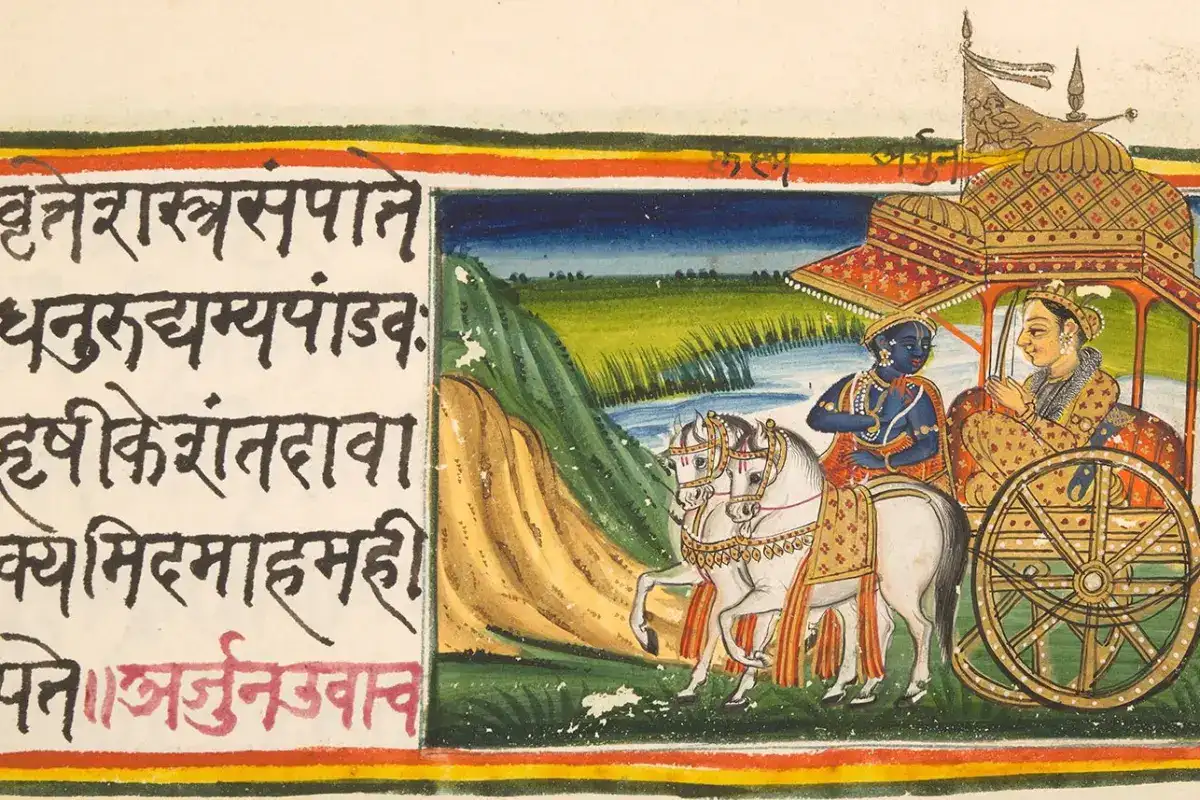
In short
Karma means action. In Indian thought it also names the principle that every intentional action leaves a trace that ripens as experience, in this life or a later one. The Bṛhadāraṇyaka Upaniṣad states it: 'as one acts, so one becomes.' The Yoga Sutras root karma in the afflictions (2.12); the Gita teaches action without attachment and says knowledge burns karma like fire (4.37).
"That's karma" has become an everyday phrase for poetic justice. The Sanskrit word means something both simpler and deeper. This page goes back to the texts that shaped the idea, from the Upaniṣads to Patañjali and the Gita, and to what a yogi is asked to do with it.
The word: action
कर्म (karma, stem karman) comes from the verb kṛ, to do, to make. Its first meaning is simply action: a deed, a task, and in the Vedas above all the ritual act. The Gita still uses it in this plain sense when it says that "no one can remain even for a moment without acting" (3.5).
Over time the word came to carry a second meaning: not only the act, but the trace it leaves and the fruit (phala) that trace bears. When people say "karma" today, they usually mean this second sense: the principle that actions return to the one who acts.
The first teaching: a secret between two sages
The earliest clear statement is in the Upaniṣads, and it is told as a secret. In the Bṛhadāraṇyaka Upaniṣad, Ārtabhāga asks the sage Yājñavalkya what becomes of a person when, at death, speech goes into fire, breath into wind and the eye into the sun. Yājñavalkya takes him by the hand: "This is for the two of us alone to know, not for a crowd." They step aside to talk, and the text says: "What they spoke of was action; what they praised was action. One becomes good by good action, bad by bad action" (3.2.13).
Later in the same Upaniṣad, the teaching is stated openly:
यथाकारी यथाचारी तथा भवति । साधुकारी साधुर्भवति । पापकारी पापो भवति ।
yathākārī yathācārī tathā bhavati | sādhukārī sādhur bhavati | pāpakārī pāpo bhavati |
As one acts, as one behaves, so one becomes. One who does good becomes good; one who does evil becomes evil.
The same passage traces the chain to its root: "As one's desire is, so is one's resolve; as one's resolve is, so is the act one does; and whatever act one does, that one attains." Karma starts with desire.
Karma in the Yoga Sutras
Patañjali gives karma a precise mechanism. Every intentional act leaves a deposit, the karmāśaya, literally "the resting place of action":
क्लेशमूलः कर्माशयो दृष्टादृष्टजन्मवेदनीयः ॥
kleśa-mūlaḥ karmāśayo dṛṣṭādṛṣṭa-janma-vedanīyaḥ ||
The store of action has the afflictions as its root; it is experienced in the present life or in lives not yet seen.
सति मूले तद्विपाको जात्यायुर्भोगाः ॥
sati mūle tad-vipāko jāty-āyur-bhogāḥ ||
As long as the root remains, it ripens as birth, length of life and experience.
Those ripenings bring joy or pain depending on whether the act was meritorious or not (2.14). The key word is root: the afflictions (kleśa), above all ignorance, then egoism, attachment, aversion and clinging to life (2.3). Remove the root and the store no longer sprouts. That is why Patañjali's practical conclusion is so hopeful: heyaṃ duḥkham anāgatam, "suffering that has not yet come is to be avoided" (2.16).
In the last chapter he adds a distinction that matters for anyone on the path:
कर्माशुक्लाकृष्णं योगिनस्त्रिविधमितरेषाम् ॥
karmāśuklākṛṣṇaṃ yoginas trividham itareṣām ||
The action of the yogi is neither white nor black; that of others is of three kinds.
Vyāsa explains the three kinds: black for the wicked; white and black mixed for actions that depend on outer means, which help some beings by harming others; white for those who practise discipline, study and meditation. The yogi's action is "neither": done without the afflictions and without seeking a fruit, it leaves no new deposit.
The Gita: act, but without clinging
The Bhagavad Gita faces the problem head on. If every action binds, should one stop acting? No, Kṛṣṇa answers: no one can stop acting (3.5), and inaction is itself a choice. The question is how to act. Its most famous verse, karmaṇy evādhikāras te mā phaleṣu kadā cana, "your right is to the action alone, never to its fruits" (2.47), is the foundation of karma yoga.
The Gita also warns against easy judgements:
कर्मणो ह्यपि बोद्धव्यं बोद्धव्यं च विकर्मणः । अकर्मणश्च बोद्धव्यं गहना कर्मणो गतिः ॥
karmaṇo hy api boddhavyaṃ boddhavyaṃ ca vikarmaṇaḥ | akarmaṇaś ca boddhavyaṃ gahanā karmaṇo gatiḥ ||
One must understand action, understand wrong action, and understand inaction: deep is the way of action.
And it gives the way out:
यथैधांसि समिद्धोऽग्निर्भस्मसात्कुरुतेऽर्जुन । ज्ञानाग्निः सर्वकर्माणि भस्मसात्कुरुते तथा ॥
yathaidhāṃsi samiddho 'gnir bhasmasāt kurute 'rjuna | jñānāgniḥ sarva-karmāṇi bhasmasāt kurute tathā ||
As a blazing fire reduces firewood to ashes, Arjuna, so the fire of knowledge reduces all actions to ashes.
How karma ends: the potter's wheel
If knowledge burns karma, why does the sage go on living, eating, falling ill? The Vedānta tradition answers with an image. In his commentary on the Brahmasūtra (4.1.13-15), Śaṅkara explains that knowledge destroys the accumulated actions that have not yet begun to bear fruit, and prevents new ones from clinging. But the actions that have already begun to ripen, the ones that produced this very body, run their course, "like a potter's wheel" (kulāla-cakravat) that keeps turning after the potter has stopped, until its momentum is spent.
Later Vedānta gives the three stocks names that are still used today: sañcita, karma accumulated from the past; prārabdha, karma that has begun to bear fruit in this life; and āgāmin, karma being created now. The practical lesson is simple: you cannot change what has already been set in motion, but you are entirely responsible for what you set in motion now. Liberation from this cycle is called mokṣa.
What karma does not mean
- Not fate. The texts never say "it was written". They say "as you act, so you become", which places the future in your hands.
- Not a cosmic punishment system. The Upaniṣads and Patañjali describe a process, like a seed that sprouts, not a judge who sentences.
- Not a reason to blame people for their suffering. No text asks us to read other people's past lives in their misfortunes; the Gita calls the way of action "deep". The first ethical rule of yoga is ahiṃsā, non-harming, not judgement.
- Not instant justice. The "karma will get them" of everyday speech has little to do with a teaching in which fruits may ripen in "lives not yet seen".
Working with karma: a yogi's practice
- Watch the root. Before an important act, ask what desire is moving you (Bṛhadāraṇyaka 4.4.5: desire, then resolve, then act).
- Do the work, drop the fruit. For one task a day, do it as well as you can and consciously give up the result: the practice of Gita 2.47.
- Accept what is already in motion. When something you cannot change happens, name it as prārabdha, the wheel still turning, and put your energy into your next act instead.
- Lighten the deposit. Patañjali's niyamas, especially tapas, study and surrender, are the tools he gives for thinning the afflictions (2.1-2.2).
Questions people ask
What is the simple meaning of karma?
Karma (karman) is Sanskrit for action, deed, work. As a teaching, it says that intentional actions have consequences that come back to the one who acts: good deeds make one good, harmful deeds make one harmful, and their traces ripen as future experience.
Is karma the same as fate?
No. In the texts, karma is what you did, and the future is shaped by what you do now. Patañjali says that suffering yet to come can be avoided (Yoga Sutra 2.16), and the Gita urges Arjuna to act. Only the karma that has already begun to ripen in this life is said to run its course.
What is the difference between karma and karma yoga?
Karma is action and its consequences. Karma yoga is a way of acting: doing what must be done without clinging to its fruits, as the Bhagavad Gita teaches (2.47). Karma yoga is the yogi's answer to the problem of karma.
What are the three types of karma?
Later Vedānta distinguishes the karma accumulated from the past (sañcita), the karma that has begun to bear fruit in this life (prārabdha) and the karma being created now (āgāmin). Śaṅkara's commentary on Brahmasūtra 4.1.13-15 already sets out the principle: knowledge destroys the stock not yet begun, while begun karma runs out like a potter's wheel.
Does karma mean that suffering is deserved?
The texts do not ask anyone to judge the suffering of others, and using karma to blame victims goes against the yamas, beginning with non-harming. The Gita describes the ways of action as 'deep' (gahanā, 4.17): too subtle for us to read in other people's lives.
Sources
- Bṛhadāraṇyaka Upaniṣad (Kāṇva recension) with Śaṅkara's commentary, Sanskrit text (GRETIL): 3.2.13 and 4.4.5 checked October 20, 2026
- Patañjali, Yogasūtra with Vyāsa's Yogabhāṣya, Sanskrit text (GRETIL, University of Göttingen): 2.12-2.16, 4.7 checked October 20, 2026
- Bhagavadgītā, critical edition (BORI), Sanskrit text (GRETIL): 2.47, 3.5, 4.17, 4.37 checked October 20, 2026
- Bādarāyaṇa, Brahmasūtra with Śaṅkara's commentary, Sanskrit text (GRETIL): 4.1.13-15 checked October 20, 2026