योगनिद्राyoga-nidrā · yogic sleep
Does yoga nidra help you sleep?
11 min read · Updated October 23, 2026 · sources checked October 19, 2026 · Editorial: The Yogide team
In short
Probably a little, and the evidence is thin. A 2026 meta-analysis found only five usable studies: sleep quality improved after yoga nidra, but the effect was not statistically significant in the randomised trials and the certainty was very low. One small Indian trial saw deeper sleep on polysomnography, repeated only in volunteers. Yoga nidra is a gentle, low-risk way to wind down, not a treatment for insomnia.
The short answer
Probably a little, and honestly, nobody can yet say how much. Three pieces of research, read today, draw the picture.
The only meta-analysis is cautious. In 2026, an Indian team searched four databases up to March 2025 and found just five usable studies of yoga nidra for poor sleep (Singh et al., Sleep and Breathing). The two randomised trials, with 181 people in all, showed a large-looking improvement in Pittsburgh sleep-quality scores (SMD −1.04) that was not statistically significant (p = 0.50). Two observational studies, 45 people, found a significant and large effect (SMD −1.82, p = 0.026), which is what you would expect when there is no control group. On the Insomnia Severity Index, two trials with 99 people again showed no significant effect (SMD −1.00, p = 0.06). The authors grade the certainty very low and call their own findings "preliminary and hypothesis-generating". Most trials came from India, and small samples and heterogeneity weigh on all of them.
One trial measured sleep in the lab, and it is encouraging. Forty-one adults with chronic insomnia were randomised between 2012 and 2016 to cognitive behavioural therapy for insomnia (20 people) or yoga nidra (21 people) (Datta et al., 2021). Everyone had polysomnography before the programme, but the recording was "repeated only in those who volunteered", and the abstract does not say how many did. Among them, both groups slept longer and were awake less, and yoga nidra showed a marked rise in the share of N2 and N3 sleep, the deep stages; subjective sleep quality improved too. Salivary cortisol fell significantly after yoga nidra (p = 0.041). The authors conclude that it "can be used for treatment of chronic insomnia after supervised practice sessions". Keep the size in mind: 41 people, no untreated group, sessions supervised by the researchers, and lab results from an unknown, self-selected subset.
A sleep-lab study shows what changes in the body, and what does not. Twenty-two adults with self-reported insomnia came twice to a sleep laboratory; on the second visit half were randomised to practise yoga nidra for the first thirty minutes of a ninety-minute lying rest (Sharpe et al., 2023). Alpha brain-wave power, heart-rate variability and the time to fall asleep did not differ between the groups. Breathing did: the yoga nidra group slowed by 1.4 breaths a minute during the practice and 2.1 afterwards, while the control group sped up slightly (p = 0.03). Slower breathing, an unchanged brain picture, a practice that was well tolerated, with one person in twenty dropping out.
Put together: yoga nidra is a gentle, low-risk way to rest that may improve how you sleep, with evidence too thin to promise anything. That is more than most bedtime habits can claim, and less than the videos promise.
Can yoga nidra reduce the sleep you need?
No study measures that, and none of the trials above claims it. They ask whether people sleep better, never whether they can sleep less. The lab study is the closest thing to a test: brain measures and sleep latency did not differ from lying quietly. If a daily practice leaves you sleepy in the afternoon, read that as a body asking for more sleep, not less. Treat yoga nidra as rest added to your night.
Where it fits beside real treatment
For chronic insomnia, the American Academy of Sleep Medicine's 2021 guideline gives a strong recommendation to multicomponent cognitive behavioural therapy for insomnia, CBT-I, and conditional recommendations to brief multicomponent therapies, stimulus control, sleep restriction and relaxation therapy; it advises against sleep hygiene advice used on its own (Edinger et al., 2021). Yoga nidra belongs to the relaxation family: a reasonable companion to CBT-I, not a replacement. Our page on yoga for sleep and insomnia sets the wider research in the same frame.
Two questions worth asking a doctor or sleep specialist: whether CBT-I is available to you, and whether practising while lying in bed fits the rules they give you, since some programmes ask you to keep the bed for sleep alone. One question for any teacher: what they do when a student falls asleep in class. The right answer is "nothing".
Where the word comes from
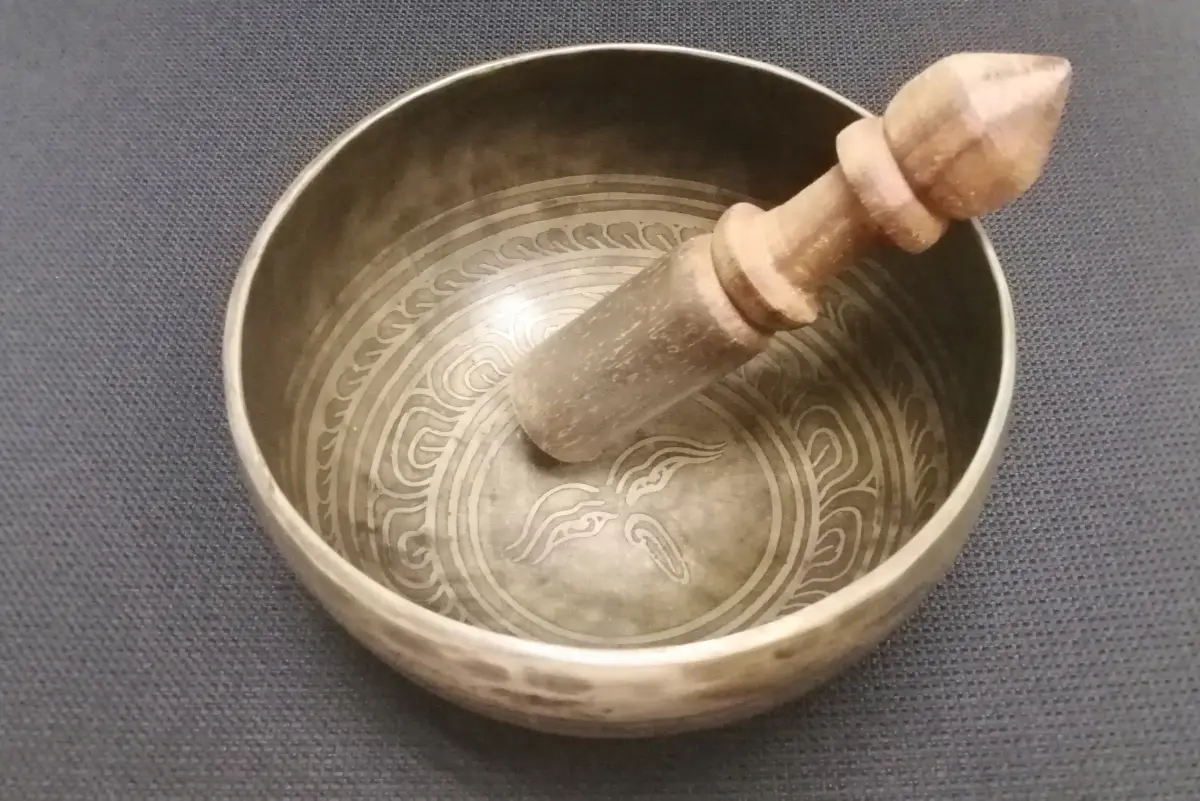
Monier-Williams defines yoga-nidrā (योगनिद्रा) as "meditation-sleep", a state half meditation and half sleep, and especially the sleep of Viṣṇu at the end of an age, personified as a goddess and said to be a form of Durgā. The medieval hatha texts use it for the summit of practice:
अभ्यसेत्खेचरीं तावद्यावत्स्याद्योगनिद्रितः । सम्प्राप्तयोगनिद्रस्य कालो नास्ति कदाचन ॥
abhyaset khecarīṃ tāvad yāvat syād yoga-nidritaḥ | samprāpta-yoga-nidrasya kālo nāsti kadācana ||
Let one practise khecarī until one is asleep in yoga. For one who has reached yogic sleep, time (death) never comes.
Kāla means both time and death here: the verse promises the yogi who rests in yoga-nidrā an escape from mortality, not a better night.
The guided technique is modern. Swami Satyananda Saraswati, born in 1923 at Almora and founder of the Bihar School of Yoga, set out his system of guided relaxation in his book Yoga Nidra in 1976, in eight stages: internalisation, resolve (saṅkalpa), rotation of consciousness, breath awareness, opposite sensations, visualisation, the resolve again, and return. A French yoga author, Dennis Boyes, had published Le Yoga du sommeil éveillé three years earlier. Everything you hear in a recording today descends from that period, not from the Pradīpikā. The full history and stages are on our yoga nidra page.
A short practice for bedtime
The practice below follows Satyananda's eight stages and fits the length of the shortest recording in the German trial, eleven minutes. Read it once, then do it from memory, or record it in your own voice with long pauses.
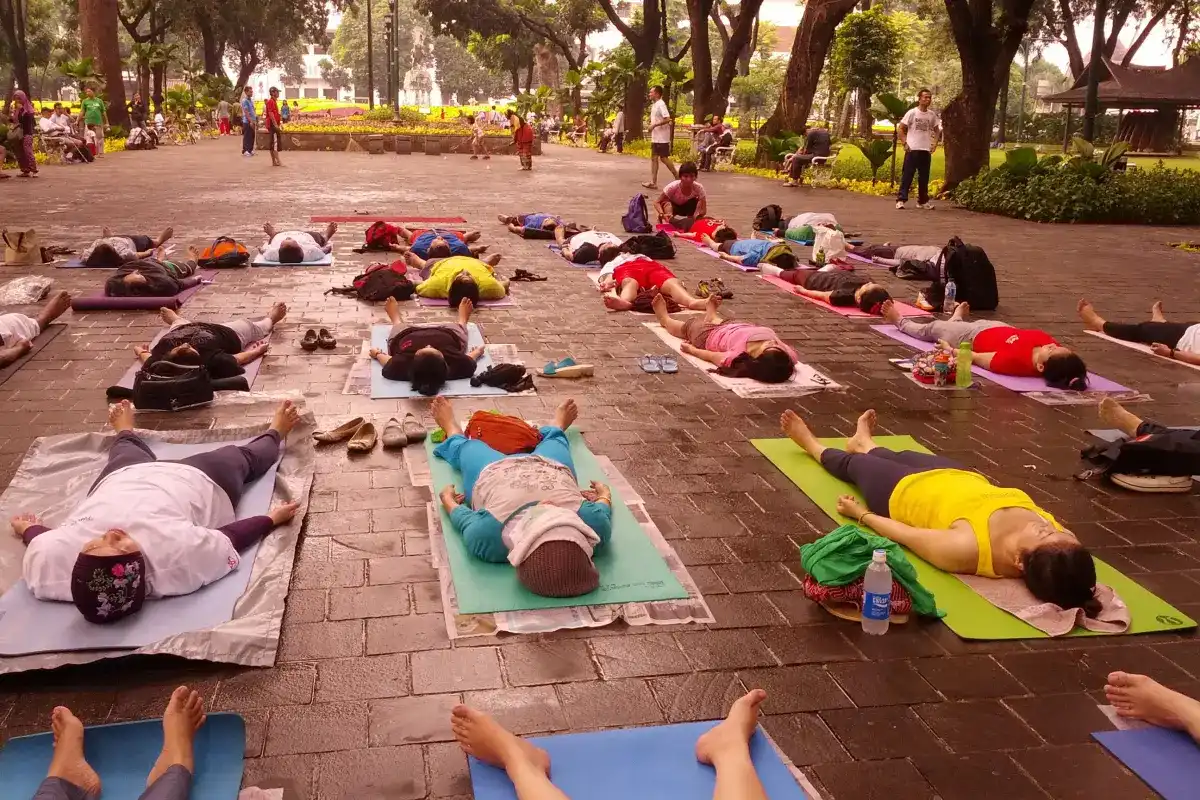
- Settle. Lie in śavāsana, arms a little away from the body, palms up, feet falling outwards. Say silently: I am going to practise yoga nidra. I will stay awake and listen. At bedtime, drop that sentence: tonight, falling asleep is allowed.
- Sounds. Hear the farthest sounds, then nearer ones, then the sounds in the room, then the breath. Do not name them.
- Resolve. One short sentence in the present tense, about what matters to you. Repeat it silently a few times, with feeling, then let it go.
- Rotation. Move attention, without moving the body, through the right side: thumb, each finger, palm, wrist, elbow, shoulder, side, hip, thigh, knee, calf, ankle, heel, sole, toes. Then the left side in the same order, the back from heels to head, the face from forehead to throat, then the whole body at once.
- Breath. Feel the belly rise and fall. Count the breaths backwards from a number you can hold; if you lose the count, begin again.
- Opposites. Feel the body heavy, sinking into the bed. Then light, as if floating. Then let both go.
- Images. Let a few simple pictures pass without holding them: a lamp burning without wind, a river at dawn, a bird crossing a clear sky.
- Resolve and return. Repeat the same sentence. Then, if you are practising in the day, feel the floor, move fingers and toes, roll to the side and sit up slowly. At bedtime, skip the return and let sleep come.
The practice and the night are two different things. In the day, stay awake through the ending; at night, use the stages as a road into sleep and do not mind where you leave it. If a longer out-breath settles you faster, bhramari, the humming breath, done a few times before you lie down, pairs well with this.
Choosing a recording
Any video can call itself yoga nidra for sleep, and no trial compares one against another, so there is no best. The German trial is useful here: 362 adults were randomised to an eleven-minute recording, a thirty-minute recording, an active control or a waiting list, practising online for two months; the eleven-minute group improved on well-being compared with the waiting list, with very small effects (d = 0.08 to 0.16), and regular practice went with lower cortisol (Moszeik et al., 2025). A short recording, done regularly, is enough. When you choose one, listen for the stages above, for permission to move or open your eyes, for a voice that does not hurry, and for the absence of promises: no healing, no hours of sleep gained. Start the video, turn the screen face down, and keep the room dark. For supported postures before lying down, restorative yoga is the natural partner.
How to judge whether it works for you
Give it a fixed slot each evening for two months, the span of the German trial, and note three things each morning: when you went to bed, whether you practised, and how you slept. The diary tells you more than any study can, and it is exactly what a doctor needs if sleep does not improve.
Our book on yoga nidra goes further than one bedtime script: it separates what the old texts say from what Satyananda built, gives eight original scripts from ten to forty minutes, including one written for falling asleep and one seated, helps you write a saṅkalpa that lasts, says who should be careful, and reads the research with every study checked on PubMed.
Questions people ask
Is yoga nidra good for sleep?
It is a reasonable, gentle thing to try. In the only meta-analysis so far, people who practised yoga nidra reported better sleep quality, but the pooled result from the two randomised trials was not statistically significant and the certainty of the evidence was rated very low. One trial of 41 adults with chronic insomnia found more deep sleep after supervised yoga nidra, though the sleep recording was repeated only in those who volunteered for it. Try it, keep a sleep diary, and do not expect it to replace treatment.
What is the best yoga nidra for sleep?
No study compares recordings or teachers, so nobody can honestly name a best one. The German trial that showed small effects used an eleven-minute recording listened to online, which tells you that short and simple works. Choose a voice you find calm, a script that follows the classical stages, that gives you permission to move or open your eyes, and that makes no promises of healing.
Can yoga nidra reduce the sleep you need?
No study we read measures that, and none of the trials claims it. They measure how well people sleep, not how little they can get away with. In the sleep-lab study, breathing slowed during the practice but brain-wave measures and the time to fall asleep did not differ from lying quietly. Treat yoga nidra as rest added to your night, never as a substitute for it.
Is a yoga nidra for sleep video on YouTube enough?
A recording is a legitimate way to practise: the largest randomised trial delivered yoga nidra entirely online, as audio, over two months. A video adds a screen, which is the one thing you do not want at bedtime, so start it, put the phone face down and listen. If poor sleep has lasted weeks, a recording is not enough, and a doctor should hear about it.
How long does yoga nidra take to help with sleep?
Nobody knows precisely. In the German trial, people practised for two months, ideally daily, and the measured gains in well-being were very small. In the Indian insomnia trial, improvements followed supervised practice sessions. Give it a regular slot at the same time each evening for two months, note your sleep each morning, and judge from your own diary.
Yogide explains what the texts and the studies say; it is not medical advice. If you have a health condition, are pregnant or feel pain, talk to your doctor before practising, and stop any posture that hurts.
Sources
- Singh S, Dhanlika D, Singh U, Haldar P, Sharma G. Effect of yoga Nidra (yogic sleep) in sleep disturbances and insomnia: systematic review and metanalysis. Sleep and Breathing, 2026 DOI 10.1007/s11325-026-03685-0 PMID 42043659 checked October 19, 2026
- Datta K, Tripathi M, Verma M, Masiwal D, Mallick HN. Yoga nidra practice shows improvement in sleep in patients with chronic insomnia: A randomized controlled trial. The National Medical Journal of India, 2021 DOI 10.25259/NMJI_63_19 PMID 34825538 checked October 19, 2026
- Sharpe E, Butler MP, Clark-Stone J, Soltanzadeh R, Jindal R, Hanes D, Bradley R. A closer look at yoga nidra: early randomized sleep lab investigations. Journal of Psychosomatic Research, 2023 DOI 10.1016/j.jpsychores.2023.111169 PMID 36731199 checked October 19, 2026
- Moszeik EN, Rohleder N, Renner KH. The Effects of an Online Yoga Nidra Meditation on Subjective Well-Being and Diurnal Salivary Cortisol: A Randomised Controlled Trial. Stress and Health, 2025 DOI 10.1002/smi.70049 PMID 40373021 checked October 19, 2026
- Edinger JD, Arnedt JT, Bertisch SM et al. Behavioral and psychological treatments for chronic insomnia disorder in adults: an American Academy of Sleep Medicine clinical practice guideline. Journal of Clinical Sleep Medicine, 2021 DOI 10.5664/jcsm.8986 PMID 33164742 checked October 19, 2026
- Farias M, Maraldi E, Wallenkampf KC, Lucchetti G. Adverse events in meditation practices and meditation-based therapies: a systematic review. Acta Psychiatrica Scandinavica, 2020 DOI 10.1111/acps.13225 PMID 32820538 checked October 19, 2026
- Monier-Williams, Sanskrit-English Dictionary (1899), entry yoga-nidrā, Cologne Digital Sanskrit Dictionaries checked October 19, 2026
- Svātmārāma, Haṭhayogapradīpikā, Sanskrit text, verse 4.49 (GRETIL, University of Göttingen) checked October 19, 2026
- Yoga nidra, Wikipedia: Satyananda Saraswati's 1976 system of guided relaxation and its eight stages; Dennis Boyes, Le Yoga du sommeil éveillé (1973) checked October 19, 2026
- Sri Swami Satyananda Saraswati, born 1923 at Almora, mahasamadhi on the midnight of 5 December 2009, Bihar School of Yoga (official site) checked October 19, 2026