सत्सङ्गsatsaṅga · company of the good
Satsaṅg and kīrtan, singing and sitting together
3 min read · Updated October 17, 2026 · sources checked October 17, 2026
In short
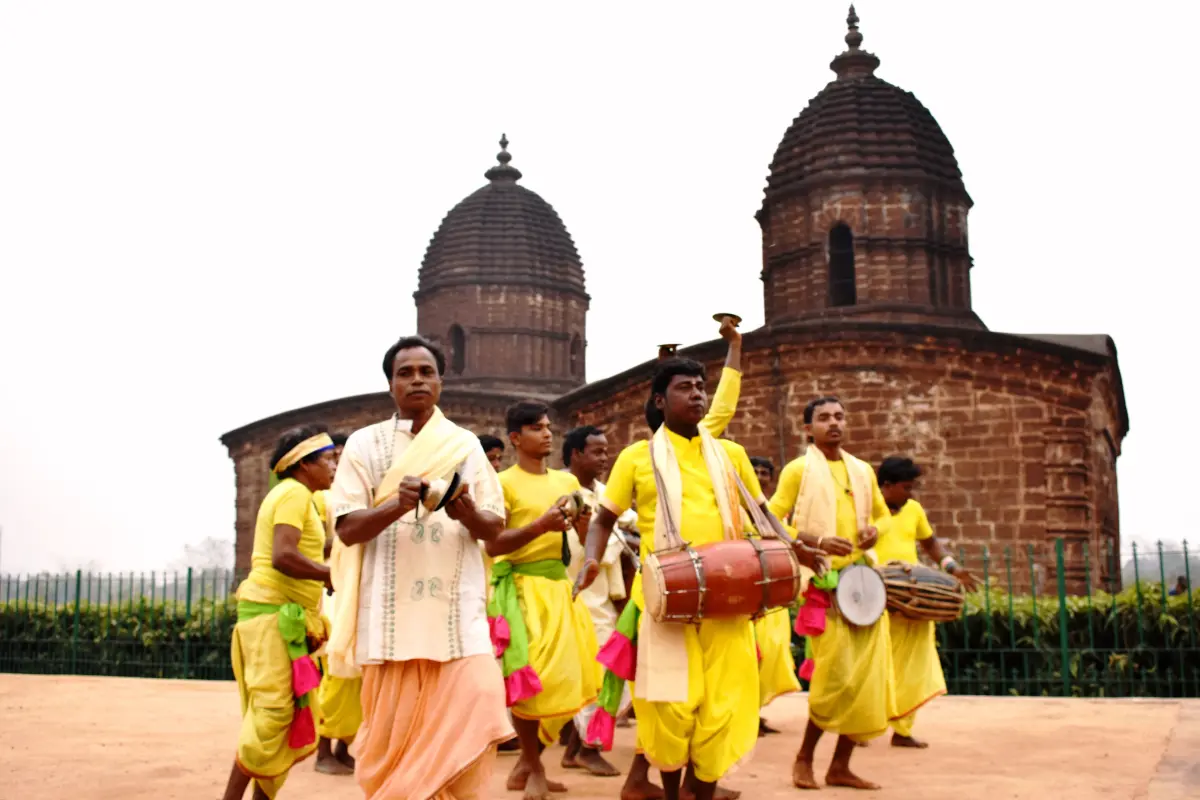
Satsang, from sat (the true, the good) and saṅga (company), is a gathering around a teacher or a text, with talk, questions, silence and song. Kirtan, from kīrtana (praising, telling), is the singing of the divine names, often in call and response with a harmonium and drums. Both are practices of bhakti yoga: the Bhagavad Gita (9.14) praises those who always sing the Lord's names.
In many ashrams of Rishikesh, the day ends the same way: people sit on the floor, a voice sings a line to a harmonium and small cymbals, the room sings it back. That is kīrtan. Before or after, someone reads a verse, speaks, answers questions, and everyone sits in silence. That is satsaṅg. For a great many people in India, this is what yoga looks like.
The words
सत्सङ्ग (satsaṅga) joins sat, being, the true, the good, and saṅga, company, association. Monier-Williams defines it simply as "association with the good". It can mean keeping good company in daily life, and, in the narrower sense used in ashrams, a gathering around a teacher or a sacred text.
कीर्तन (kīrtana) comes from the root kīrt, "to mention, to tell, to praise". It first means telling or repeating; in devotional practice, singing the names and deeds of the divine. Kīrtan is often sung in call and response, the same few words repeated, sometimes for hours.
In the texts
The Bhagavad Gita describes those who worship through song and through company:
सततं कीर्तयन्तो मां यतन्तश्च दृढव्रताः । नमस्यन्तश्च मां भक्त्या नित्ययुक्ता उपासते ॥
satataṃ kīrtayanto māṃ yatantaś ca dṛḍha-vratāḥ | namasyantaś ca māṃ bhaktyā nitya-yuktā upāsate ||
Always singing my praise, striving, firm in their vows, bowing to me with devotion, ever united, they worship me.
मच्चित्ता मद्गतप्राणा बोधयन्तः परस्परम् । कथयन्तश्च मां नित्यं तुष्यन्ति च रमन्ति च ॥
mac-cittā mad-gata-prāṇā bodhayantaḥ parasparam | kathayantaś ca māṃ nityaṃ tuṣyanti ca ramanti ca ||
Their minds on me, their life given to me, awakening one another and always speaking of me, they are content and rejoice.
The second verse is a perfect description of satsaṅg: people who awaken one another by speaking of what matters most.
The Bhāgavata Purāṇa lists the nine forms of devotion in the words of the child Prahlāda; the first two are listening and singing:
श्रवणं कीर्तनं विष्णोः स्मरणं पादसेवनम् । अर्चनं वन्दनं दास्यं सख्यमात्मनिवेदनम् ॥
śravaṇaṃ kīrtanaṃ viṣṇoḥ smaraṇaṃ pāda-sevanam | arcanaṃ vandanaṃ dāsyaṃ sakhyam ātma-nivedanam ||
Hearing and singing of Viṣṇu, remembering him, serving his feet, worship, salutation, service, friendship and the offering of oneself.
And a hymn traditionally attributed to Śaṅkara, the Bhaja Govindam, makes good company the first step of a chain that ends in liberation:
सत्सङ्गत्वे निस्सङ्गत्वं निस्सङ्गत्वे निर्मोहत्वम् । निर्मोहत्वे निश्चलतत्त्वं निश्चलतत्त्वे जीवन्मुक्तिः ॥
satsaṅgatve nissaṅgatvaṃ nissaṅgatve nirmohatvam | nirmohatve niścalatattvaṃ niścalatattve jīvanmuktiḥ ||
From good company comes detachment; from detachment, freedom from delusion; from freedom from delusion, unwavering truth; from unwavering truth, liberation in this life.
An evening satsang in an ashram
Many Indian ashrams hold a satsang every evening. The Divine Life Society, the ashram founded by Swami Sivananda in Rishikesh, publishes its own programme: an evening satsang from 7:30 to 9:30 pm, with "Lectures, Kirtans & Bhajans", in English and Hindi. A satsang often includes:
- Silence or meditation for a few minutes.
- Chanting of a few mantras, then kīrtan and bhajans.
- A reading from the Gita, the Upanishads or the teacher's writings.
- A talk and sometimes questions.
- A closing prayer or chant.
If you visit, arrive on time, remove your shoes, dress modestly, sit quietly, and ask before photographing. The Rishikesh ashrams page gives published programmes and rules.
A simple kirtan at home
- Choose a short mantra you know the meaning of: Om namaḥ śivāya, oṃ namo nārāyaṇāya, or the name of the deity close to your heart. The page on Sanskrit mantras explains which are public.
- Sit in a circle on the floor or on chairs. One person leads; a harmonium, a drum or simply clapping keeps the rhythm.
- Call and response: the leader sings a line; everyone sings it back. Start slowly.
- Let it build, then slow down again.
- End in silence for two or three minutes, eyes closed. Notice the stillness after the sound.
Fifteen to twenty minutes is enough. The quality of attention matters more than the quality of the voice.
Satsaṅg in daily life
The old meaning of satsaṅg is broader than a gathering: it is the company you keep. Reading a sacred text is satsaṅg with its author; listening to a wise person is satsaṅg; so is a friendship that brings out the best in you. The tradition counts it among the most powerful supports of practice, together with svādhyāya, the study of the texts, and sevā, service.
Where it belongs
Satsaṅg and kīrtan are practices of bhakti yoga, the path of devotion, and of nāda yoga, the yoga of sound. They sit beside mantra meditation and silent japa. The overview of yoga practices shows where each fits.
Questions people ask
What is the difference between kirtan and bhajan?
Usage varies, but kirtan usually means the call-and-response singing of divine names, repeated and often accelerating, while a bhajan is a devotional song with verses, often composed by a saint-poet. Both are sung in satsang.
Do I need to be Hindu to join a satsang or kirtan?
Most ashrams that open their satsang to the public welcome anyone who comes with respect. Dress modestly, remove your shoes, sit quietly, and join the singing when you can.
Is kirtan a form of meditation?
In the bhakti traditions, yes: singing the names with attention is a way of fixing the mind on the divine. The silence after a kirtan is often the deepest moment.
Sources
- Bhagavadgītā, critical edition (Bhandarkar Oriental Research Institute), Sanskrit text (GRETIL) checked October 17, 2026
- Bhāgavata Purāṇa, Sanskrit text (GRETIL, University of Göttingen) checked October 17, 2026
- Bhaja Govindam (Moha Mudgara), attributed to Śaṅkara, Sanskrit text (sanskritdocuments.org) checked October 17, 2026
- Ashram Activities, daily programme, The Divine Life Society (official site) checked October 17, 2026
- Monier-Williams, Sanskrit-English Dictionary (1899), entry sat-saṅga, Cologne Digital Sanskrit Dictionaries checked October 17, 2026